At a time when our nation was still young and finding its feet culturally, Frederic Church took on the role of explorer and interpreter of the visual splendors of the New World—and of the rest of the world. He was a native American genius who also became a global artist, showing America to Americans and America to the world.
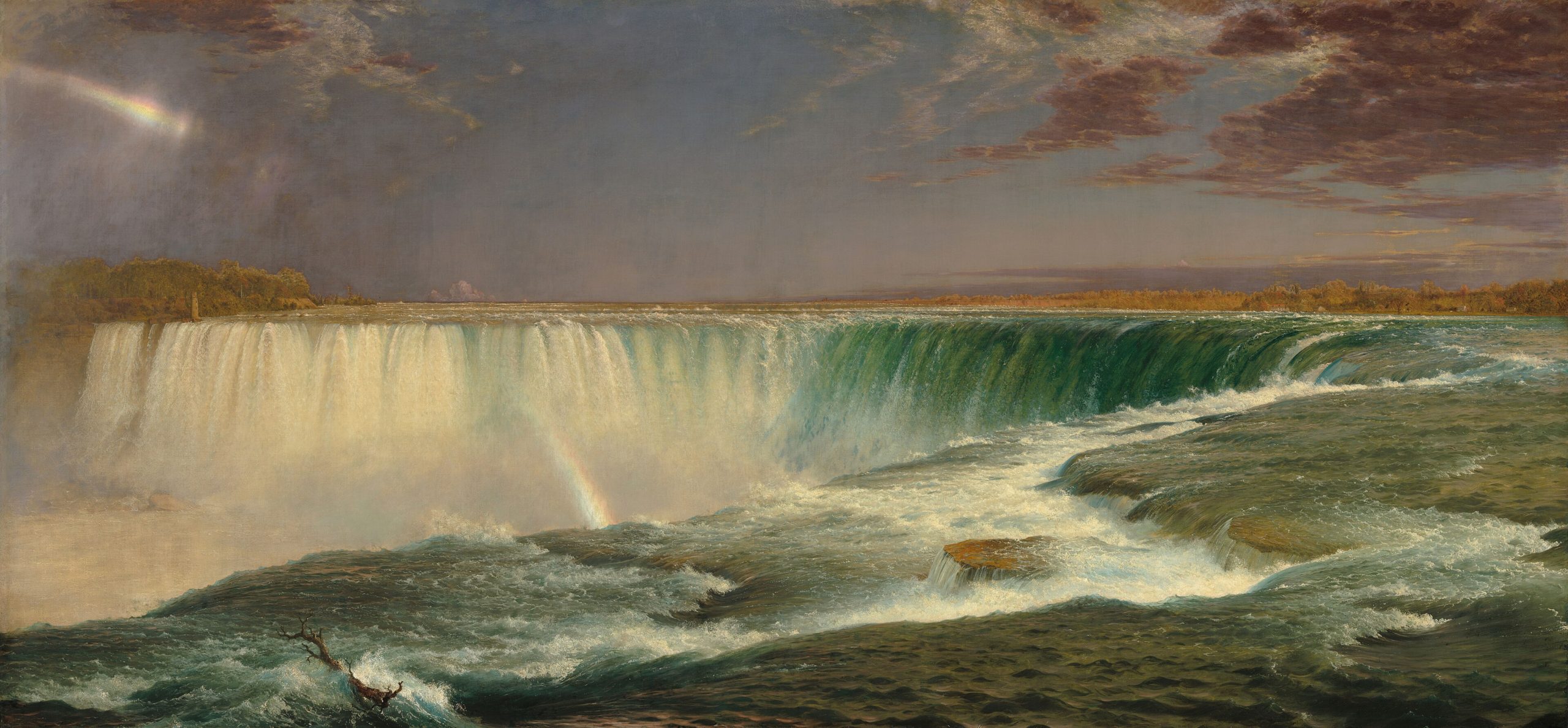
Niagara Falls
This year marks the 250th anniversary of America’s founding, as we are all aware. But it also marks the 200th birth anniversary of one of America’s greatest artists: Frederic Edwin Church. During the second half of the 19th century Church was perhaps our foremost landscape painter, who captured on large canvases the beauty and majesty of the American scene. In the generations after the founding of the American Republic, Church was one of the cultural heroes who proved that America could produce great art. His grand Romantic vistas of the Americas (both North and South) have not dimmed a bit since his death in 1900. On the contrary, they remain a sight for jaded modern eyes and in some ways more vital than ever.
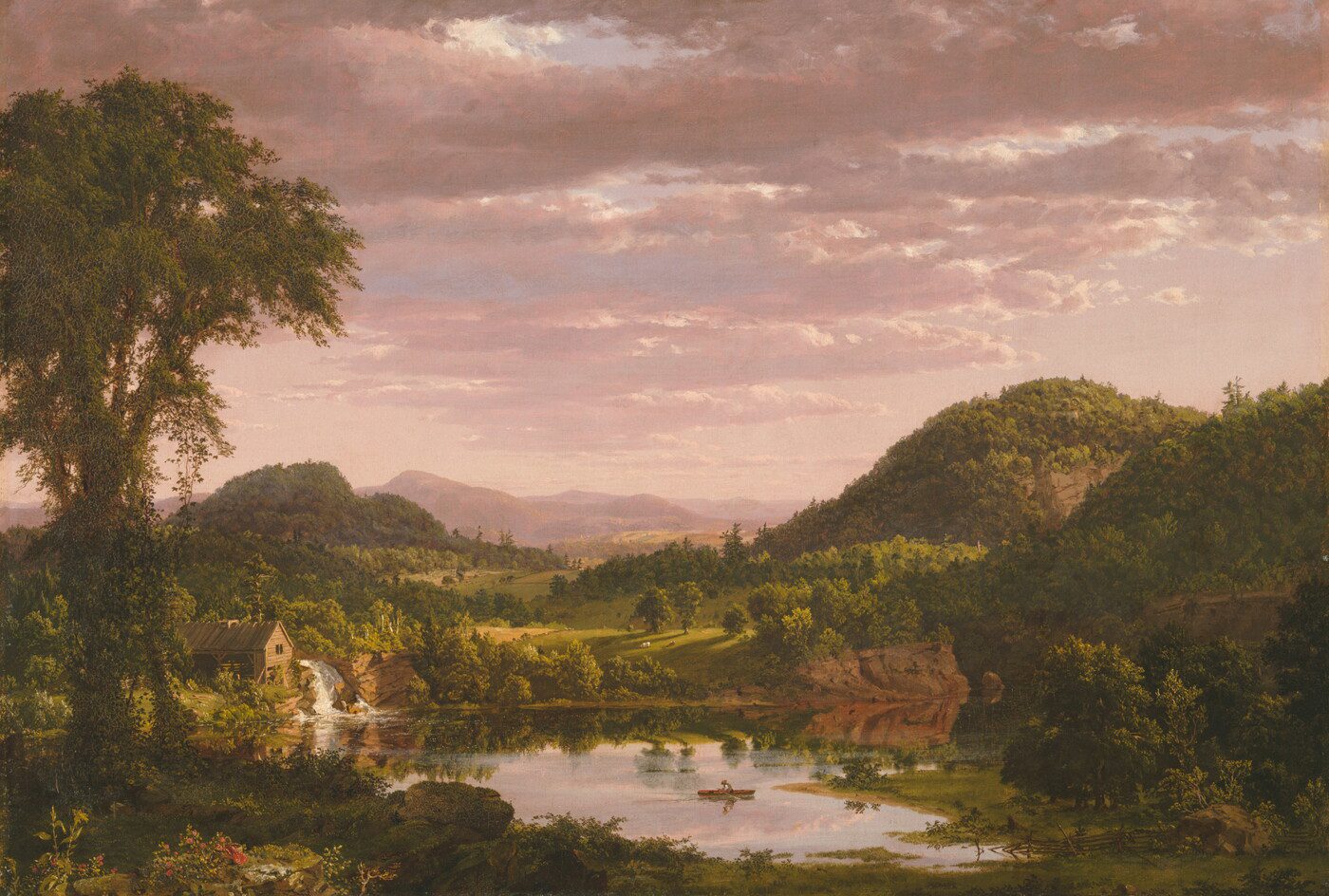
New England Landscape
Born in Hartford, Connecticut on May 4, 1826, Church studied painting with Thomas Cole, one of the great American artists of the previous generation. Cole had been born in England and came as a child to the United States, where he became a charter member of the loosely associated group of artists known as the Hudson River School. Eventually numbering in the dozens, this famed group of painters committed themselves to documenting the American landscape on canvas—starting from the picturesque Hudson Valley in New York State, and going on to New England and the Western frontier. Inspired by Romantic, patriotic, and religious ideals, their paintings aimed to induce awe and were successful at portraying the distinctive visual and topographical features of the United States.
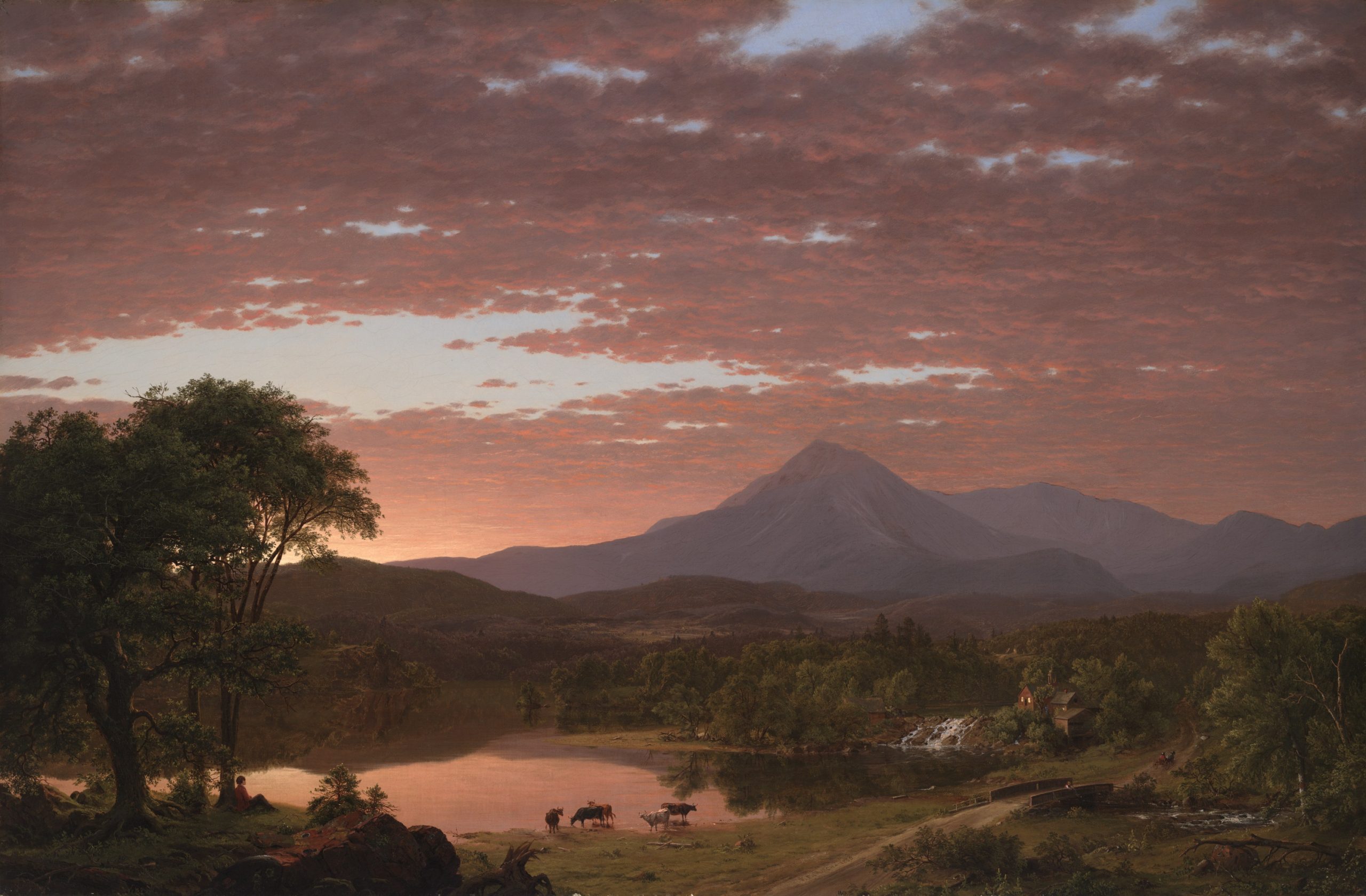
Mount Ktaadn
Church would inherit Cole’s mantle as the leading Hudson River School artist. And he would expand the visual repertoire of the School from the Hudson Valley to Latin America (Mexico, Ecuador), the Caribbean, Europe, and the Holy Land in his quest for terrestrial beauty. Church’s mastery of photographic realism in painting—achieved at a time when photography was on the rise as a means of recording everyday reality—was complete. His canvases look exactly like the scenes they depict, with a dazzling depiction of light, color, and atmosphere. When Church paints Niagara Falls, you can practically hear the roar of the waters. (This is due in part to Church’s bold perspective, which places us right in the middle of the falls!) Often doing preparatory sketches on site, Church studied vegetation and terrain to get the details in his paintings exactly right. His approach reflected the increasing 19th-century emphasis on scientific truth.

Rainy Season in the Tropics
But to this documentary realism he added mystical and emotional resonance through the use of devices like rainbows, sunsets, and outright natural wonders like auroras and volcanoes. The Hudson River School’s underlying aim was essentially religious, that of showing how God’s presence is revealed in the order and majesty of nature. Church’s pictures are a meticulous blending of science, poetry, and theology. The Christian cross, standing alone in the wilderness, figures in a number of Church pictures. Like other Hudson River artists, Church portrayed nature, and hence divinity, as towering over humanity in awesome transcendence. What human figures exist in Church’s pictures—and they are few and far between—appear dwarfed by the vastness of creation. Church’s art, like Romanticism in general, aimed at representing the Infinite, that which human beings cannot measure or encompass.
Underlying much of Hudson River art was the understanding of America as a New Eden, an unspoiled wilderness of beauty and promise, and the American as a New Adam with the task of cultivating this paradise. Of course, critics who take a dark view of things have caricatured this as merely an apology for Manifest Destiny and American expansionism. But Church’s art is not simplistically Edenic. There is a sense of melancholy behind his magnificent landscapes. For Church and his generation, industrialism and modern progress were encroaching on nature, while the scientific research of Darwin seemed to imply a disenchanted cosmos ruled by a heartless evolution.

Jerusalem from the Mount of Olives
Darwin’s theories put faith in a beneficent and providential God to the test, and Church felt the pressure keenly. He had been a follower of Alexander von Humboldt, the German naturalist who taught that nature is a “harmony, blending together all created things […] one great whole animated by the breath of life.” Humboldt preached a harmony of science, beauty, and theology, a harmony that informed Church’s artistic vision but which Darwin’s ideas threatened to destroy. Although some theologians and artists were starting to work out a rapprochement with evolutionary ideas by the end of the 19th century, Church’s worries were unresolved and his Romanticist vision remained uncertain.
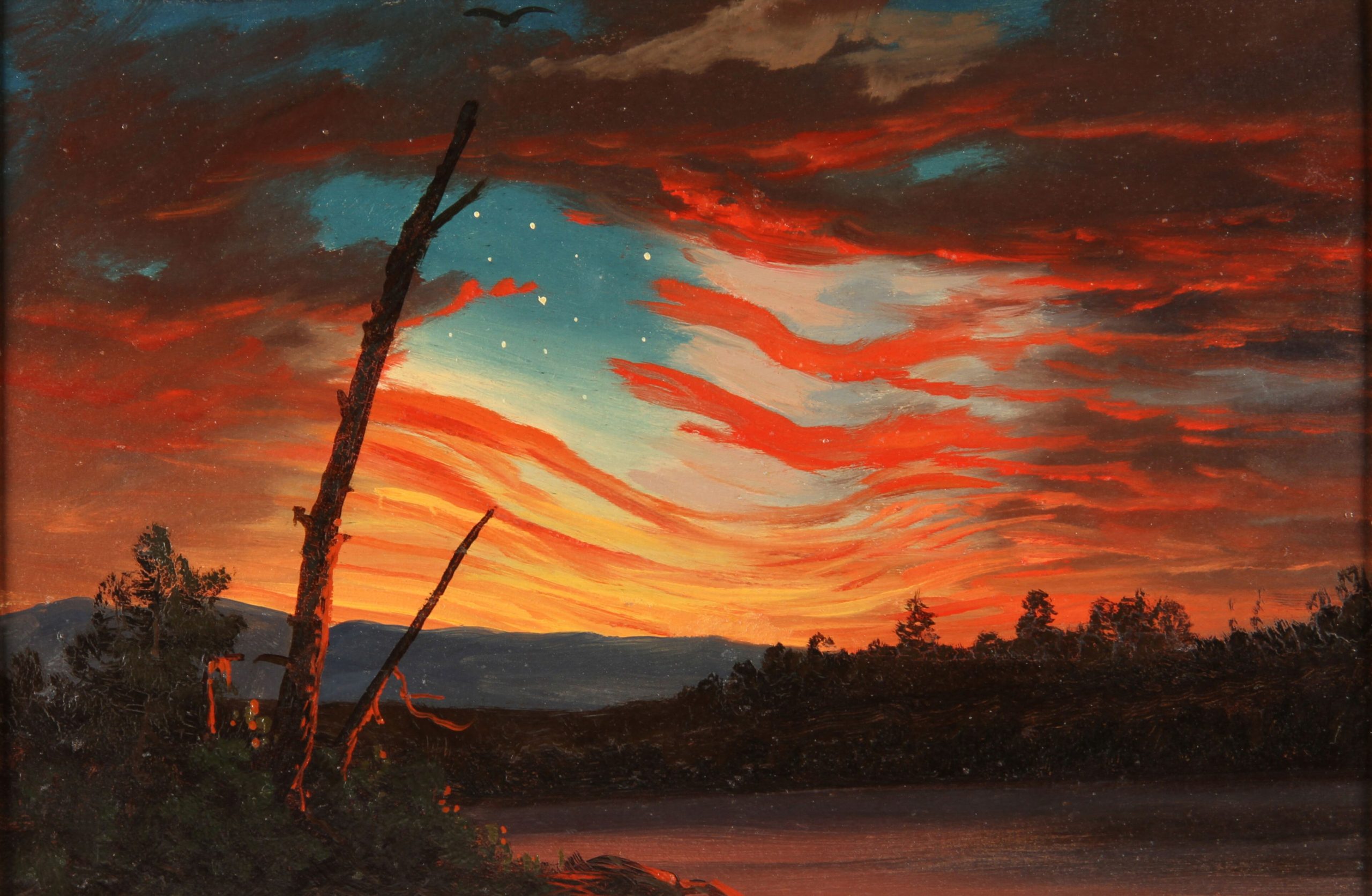
Our Banner in the Sky
The loss of American unity during the Civil War also affected Church’s art: his landscape Our Banner in the Sky features a blood-red sunset, symbolic of the blood lost during the war and forming a mystical vision of the American flag. Thus, the sense we get from Church’s scenes is sometimes of a lost Eden, or one that is slipping away. Church lived long enough to see his art superseded by other styles and perspectives, casting another shadow over his later life. Persistent rheumatism in his hands forced him to stop painting after 1877, which may also have contributed to the eclipse of his art in the public eye. His later years were spent in Olana, the estate he built on the Hudson River which is now a museum dedicated to his works. Church died 1900, a still venerated figure but one whose ideas and aesthetic had passed.
And after the death came the resurrection. Since the middle of the 20th century, Church’s reputation and significance have been restored. With modernist prejudices now on the decline, the Hudson River artists as a whole are now seen for what they are: American Romantic geniuses whose imaginative and technically accomplished work can inspire and awaken our senses to the beauty around us.

Morning in the Tropics
The mature Church painted only landscapes; yet they are extremely varied in subject and locale, showing the breadth of his vision. His paintings can be seen in museums from coast to coast, and good reproductions are easy to come by. I will speak briefly to some of my favorites. Outstanding examples of the “calm after the storm” genre are New England Landscape (Evening After a Storm) and the moody After the Rain Storm. Church’s sunset paintings are a major subset of his work and include such marvelous views as Mount Ktaadn (in Maine) and Twilight, ‘Short arbiter ’twixt day and night’.
One of my favorite Church scenes is among his simplest. It is dedicated to his beloved teacher and mentor: To the Memory of Cole consists of a cross strewn with roses in a field under a sky with rolling clouds. The motif of the cross in the wilderness is repeated in The Heart of the Andes, which represents the cream of Church’s South American work, just as Morning in the Tropics and Sunset, Jamaica show his experience in the Caribbean. In Europe, Church got a chance to paint The Parthenon, and in the Holy Land Syria by the Sea and Jerusalem from the Mount of Olives—a painting whose biblical weight is immediately apparent.
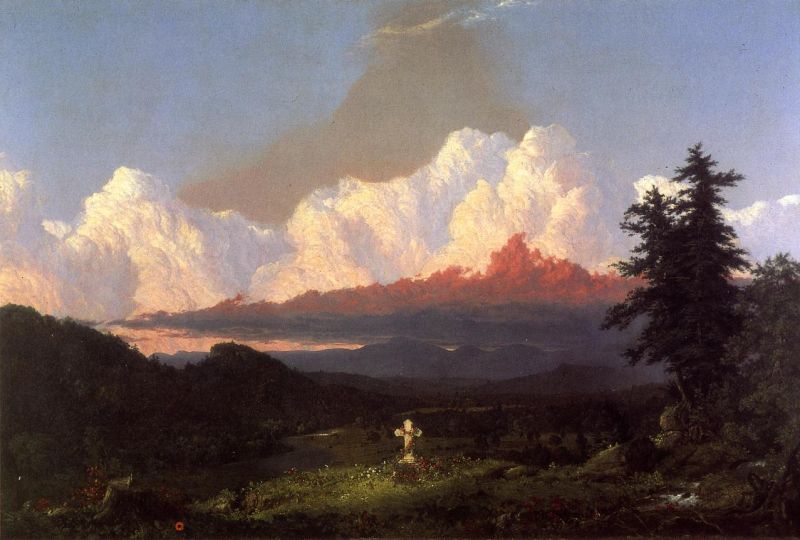
To the Memory of Cole
Back on our shores, there are the impressive Niagara Falls pictures: Niagara and Niagara Falls, from the American Side. Finally, no one who has seen Aurora Borealis can forget the weird beauty of that celestial apparition: the essence of the Romantic sublime, with an American accent.
At a time when our nation was still young and finding its feet culturally, Frederic Church took on the role of explorer and interpreter of the visual splendors of the New World—and of the rest of the world. He was a native American genius who also became a global artist, showing America to Americans and America to the world. As we celebrate the 250th birthday of our nation, the art of Church is a cause for national pride.
___________
The Imaginative Conservative applies the principle of appreciation to the discussion of culture and politics—we approach dialogue with magnanimity rather than with mere civility. Will you help us remain a refreshing oasis in the increasingly contentious arena of modern discourse? Please consider donating now.
All images are in the public domain, courtesy of Wikimedia Commons.