Peter Gammons has given us a series of glimpses into the recent baseball past and a crutch to help us survive what might be a baseball-less future–at least for a while.
It’s All About The Players: What I Have Learned About Baseball’s Best, by Peter Gammons (347 pages, Grand Central Publishing, 2026)
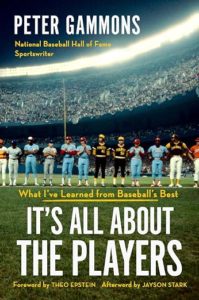 What might have been a memoir is both less and more than that. This is especially so, since it really is all about the players. And it’s less what Peter Gammons has learned about them than what they have confirmed for him. Still, this confirmation clearly has been well worth his time. And now it is well worth ours.
A freshly minted octogenarian, veteran baseball writer Peter Gammons almost didn’t acquire so much as the status of a sexagenarian, what with a near-death experience roughly two decades ago. But survive he did, and since then he has continued to pursue his long time love affair with what once was America’s game.
As far as Gammons is concerned, baseball remains, and always will remain, America’s game. How could that not be the case, since his own love affair began early in Gammons’ New England youth. Initially confined to the Boston Red Sox, it gradually spread well beyond Fenway Park during his many years of baseball writing for the Boston Globe and Sports Illustrated, as well as his years of baseball observing and commenting on ESPN.
It might have been time, if not well past time, for a full-fledged, undisguised Gammons memoir. But his preference here has been to confine himself to the players whom he has admired, both from afar and up close and personal. That admiration was firmly in place even when Gammons was a school boy listening to the radio call of the ball off Yankee Gil McDougald’s bat that hit Indians pitcher Herb Score.
Maybe it would be accurate to make that especially the case even then. But if so, his love and admiration have barely flagged over the decades since then. To be sure, both have remained very much alive during all his adult years of baseball writing, years that began shortly after his school days ended, following his graduation from the University of North Carolina. What, no Harvard? And not even Boston College?
In a sense, this is an insider’s account, given Gammons’ access to clubhouse after clubhouse. But it is not a tell-all account. In fact, it is very much the reverse of that. Gammons is not out to point to, much less to dwell on, the failings and errors of his diamond heroes. Nor is he determined to expose their sins, whether committed on the field or away from it.
If anything, the lovelorn Gammons is determined to remind himself and his readers of their commitment to the game. And maybe, just maybe, there is absolutely nothing wrong with that. The game may well be awash in money. And it is. We all know that. In fact, because of that there may not be a baseball season come the spring of 2027. After all, an owner-imposed lockout is looming. The players are opposed to a salary cap, and the owners are convinced that there must be one. At least most of them are. An impasse seems inevitable. A summer without major league baseball seems entirely possible.
Peter Gammons, among countless others, will not be pleased if this turns out to be the case. In the meantime, he cannot be bothered to offer either tear-stained lamentations or hard-edged solutions. For example, why not combine a salary cap for, say, twenty-four of the twenty-six players on a major league roster, while permitting each team to pay two stars, or would-be stars, whatever they want?
Gammons can’t be bothered with any dithering about money matters. Instead—and pardon the football interruption—at this equivalent of a two-minute warning he has called for an additional time-out to write this semi-memoir, all in anticipation of a summer without baseball. If so, he has done himself, and the rest of us, a favor. We all could use a reminder that baseball still deserves its standing as America’s game… even if it no longer is.
Nor is Gammons interested in the players’ private lives. Their commitment to the game is good enough for him. Therefore, his sense of their goodness is confined to their baseball lives. Virtually anything else is virtually irrelevant. His love of the game and their own love of the game, plus their careful attention to the details of the game, are more than sufficient. If anything, Gammons’ accounting of baseball’s best players tells us that these players love and respect the game as much as a young Peter Gammons ever did.
And just who are among the best? Or at least whom does Gammons regard as the best? A partial list includes a few of the obvious, especially Ted Williams and Carl Yastrzemski. Therefore, one might accuse New Englander Gammons of excessive homerism, despite his youthful escape to points south. But one would be mistaken to do so. To be sure, both are very much included, as are local heroes Jim Rice, Carlton Fisk, Louis Tiant, Bernie Carbo, Dwight Evans, Tony Conigliaro, and Dustin Pedroia. But so are the likes of the entirely likeable Derek Jeter, Cal Ripken, Jr., Ichiro Suzuki, Kirby Puckett, Tony Gwynn, and Ken Griffey, Jr., among countless others.
For that matter, he even manages to give us reasons to like the mostly, and previously, unlikeable likes of Bobby Bonds, Bryce Harper, and Alex Rodriguez. And then there was this brief Gammons encounter with the inscrutable Roger Maris. Still a teenager, Gammons was with his parents in a Boston hotel where the Yankees happened to be staying. At breakfast, Gammons’ mother noticed Maris eating alone at a nearby table. She nudged her baseball-infatuated son to ask Maris for an autograph.
“No, Mother,” was his quick reply. This was the summer of 1961. Why would he want to interrupt a ballplayer, especially one who was on his way to breaking Babe Ruth’s home run record?
Well, on his way out of the restaurant the kid heard a voice say, “son.” It was Maris. Having overheard the mother-son exchange, he thanked the kid for “respecting my privacy” and gave him his autograph. That might have been that—except that it wasn’t.
Maris asked the kid if he would be going to the game that afternoon. And if so, might he be walking to Fenway. Yes and yes, the kid replied, and at around 11 that morning. Who should appear in the lobby at that precise time but Roger Maris with a piece of paper in hand. On it were his autograph and that of a fellow by the name of Mickey Mantle.
Years later, Montreal Expos manager Gene Mauch gave a reporter by the name of Peter Gammons an hour of his time. Why? “You clearly love the game,” Mauch told Gammons. “You’re respectful.” Gammons doesn’t report his reply to Mauch, but he does report this to his readers: “I credited Roger Maris.”
Yankees aside, whether hated or otherwise, let’s return to the Red Sox. One of the others deserving of the Gammons treatment is Mookie Betts. Once a member of the author’s beloved Boston Red Sox, Betts is now a Los Angeles Dodger, no, make that a hated, dollar-fueled LA Dodger. Except Gammons is not about to add anything approaching any adjective–or reference–of that sort. He loves and admires Betts; therefore, he is not about to resort to anything as negative as that, especially not in a book like this.
Occasionally, but not very often, Gammons will toss in a few stats, but numbers never drive the narrative or interfere with the flow of his prose. And they are never the point of the point he is trying to make. Two years after joining the Sox, Gammons manages to inform us, Betts did bat .318, hit 31 homers, and was runner-up for the American League MVP. Two years later Betts was the MVP and led the Red Sox to a World Series championship. That might have been that about one Mookie Betts—except that it wasn’t.
After game two of that series, Betts and a few friends gathered up clubhouse food to distribute to the homeless around Copley Square. A fan happened to be on hand to witness the scene. He snapped a picture and sent it to the Boston Globe. Gammons told Betts that he deserved great respect for what he had done. Betts disagreed: “Thanks, but doing something for other people shouldn’t be about me. I wish no one had seen it. The people out there need respect and self-esteem.” And that is a point worth noting about Betts, at least as far as Peter Gammons is concerned.
Yes, Gammons does now and again bother to take his story away from the diamond, but never to disparage a player, only to add to his admiration for him.
Just in case you might be wondering, Gammons does not ignore pitchers and general managers. Jim Palmer and Jim Lonborg figure prominently, as does the fearsome Braves troika of Tom Glavine, John Smoltz, and Greg Maddux. But curiously, Curt Schilling and his bloody sock are nowhere to be found.
When it comes to GMs, Branch Rickey predates Gammons, but Theo Epstein and Pat Gillick do not. They, too, have caught Gammons’ attention. And once again it’s all about the human touch and the human eye—and not about either exit velocity or spin rate.
In sum, Peter Gammons has given us a series of glimpses into the recent baseball past and a crutch to help us survive what might be a baseball-less future—at least for a while. Usually, such books are written to fuel the hot-stove-league season. Not so this time around. Come spring, the game might not be on hand. But no matter. Peter Gammons will be. Thankfully, a book of this sort, like the game itself, is timeless.
*
Chuck Chalberg once performed as baseball’s Branch Rickey, but never could hit or field a moving baseball very well at all.
___________
The Imaginative Conservative applies the principle of appreciation to the discussion of culture and politics—we approach dialogue with magnanimity rather than with mere civility. Will you help us remain a refreshing oasis in the increasingly contentious arena of modern discourse? Please consider donating now.
All images are in the public domain, courtesy of Wikimedia Commons.