If we learn how to wait while doing all we can to invite the Holy Spirit to take possession of us, then before too long all our hopes, all our deepest desires and yearnings will be realized.
 I never spoke to my father about his spiritual life, or my own for that matter, but I know that after reading a book on the Desert Fathers he became very interested in their spiritual teaching, and what they came to call the “Prayer of the Heart”. All those early monks, like St Antony, left home where through meditation they had come to know and love Christ. It was this love that inspired and set them afire while they were in the “world” that led them into the desert. It was here that their love would be prepared and purified sufficiently for the union that they desired with every spiritual and physical fibre of their being. What was then called the “Desert” and what later came to be called the “Dark Night of the Soul” was the place where this purification took place, as they now prayed using a new form of prayer, because the meditation that had initially set them afire with the love of Christ was no longer possible for the reasons that we have seen. This new form of prayer came to be called the “Prayer of the Heart” or the “Prayer of Faith”. It would help prepare them for what the Eastern Church called Divinization.
It must have been the way that they used this prayer, or these prayers to sanctify their day and off er everything to God that they did in that day, which affected my father most. After his death I found a quotation from John Cassian on the final page of his missal which helped him to keep his Morning Offering on course throughout the day. It helped him to live out the new worship “in spirit and in truth” that Christ had introduced to the early Church through his apostles. It helped him to off er himself up to God in myriad acts of self-sacrificial loving, as Christ had done. Thanks to the Ignatian form of meditation to which he was introduced long before he was married to my mother, he had passed through meditation and into mystical contemplation that, unknown to him, had led him into the “Dark Night”. Here he learned a new form of simple prayer that he could easily integrate with his life as a businessman and father of a family, precisely because it was so simple. In with and through Christ he learnt to make acts of love wherever possible even on the busiest of days.
These acts of love are like waves contained in a channel that reaches upwards to God allowing his love to reach downwards to us. Gradually the waves of love subside into a stiller, smoother, more silent sea of contemplative loving, enabling our loving to rise into God and God’s loving to descend into us. In this way God imparts something of the Ocean of his infinite love to us even in this life, which will be our ultimate destiny in the next. Christ is that channel of love, the Holy Spirit the waves, whose loving gradually merges with our own leading us on and into the still and silent contemplative loving that enables us to glimpse something of the loving that has always passed to and fro between the Father and the Son from all eternity.
My Father learnt from John Cassian how to use these acts of love throughout his day, not just when all was going well but when all seemed to be going wrong too. The prayer he used most was simply, “O God come to my aid, O Lord make haste to help me”. As I have already mentioned John Cassian said that this prayer was taught to his disciples by Abbot Isaac and later used by St Benedict with which to begin the divine office throughout the day, as it is still used today. Under this little prayer, my father copied out the following words from Abbot Isaac, written for the benefit of his followers.
You must continually use this prayer in your heart, whatever you are doing or whatever office you are holding, or journey you are undertaking; in adversity that you may be delivered, and in prosperity that you may be preserved. You should be so moulded by the constant use of it that when sleep comes you are still considering it so that you become accustomed to repeating it even when you sleep. When you awake let it become the first thing that comes into your mind, let it anticipate all your waking thoughts. When you rise from your bed let it send you down on your knees, and thence send you forth to your work, and let it follow you all through the day.
Abbot Macarius used to tell his disciples to say simply, “Lord to the rescue”, or call upon him by name by using the holy name “Jesus” whenever they were in danger of losing their way or forgetting what they were about. Abbot Macarius was believed to be the originator of the Jesus Prayer. Later it developed into the prayer as we know it today, which was originally composed by Saint John Climacus, “Jesus son of God have mercy on me a sinner”. These short prayers were not only used by the Desert Fathers but have been used continually throughout subsequent centuries. They have always been used to help Christians keep their attention fixed on their calling throughout the day and help them when distractions or temptations threaten to overwhelm them. One of my mother’s favourite little prayers that helped her throughout her day was, “Jesus mercy, Mary help”. My primary school teacher, Miss Holt, taught us all to say, “Sacred Heart of Jesus I put my trust in you”. During the First World War, Fr Willie Doyle SJ used to give his troops his “pink pills” to use in the batt le ahead. They were short pithy prayers easy to remember that they could repeat over and over to support, inspire and sustain them. We might not have to face such terrible physical batt les each day, but we do have to fight very many spiritual batt les, so we too have need of his “pink pills”. He encouraged his men to choose their own so they could be personalised to their own individual needs. I have made my own “pink pills” – why not make some for yourself?
Morning prayer was not the beginning and end of daily prayer, for it was the custom of the early Christians to pray five times a day, as Jesus did. It is still possible for us to do this, as I believe my father did. I remember asking him why he put little stickers on his wristwatch. One was pointing to nine o’clock another to twelve o’clock, and the third to three o’clock. He merely said it was a little device to help him remember something. In earlier times when Christian Europe was predominantly rural, the Angelus bell that pealed three times a day called everyone to prayer wherever they were and whatever they were doing. This was a world that neither my father nor his forebears had known, for unlike my mother, whose forbears were recusants, they were all Protestant. His parents were converts and like them, he was always reticent to speak about his faith. When it came to the spiritual life, he was an intensely private man who found it difficult to speak about it, let alone his own. However, one thing I know for certain was that he always tried to find some time each day, in addition to all else, to enter into what my mother called his inner garden shed for his daily prayer.
As far as I have been able to gather, the prayer of the heart that he used there when he had more time did not diff er from the prayer of the heart that he used during his day. He used it in exactly the same way that was suggested in Chapters 45–48, but in longer and more concentrated periods of time. Please remember something that I said earlier – time for meditation that I believe should be part of our earliest Catholic education would only take up a fraction of our life-long journey in prayer. For the vast majority of the time this journey is predominantly composed of acts of love, or prayers of the heart, made in and outside of prayer, but always within the mystical body of Christ. Then, when God chooses, he will “touch” us and moments of contemplative stillness will envelop us that will sometimes rise to shattering degrees of intensity. When you persevere come what may, in darkness or in light, in sickness or in health, in desolation or in consolation, then you will be carrying your cross and practising the white martyrdom that leads onwards and into the greatest Martyr of all, the greatest mystic the world has ever known. In his “darkest hour” Winston Churchill wrote: “Success is not final, failure is not fatal: it is the courage to continue that counts.” He might not have been a saint or a mystic, but he was a wise man, at least when he said that, for it certainly encourages me in my darkest hours.
If you only journey on because you want to experience the consolations of God, rather than the God of consolation, then you are going nowhere. At least you will go nowhere until in purification your motives are purified by the God of consolation, to enable you to receive the consolations that only he can give. Next time a parish priest asks me to speak to his parishioners about meditation I will be sure to speak about contemplation too, the contemplation where the love is truly learnt, in a lifetime of loving that leads to an eternity of loving, together will all those we love and hold dear.
Let me end with one further suggestion that you might find helpful. It is taken from an ancient tradition traced back to the Desert Fathers, that I am sure my father must have used, because I know my mother did, for she taught it to me. When you are in bed say a short prayer and repeat it slowly and prayerfully. It may simply be the word, “Jesus”, or the full Jesus prayer, “Jesus Son of God, have mercy on me, a sinner”. This prayer and others like it came to be used most particularly in the Eastern Christian Church, with slow rhythmical breathing. It was not a device for relaxation, but for reminding the believer of the all-pervading action of the Holy Spirit. The ancient Jews believed that their breath was their life-principle, their spirit, so naturally they believed that God’s breath was his life-principle, his Spirit. As a mark of respect, God’s breath or his Spirit came to be called the Holy Spirit. So, deep rhythmical breathing that often accompanied short prayers of the heart, helped remind Eastern Christians of the incoming Spirit who dwelt within them with ever-increasing power the more they prayed. It can be a reminder to us too, particularly when preparing for sleep.
The prayer “Come, Holy Spirit” can accompany the slow intake of breath followed by the prayer, “Conceive Christ in me”, as we breathe out. With the next breath pray again, “Come, Holy Spirit”, followed by, “fi ll every part of me”, and again with the next breath, “Come, Holy Spirit”, followed by, “bring Christ to birth in me”. Then the three prayers can be repeated again and again. Other short prayers can be used like “Come, Lord”, or “Come, Lord Jesus”, or whatever short prayer you feel helps you best. When this practice becomes a habit, it can be far more effective than sleeping pills, and there are no side effects either. This sort of prayer need not be restricted to preparation for sleep, for once you have become used to using it at night, you can use it at other times of the day too. It can be used when you are waiting for a bus, the train or the plane, when you are sitting in a waiting room, waiting for the doctor, the dentist or the consultant, or when you are waiting for a phone call, for the plumber or for the electrician to come. Instead of letting frustration take possession of you, use the time to let the Holy Spirit take possession of you instead. Then, instead of anger and impatience, you will be filled with peace.
At the end of his book The Count of Monte Cristo by Alexandre Dumas, the author says that all the wisdom in the world is contained in just two words – waiting and hoping. If we learn how to wait while doing all we can to invite the Holy Spirit to take possession of us, then before too long all our hopes, all our deepest desires and yearnings will be realized. For, as the Holy Spirit suffuses our love with his love, then that love can take us up into Christ where we are able to contemplate the Father, in, with, and through him. Then, we will be able to experience brief moments of heavenly peace in this world, as we are beginning the journey to experience the fullness of heavenly peace in the next, and for all eternity. When at the end of the day you have finished trying to pray as best you can, be at peace. You have done your best, now leave the rest to God, remembering the words of St Padre Pio: “Pray, trust and don’t worry.”
___________
This essay is chapter sixty-four of The Primacy of Loving and is published here by gracious permission of the author.
The Imaginative Conservative applies the principle of appreciation to the discussion of culture and politics—we approach dialogue with magnanimity rather than with mere civility. Will you help us remain a refreshing oasis in the increasingly contentious arena of modern discourse? Please consider donating now.
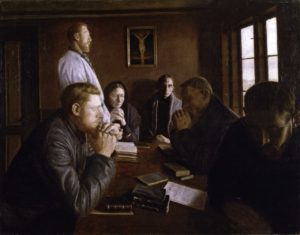
The featured image is “A Prayer Meeting” (1897), by Niels Bjerre, and is in the public domain, courtesy of Wikimedia Commons.