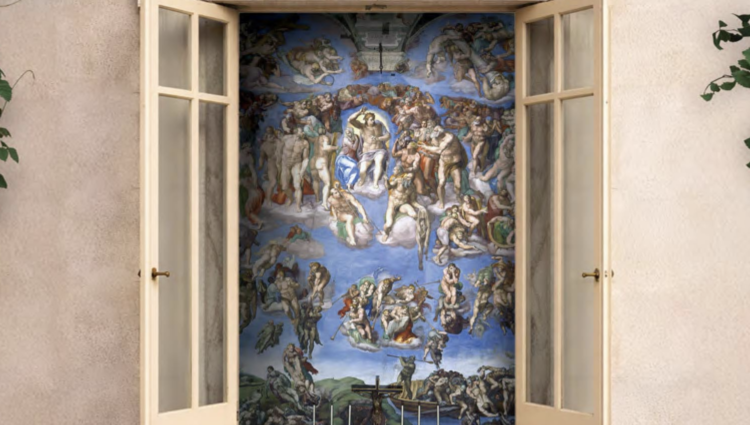
Peter Giersch’s “Talking of Michelangelo” is an account of his trip to a French monastery to plunge into a week-long Ignatian retreat. But who wants to read about the inner musings of someone’s religious retreat? Happily, the most likely answer is: You do.
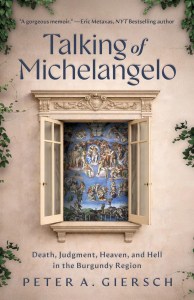 Peter Giersch has been a French teacher, a catechist, a business entrepreneur and the CEO of a successful management consulting firm. He’s also a musician, husband, father, and a Catholic devotional writer.
His latest book, Talking of Michelangelo, is an account of his trip to a French monastery to plunge into a week-long Ignatian retreat. J. Alfred Prufrock enters the tale from time to time as a kind of alter ego. T.S. Eliot’s timid, introspective anti-hero offers the pilgrim images for his own introspection as he goes on the inner journey of an Ignatian retreat.
My description makes Giersch’s book sound like a rather worthy, but turgid read. Who wants to read about the inner musings of someone’s religious retreat? It reminds me of a religious publisher’s comment to me once: “I immediately reject any book proposal that has the word ‘reflections’ in the title.” Which is a terse reminder of that other publishing commonplace: “Everybody has a book in them, and for most people that’s where it should stay.”
Happily, Giersch sidesteps dull religious writing by setting the account of his inner journey in an outer journey. We join him on his trek from suburban America to rural France, sharing his visit to Paris on the way.
In doing so, Giersch re-visits the city he first visited as a college student, and we share his nostalgia and love of France and Paris as he re-traces his steps, visits old haunts, and reminisces about those golden days of his youth: hitchhiking across Europe, sleeping rough, making friends, and making mistakes. He writes in a casual, jocular, and conversational style, mixing up pop-culture references with his love of literature, his Catholic faith, and some of his personal struggles.
I’ve visited French monasteries in my own travels, and Giersch’s description of the traditionalist monastery in France evokes that particular strand of Catholicism beautifully. It combines the beauties of the French countryside steeped in the ancient faith with Benedictine culture and spirituality—an exquisite balance of fine food served simply, the monastic regime, prayer, study, warm hospitality, gentle camaraderie, and the strictures of asceticism, balanced by St Benedict’s advice that there should be “nothing harsh, nothing burdensome.”
As the Prufrockian retreatant is taken through his meditations on the Gospel, he confronts himself, his past, his guilt, and his forgiving Lord in a fresh way. He questions his sometimes complacent and comfortable faith—challenged to go more deeply into his relationship with Christ. As one should on an Ignatian retreat, he faces some of the darkness before coming into the light.
As a fellow religious writer, I’m pleased that Sophia Institute Press has published Talking of Michelangelo. C.S. Lewis once observed that we don’t need more good Christian books, we need more good books by Christians. In other words, more good fiction, more good horror, more good history, more good drama, more good short stories, more good fantasy, and in this case, more good travel books. Let them be good books, well-written, and let the religion be down deep in the foundations. Let it be the seasoning that brings out the flavor rather than always being the main dish.
Giersch’s book is not quite that because it is overtly religious in its intent and delivery, and this is the fault I found in the book. I greatly enjoyed the travel writing and the visit to the monastery, but I had to struggle to stay with the religious introspection. The author kept me turning the pages because he kept the narrative personal and specific and did not lapse into religious bromides, easy cliches, and sentimental mush.
I would have enjoyed meeting the monks and his fellow retreatants more, and I would have like to have more about his return to his ordinary world with wife, kids, and business concerns. How did the retreat change his approach to the “real world”?
If you are looking for a good religious read that is also entertaining and absorbing, dare to eat a peach and walk along the beach and pick up Talking of Michelangelo.
__________
The Imaginative Conservative applies the principle of appreciation to the discussion of culture and politics as we approach dialogue with magnanimity rather than with mere civility. Will you help us remain a refreshing oasis in the increasingly contentious arena of modern discourse? Please consider donating now.