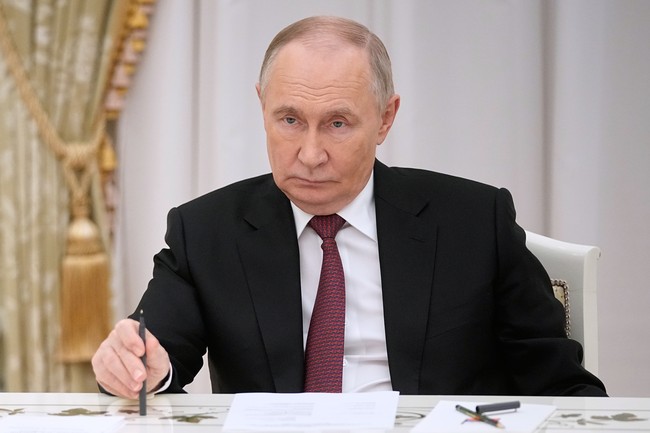
Recently we learned that President Putin is spending more time in bunkers and cracking down on internal security as he fears the possibility of a drone strike or a coup.
In addition to seeking to preserve his own personal security, Putin has cracked down on people’s personal freedoms by shutting off social media and private messaging accounts and pushing everyone toward Kremlin-monitored accounts.
But there are signs that this repression is starting to backfire as people are increasingly willing to oppose Putin publicly. Case in point, Ilya Remeslo, a former Putin supporter who spent years harassing Putin’s enemies.
Remeslo was once part of a team of Kremlin propagandists who targeted Russian opposition figures, including, most prominently, the late opposition leader Alexei Navalny. Remeslo used his background as a lawyer to testify against the opposition figures in court and smear them online.
In an interview last week with Ksenia Sobchak, a television celebrity and the daughter of Putin’s onetime political mentor, St. Petersburg mayor Anatoly Sobchak, Remeslo said that he paid a pensioner to file a lawsuit against Navalny alleging fraud related to donations to Navalny’s Anti-Corruption Foundation.
The allegations were part of a case that landed Navalny a nine-year jail sentence in March 2022. Navalny was serving that sentence in a remote Arctic penal colony when he died in February 2024 — killed by a rare poison according to Western governments.
Despite this background, Remeslo has now turned on Putin and, surprisingly, has survived his first bout with the kind of treatment Navalny got.
When Ilya Remeslo, a longtime Kremlin attack lawyer and propagandist, first turned against Vladimir Putin in March, posting publicly that the Russian president should resign and be brought to justice as “a war criminal and a thief,” the Russian authorities rapidly carted Remeslo off — against his will — to a St. Petersburg psychiatric hospital.
But, in a highly unusual development for a regime that is notorious for incarcerating its critics for years, Remeslo was freed after 30 days. Now, the pro-Kremlin henchman and blogger, who worked for the presidential administration for about a decade smearing opposition activists, is vowing to remain in Russia and continue a public anti-Putin fight.
Why was Remeslo allowed out? Apparently because Putin has internal opponents who agree with what Remeslo is saying. And what he’s saying is that Putin’s tenure is nearing an end.
“The scale of dissatisfaction is colossal,” Remeslo said in the interview with The Post, his first with an international media organization since his release. “I have the impression that part of the system is already starting to work against Putin … It’s essentially … similar to what happened at the end of the Soviet Union, when people hated the [Communist] Party and did everything for it to end. Putin’s Russia will follow the same path as the Soviet Union. Everything is being repeated.”
What’s playing out behind the scenes is a battle for control between Putin’s FSB and forces that are less loyal to him.
The security services are widely believed to be behind the clampdown on internet access, fearing it could be used to target Putin and to mobilize anti-government opposition. Some of Putin’s political advisers, however, see the restrictions as stoking anti-government anger in Russia’s highly digitalized society.
“A very big battle for power is going on,” Remeslo said, noting he remains in contact with some former allies in Russian power structures. “The FSB and the administration are very much in conflict.”
There’s another story out today in the Economist which suggests Russian society has gradually pulled itself away from Putin as the person who decides the country’s future.
The first manifestation is a shift in the language used by senior officials, regional governors and businessmen: they have stopped using the first-person plural when talking about the actions of authorities in the country.
As recently as last spring, everything was “we” and “ours”. Mr Putin’s war on Ukraine may be reckless and failing, but it was shared. “We” were inside it, and it would be better for all of “us” if it ended sooner. Now they describe what is happening as “his” story, not “ours”. Not our project, not our agenda, not our war.
The anonymous author says there are several reasons for this but one is the fact that Putin’s clampdown on freedoms breaks an unwritten rule of Russian society.
The previous social contract, whereby the state stayed out of people’s private lives while citizens stayed out of politics, has collapsed. In the past the system bought people’s loyalty with convenience, services and consumption. Now all it can offer is repression, intrusion and censorship—of which this year’s internet restrictions are the most striking manifestation.
The issue is not so much repression itself as repression without purpose. An ideology by definition presupposes an image of the future. This one demands discipline without offering one. People are required to be loyal without being told what future that loyalty serves. The political reality does not look desirable even for most of the technocrats involved in its construction. Optimism has been burned out from within.
People can put up with a lot if they are getting richer or see some promise on the horizon. But that’s not what is happening in Russia at present. The economy is on life-support with low growth and high inflation and there seems to be no end in sight.
High-energy pop music blares out across the atrium of a glitzy shopping mall in a middle-class Moscow suburb. But what was meant as the soundtrack to the hustle and bustle of shoppers is instead playing to largely vacant and boarded-up glass-fronted units – a poignant sign of Russia’s economic malaise.
The sprawling Goodzone mall flung open its doors in 2014 amid much fanfare. It includes an eight-screen multiplex cinema that now sits deserted, its foyer lights switched off. Though still open seven days a week, the mall in southern Moscow appears to be slowly dying, with few open shops and even fewer customers…
…the economy is beginning to show signs of creeping strain, with GDP contracting 1.8% in the first two months of 2026. Russian President Vladimir Putin acknowledged the issue in a government meeting on economic affairs in mid-April.
“Statistics show that economic growth has, unfortunately, been slowing for two consecutive months,” Putin said, demanding officials explain “why the trajectory of macroeconomic indicators is currently falling short of expectations.”
Russia’s future under Putin looks bleak and his popular support is finally dropping. The people in Russia don’t have much say in Putin’s future, but at some point the other officials around him will decide they’ve had enough. The internal conflict mentioned above suggests that is already starting to happen. Putin has been squeezing tight to maintain control, but he’s still losing his grip.
Editor’s Note: Thanks to President Trump and his administration’s bold leadership, we are respected on the world stage, and our enemies are being put on notice.
Help us continue to report on the administration’s peace through strength foreign policy and its successes. Join HotAir VIP and use promo code FIGHT to receive 60% off your membership.