It’s been three years since the last time I wrote anything about the West African country of Mali, one of the nations in the swath of North Africa running latitudinally known as ‘the Sahel.’ It is the biogeographical zone where the transition begins from the African savannas mid-continent to the drier coastal plains and the Sahara in the north.
This gives you some idea of how friendly the terrain is.
Areas covered by desert in North Africa and the Sahel. pic.twitter.com/z5GwCTozZ0
— African Maps (@MapsAfrican) April 20, 2026
Culturally, it’s part of a large umbrella that spans the northern part of the African continent known as ‘The Magreb,’ or the Western part of the Arab world.
The Maghreb,[a] also known as the Arab Maghreb,[b] the Greater Maghreb,[c] and Northwest Africa,[3] is the western part of the Arab world. The region comprises western and central North Africa, including Algeria, Libya, Mauritania, Morocco, and Tunisia. The Maghreb also includes the disputed territory of Western Sahara. As of 2018, the region had a population of over 100 million people.
From 2020 on, governments across the Sahel had been plagued by ISIS and al-Qaeda-related terrorist armies operating in their hinterlands, as well as Russians working their fiscal and military assistance magic with the aid of the then-powerful Wagner group mercenaries.
In May of 2023, the Russians began forgiving huge loans, upwards of $20B worth, to African countries in order to curry favor and in an attempt to move them away from both the United States and our dollar into a Russian and Chinese-supported BRICS trading bloc as a G-7 alternative. They were exploiting the African distaste for the US and European strong support of Ukraine to undercut us on the continent and destabilize already shaky African governments.
…Russia has had mercenaries in Africa for quite some time, but lately, the Wagner group, famous for their brutality and ruthless efficiency (also horrific losses) in Ukraine has been causing tremendous concern. They’re on the continent, actively undermining weak governments, extorting mineral rights, officials, or outright plotting assassinations of inconvenient folks in their way.
…But it’s Wagner’s activities in Africa, especially the geopolitically important Sahel region, that require closer attention. Formed in 2014 by Yevgeny Prigozhin, a longtime loyalist of President Vladimir Putin of Russia, Wagner was created to support Russia’s initial foray into Ukraine nine years ago. Since then, it has evolved into a shadowy network of mercenaries deployed throughout the globe. This includes a growing footprint in Africa, where Wagner has deployed forces to Central African Republic, Libya, Mali, Mozambique and elsewhere.
Combining hard and soft power, Wagner’s forces are destabilizing poorly governed regions, like the Sahel, through wanton human rights abuses, rapacious resource extraction and covert disinformation efforts that meddle in the internal politics of the countries where they operate. In Sudan, Wagner operatives advised the strongman Omar al-Bashir, who has been charged by the International Criminal Court with multiple counts of genocide, on how to operate a social media campaign that would discredit civilian protesters. In a memo to Mr. Bashir, Wagner advisers advocated publicly executing protesters to send a message to others. Phony election monitors and Wagner-engineered social media campaigns have manipulated local populations and interfered in elections in the Democratic Republic of Congo, Madagascar, Mozambique, South Africa and Zimbabwe…
During the summer of 2023, there was a series of military coups all through the Sahel, which removed governments that had formerly cooperated with the United States – such as those in Niger, Sudan, and Gabon.
Laughs in Sudanese and Afghani
— tree hugging sister 🎃 (@WelbornBeege) August 8, 2023
The French were also summarily and ignominiously booted out after over a century of lording it over their African fiefdom. In July of last year, the last French troops came home from Senegal.
The French military completed its withdrawal from Senegal on Thursday, the last West African country where it maintained a permanent troop presence, amid waning regional influence in recent years.
France has faced opposition from leaders of some of its former colonies in Africa over what they described as a demeaning and heavy-handed approach to the continent.
…France has suffered setbacks in Africa recently, including in Chad and the Ivory Coast where it handed over its last military bases earlier this year.
They follow the ousting of French forces in recent years in Niger, Mali and Burkina Faso, where military-led governments have turned to Russia instead for military support.
While France is ending its permanent military presence in West and Central Africa, some of its army staff will remain in the region.
Around 350 French servicemen are still present in Gabon, where the army has turned its base into a camp shared with the central African nation. In the Ivory Coast, some 80 French servicemen advise and train the country’s military.
The United States lost its forward operating drone base in Niger as the Biden administration botched yet another negotiation with a new junta government ( two words – Victoria Nuland). With that, we lost our eyes and ears in the middle of that vast area to keep tabs on the growing terrorist presence in the Sahel. And, naturally, we were watching the Russians, too.
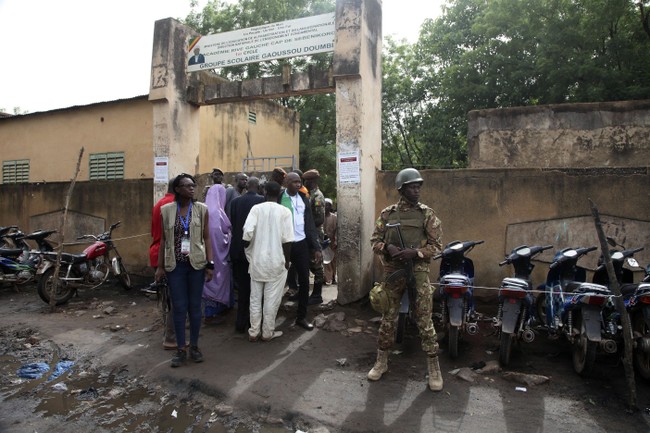
Here we are, three years later, and another revolution is unfolding, only this time, al-Qaeda is dead set on throwing the Russians out of Mali, along with the junta government they helped install a few years ago. This weekend, Malian army garrisons came under attack, and a car bomb took out the country’s defense minister, Sadio Camara, who was closely associated with the Russian Wagner group.
Camara was also the number two man in the junta.
Five Maliangarrison towns — Kati, Bamako, Sevare, Gao and Kidal — were targeted simultaneously over the weekend. The Al-Qaeda-linked jihadists of the Group for the Support of Islam and Muslims (JNIM) in coordination with the Azawad Liberation Front (FLA), mainly composed of Tuareg rebel independence movements, claimed responsibility.
Nina Wilen, director for the Africa Programme at Egmont Institute for International Relations, told DW the events are “unprecedented in Mali’s history” and showed how “strong JNIM has become over the past year.”
Wilen added: “The fact that the Malian military intelligence has not been able to detect that these attacks were about to take place is a major failure for them.”
Sadio Camara, Mali’s defense minister, was killed on Saturday, April 25, in a suicide bombing carried out by JNIM. The government said the attacker detonated a car loaded with explosives outside Camara’s private residence in Kati, located about 15 kilometers (9 miles) from the capital, Bamako.
Kati is the center of military power and the seat of the transitional government. A state funeral for the minister and a two-day period of national mourning was announced.
Nina Wilen told DW there appeared to be two reasons why Camara, considered the second-in-command within the junta, was targeted.
“He’s a very symbolic figure for the military junta,” she said. “The second reason is that Camara has been the leading figure establishing relations with Russia. So attacking him can also be a way of saying that we do not want the Russians troops here anymore.”
It was a big badda-boom, too.
‼️ NEW:
Al-Qaeda–linked JNIM terrorists assassinated Mali’s Defense Minister, Gen. Sadio Camara, in a massive VBIED blast outside his home in Kati, marking the start of coordinated nationwide attacks with Tuareg separatists.Stay connected, follow @MOSSADil. pic.twitter.com/STxcp2Vj1c
— Mossad Commentary (@MOSSADil) April 26, 2026
Terrifyingly enough, al-Qaeda has learned to use drones and employed them against the Russian soldiers manning the garrison at Kidal.
Footage has emerged showing FPV drone strikes by Al Qaeda-linked militants (JNIM) and Tuareg separatists from the FLA targeting Russian “African Corps” mercenaries in Kidal, Mali. pic.twitter.com/qKsYmP2hij
— Visegrád 24 (@visegrad24) April 27, 2026
Welcome to Africa
Imagine surviving Ukraine then be rewarded with a safe mission to Africa and then they hear that familiar buzz again
— Don (@DonroeDoctrne) April 27, 2026
After negotiating with the terrorist armies, made up of elements of al-Qaeda and Tuareg (not the VW) independence rebels, the Russian forces beat feet out of the city. There was no word on where they were headed at the time, but they’d do their regrouping elsewhere.
The Russian are fleeing Kidal, Mali
After Al-Qaeda in Mali (JNIM) & FLA took the city yesterday, the Russian Africa Corps & Malian soldiers fled to a military base outside town where they got surrounded
After negotiations, the Russians abandon the Malians & are allowed to leave pic.twitter.com/4TNPIlxpTr
— Visegrád 24 (@visegrad24) April 26, 2026
The fate of the Malians they left to the invaders was…Lordy.
About all we can say right now is ‘stop that,’ and that’s about the safest bet.
The United States strongly condemns today’s terrorist attack in Mali. We extend our deepest condolences to the victims, their families, and all those affected, and we stand with the Malian people and government in the face of this violence. The United States remains committed to…
— Bureau of African Affairs (@AsstSecStateAF) April 25, 2026
The Algerians have a hand in all the disorder, too.
🚨URGENT🚨
“CEUX QUI DISENT QUE NE NOUS SOMMES PAS LÀ, NOUS SOMMES LÀ, À LA BATAILLE DE KIDAL”
🇲🇱🇩🇿🇲🇦 Les Milliciens du Polisario, armés et logés par l’Algerie, confirment leur presence aux cotés des terroristes contre les Maliens ..! pic.twitter.com/pI5fa3iqAe
— Jaf (@Jafkech) April 27, 2026
“THOSE WHO SAY WE ARE NOT THERE, WE ARE THERE, AT THE BATTLE OF KIDAL”
The Polisario Militiamen, armed and housed by Algeria, confirm their presence alongside the terrorists against the Malians ..!
One analyst who is calling Mali Russia’s ‘new Afghanistan’ explains what she sees as the ramifications for NATO and Europe if this spirals across the Sahel.
Implications for Europe and NATO South:
The first and most immediate risk is a renewed surge in migration.
Mali lies at the center of the main overland migration corridors from sub-Saharan Africa toward Libya and the Mediterranean. The loss of state control in Bamako and across its northern and central regions is already accelerating irregular migrant flows. These movements are larger in scale than previous waves and arrive in a Europe still politically scarred by the Libyan and Syrian crises.
The second risk is the weakening of NATO’s southern flank and the growing difficulty of effective intervention.
Jihadist groups, particularly JNIM, are actively seeking to replicate in Niger and Burkina Faso the same strategy of territorial expansion, economic blockades, and coordinated attacks that has succeeded in Mali. A contiguous zone of instability stretching across the three Alliance of Sahel States members would grant jihadists strategic depth, operational sanctuaries, and easier access toward coastal West Africa and the Maghreb. This dramatically raises the cost and complexity of any future European military engagement while leaving Europe’s southern frontier increasingly exposed and harder to defend.
5 years ago, Mali was under NATO protection. They had the US and France on call, bases, aircraft, QRF ground troops, the full package.
Then their military staged a coup, kicked both out, and replaced them with Russia for some reason.
This is the result. https://t.co/a7I7prFfye
— David Lambert (@Winter_Six) April 25, 2026
There is no answer because it’s chaos.
Jihadist groups and Tuareg rebels, historical adversaries, are now tactically aligned against a common enemy. Popular dissatisfaction with the junta coexists with a deeper fear of Islamist governance, creating a tense equilibrium that sustains the current regime. Meanwhile, regional institutions such as ECOWAS find themselves constrained, powerless to exert any meaningful influence as the Sahel region plunges deeper into conflict, isolation and instability.
The Russians aren’t going away that easily, either.
Rapide résumé de la situation au Mali 🇲🇱 (un thread plus conséquent sera publié demain) :
🔹Kidal est tombée, c’est une victoire majeure pour le FLA et le JNIM, qui prennent le contrôle militairement d’une ville pour la première fois depuis 2013
🔹L’Africa Corps russe se retire… pic.twitter.com/pCUQYGr9I5— Clément Molin (@clement_molin) April 26, 2026
Quick summary of the situation in Mali 🇲🇱 (a more substantial thread will be posted tomorrow):
🔹Kidal has fallen, it’s a major victory for the FLA and the JNIM, who are taking military control of a city for the first time since 2013
🔹The Russian Africa Corps is withdrawing toward Tessalit this evening, under escort, abandoning the FAMA holed up in the former UN camp, a hard blow for Bamako
🔹Thanks to Turkish and Russian drone strikes, the FAMA and the AC have maintained their control over the main air bases, in Gao, Sévaré, Kati, and Bamako
🔹However, the JNIM has demonstrated its ability to enter the city and carry out prolonged raids, capturing significant spoils. The attacks in the center and south, though repelled, were tough for the FAMA and the AC.
🔹The Malian Chief of the General Staff and the Minister of Defense were killed in attacks at their homes. The head of the junta, Goïta, is in a camp secured by the Special Forces, giving an idea of the psychosis that’s reigning
🔹The main blow struck is political, I’ll talk about it tomorrow, we’ll also discuss the silence of the AES and the role the FLA intends to play.
I think this is just the initial phase of operations that probably aim to secure the rear base for both groups, controlling the cities notably allows access to food supplies, fuel, ammunition, and the ability to levy a tax.
Africa.
Our tough spot is missing those desperately needed bases where we had eyes and ears, and access to the interior if, God forbid, we ever needed for anything. We have Djibouti. That’s it.
What a foul, perpetual snek pit.
As far as a flood of refugees looking to pour across the Mediterranean thanks to a renewed killing cycle, I sure hope our NATO ‘allies,’ like, say, Spain…*spits*…don’t expect any help being bailed out.
We’re pretty busy at the moment, and they’re not. And haven’t been.
Handle it, Pedro.