Augustine’s transformation from a wayward professor of rhetoric into the greatest of Latin theologians did not occur in an instant. Even so, there can be very few men, converted as he was in the prime of life, who have made so profitable use of the time left to them as he did after his baptism and admission to the clergy.
 The gradual advance of the Christian religion in the Roman world was not achieved principally by the superiority of its thinkers and spokesmen to their Pagan rivals. The patient ascendancy of the Church in the generations prior to and following the rule of Constantine flowered from many invisible and anonymous lives, and grew so slowly as to be discernible to few of the men, women, and children whose actions, sacrifices and prayers were its seed and assurance. Considerable as the stature of the Church’s greatest thinkers might be, the wisest of these were well aware that the Body of Christ is not, and can never be, merely an isolated and exclusive society of scholars or inquirers into the remoter issues of doctrine. St. Paul knew the sorts and conditions of the brotherhood to which he ministered well enough to write that in it God had chosen not the wise but the foolish. And his thought was not lost on his successors: “Non in dialectica”, wrote St. Ambrose, “complacuit Deo salvum facere populum suum.” “Not by the power of reasoning did it please God to accomplish the salvation of His people.”
Even as we accept this, it remains obvious that in those formative years a select company of estimable minds was drawn by different roads and various desires into the fold of the Church; and of these few have exercised wider influence from his day to ours than the African bishop whose feast is celebrated today. So much has been said and written in his praise and of the great line of religious, mystics, rulers and doctors of the Church whom his thought has shaped that it may be worthwhile to reflect briefly on a fact which he himself acknowledged, namely that his famous conversion in the Milanese garden was no foregone conclusion but the result of a lengthy chain of graces that defeated his long efforts of spiritual resistance. There may exist such a thing as the proverbial anima naturaliter Christiana-the unbaptized man whose excellence of soul naturally predisposes him to the overtures of grace-but such a soul was not Augustine’s, if we grant any credit to his account of his early years and attend to the development of his mind and heart and the wanderings of both. A dozen different schools of philosophy or mystery religions might easily have made a permanent adherent of him; or he might conceivably have trickled his life away slipping from one belief or half-belief into another-a phenomenon common in his world as in ours. Nimble minds are not often anchored by any set of firm convictions, and the restlessness of Augustine has become, thanks to his own Confessions, a proverbial quality of the man. The late Platonism he embraced early in his adulthood might have held him permanently, as it had held other men scarcely his inferiors in powers of mind; the same Platonism had satisfied Celsus, the author of the ablest of the several Pagan treatises written against the strange and stubborn followers of a crucified insurrectionist, and Celsus was no anomaly; closer in time to Augustine, the same school had made a convert of Plotinus, among whose students senators and emperors were to be counted. Besides the Platonists, and stronger even to appeal to Augustine’s ardent nature were the Manicheans. These too, because and not in spite of their grim abstemiousness and hatred of the body, could imaginably have made a lasting possession of a young man tempted by excesses of indulgence and haunted by the sense that these excesses were bound to be the wreck of him. More than one sensualist gone to seed has been transformed into a bitter ascetic, and so might Augustine’s story have closed: unfolding the dualist mysteries to initiates eager as he had been to live disembodied lives according to the somber gospel of Mani.
Many distractions, of body and of mind, diverted Augustine prior to his hearing the fateful tolle, lege that ultimately brought an end to his soul’s drifting from one habitation to another. His transformation from a wayward professor of rhetoric into the greatest of Latin theologians did not occur in an instant. Even so, there can be very few men, converted as he was in the prime of life, who have made so profitable use of the time left to them as he did after his baptism and admission to the clergy. He was not hungry for preeminence among his peers, though at all times he appears to have attracted friends who looked to him as a natural superior, both before his conversion and after. It would not have seemed to him a poor use of his endowments to organize a monastic fraternity and bury himself in the obscure work of such a fellowship; something like this he attempted at Cassiciacum as the unofficial abbot of a small company of friends; such a calling might have contented him for the remainder of his life; sed Deo aliter visum. His ordination as a priest occurred scarcely five years after being baptized alongside his son by Ambrose of Milan, and he gained immediate renown for the quality of his homilies. Here his training in the rhetorical schools of Africa and Italy served him well, though in many respects the growth of Augustine the theologian is the story of his own gradual rejection of “mercenary eloquence”. Promotion to the bishopric of Hippo followed shortly thereafter. The diocese in which he was posted was not one of great importance in the eyes of the Empire or the Church, yet there is no hint in his surviving sermons or letters that he wished to escape his post, as a more grasping striver might have desired. The work to which he committed himself occupied him until his death. He expired in 430 A.D., while the town of Hippo was in the agonies of a siege, surrounded by the Vandal army of the barbarian chief Genseric. The bishop passed away towards the end of that summer, disposing of his cathedral’s valuables and praying constantly the Penitential Psalms, which he had ordered to be inscribed on the wall of the cell in which he spent his final weeks. When at last the Vandals took Hippo and set fire to it, the bishop’s cathedral was one of the few buildings their fury chanced to spare.
My statement that Augustine in his use of his time gave proof that he knew the value of it should be further explained. The proof is not merely in the number of books he left posterity, for a comparatively idle man might put an equal number of words on paper to little or no purpose; rather, his sense of industry appears most in the religious controversies into which he entered with schismatics and other challengers; in his choice of battles he showed always an understanding not only of the points at issue but of what disagreements were and were not worthy of his energies. He was not, like his great contemporary St. Jerome, a man who delighted in disputes almost for their own sake, and unlike that very great biblicist, he did not allow his arguments to grow envenomed or allow bitterness to get possession of himself. It has been often said, and truly, that he supplied answers and refutations not only to the dogmatic errors of his own time but to many that lay far in the future. It may be that to enter repeatedly into debate with Donatists and Manichees and others brought him little satisfaction; in the case of the Donatists especially he worried at times that the Roman government might fail in patience and fall to the use of undue force against them. Nor was victory against error assured; he wrote and argued and instructed, but several of the novelties and doctrines he saw as threatening the peace and unity of the Church were still current as he lay dying, and the Church was no more untroubled at the end of his days than it is in our own.
None of these adversities overcame him or sank him into despondency. His activities as a minister and as the most prolific of theologians ended only with his death. Up till then he exercised himself indefatigably in his several duties, walking in wisdom, and “redeeming the time, because the days were evil.”
__________
The Imaginative Conservative applies the principle of appreciation to the discussion of culture and politics—we approach dialogue with magnanimity rather than with mere civility. Will you help us remain a refreshing oasis in the increasingly contentious arena of modern discourse? Please consider donating now.
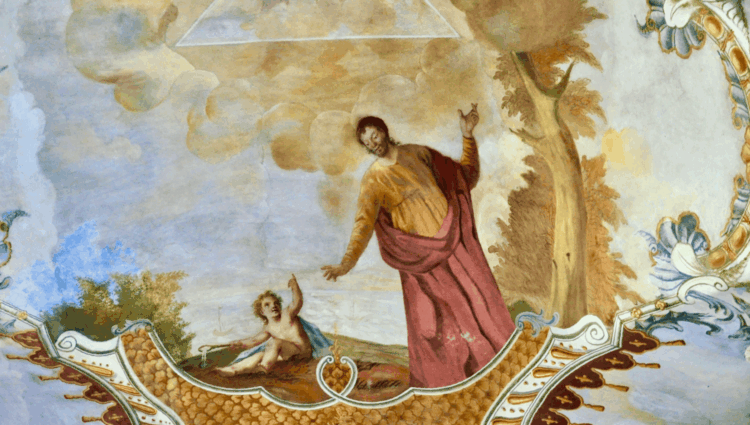
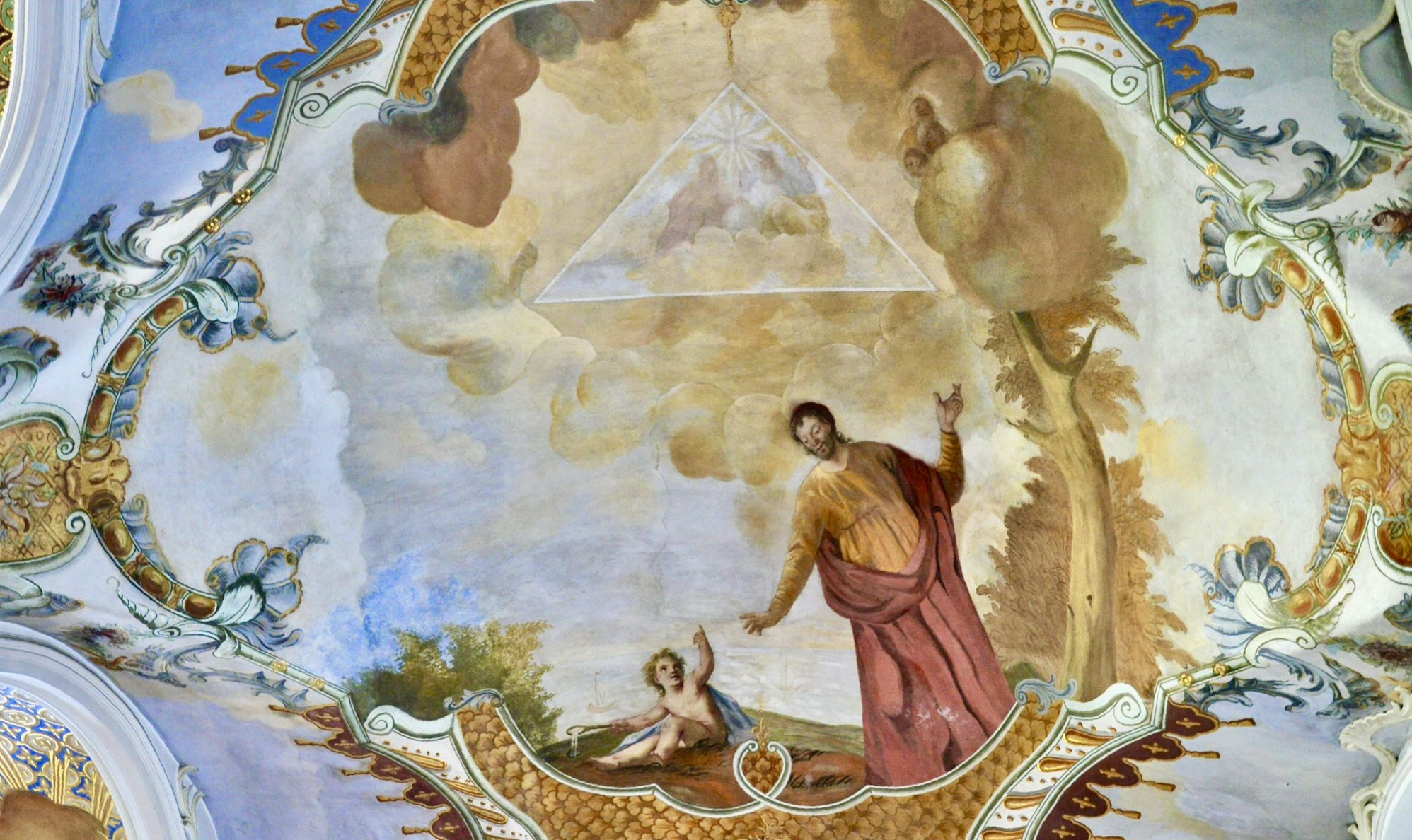
The featured image, uploaded by Andreas Praefcke, is “Schussenried Abbey Church frescoes (A4): Augustine’s conversation with the boy by the sea,” by Johannes Zick (1702–1762), and is in the pubic domain, courtesy of Wikimedia Commons.