God’s ineffable simplicity is a spring of contemplation. Our wonder only grows when we consider the dignity of the Christian call to be like God.
 God is simple. We know this from the fact that God cannot be made up of any parts. Why? Because when a whole is composed of parts, that whole needs those parts to be what it is. God, of course, doesn’t need anything. If God needed to receive something, then we would have to start asking where he got that something. Who gave it to him? God, if he is the first being of all, cannot receive, for he must be the starter, the giver. God asks us, “Who has given to me, that I should repay him?” (Job 41:11, RSVCE). He asks the question, and the whole creation answers: no one (ST I, q. 2, a. 3, corp.; q. 3, a. 7, corp.). Since he is without parts, God’s simple being makes for simple acting. God knows one thing: God. God loves one thing: God. There is no breach separating God’s intentions and his actions, but instead everything he is, everything he wants, and everything he does is unified; it is simple. God is simple.
It is important that we hold the truth of God’s simplicity tightly, because it is an easy one to let slip. And once we lose our grasp on God’s divine simplicity, we quickly begin grasping after our own creaturely complexity.
It is easy to let God’s simplicity slip, and for two reasons. First, because it is hard to wrap our heads around: if God’s simplicity entails his self-sufficiency, then we wonder where we actually fit into his ultra-simple picture. When we stress the truth that God doesn’t need us, many tend to translate that as, “God doesn’t want us.” That is not true, of course. In fact, knowing that God has precisely zero need for us (or anything, for that matter) demonstrates that the only reason God made us is that he wants us. We can be more confident in the gracious love of God when we keep ourselves focused on simplicity.
The other reason we shrink away from God’s simplicity: we are complex. God made us unto his image and likeness (Gen 1:26). But we bear that likeness with all the baggage that comes with having a body. Since we know God through creation (Rom 1:20), it is easy to arrive at an idea of God that comes stocked with many of our own complexities. When we—beings with many emotions, desires, knowledge—are the starting point of our thinking, then we tend to see a lot of ourselves at the finish line. We cross the finish line with an idea of God that looks very much like we do. We end up conceiving of God in our image and likeness rather than the other way around.
Difficult though it may be, an understanding of God’s simplicity can bear tremendous fruit in our lives. Thinking of God’s grace in light of his perfect simplicity offers an insight into how he chooses to abide in us (John 14:23).
God bestows on us his grace, which is nothing other than the pouring of his love into our hearts (Rom 5:5). Saint Thomas follows the Apostle Paul when he describes grace as “a certain participation of the Divine Nature” (ST I-II, q. 112, a. 1, corp.). Grace, then, is a share in God. And where God goes, his simplicity follows. This is not to say that everyone with grace, every creature, both angels and men alike, is simple in the same way as God—this would be to change the creature beyond recognition. No, I refer to a share in God’s simplicity according to our own creaturely limitations. In other words, we can imitate God’s perfectly simple being and action by engaging our minds in the same activity that God has been doing for all eternity: we can focus on God with the same knowledge that he has of himself.
Thinking like God about God does not destroy our complexity, but it offers us a means whereby we overcome complexity’s limitations. One such limitation is our oppressive awareness of the complexity of our motivations. When we take stock of ourselves, we see a strange combination: good mixed with bad and certainty mixed with confusion. Our self-gaze can be paralyzing! Leo Tolstoy illustrates the paralyzing effect of complexity when he describes the weak and indecisive Pierre Bezukhov, a central character in War and Peace: “Pierre was one of those people who are strong only when they feel themselves perfectly pure” (Tolstoy, War and Peace, Pevear and Volokhonsky trans., 209). As the plot goes on to display, Pierre is not strong, and that’s because he never feels himself pure. Before taking action, Pierre obsessively analyzes his motivations. If he finds an impure motive, he refrains from acting. Consequently, life constantly catches Pierre flat-footed.
Pierre is not a man of action because he cannot bear the weight of his own complexity. And neither can we. None of us will ever look into ourselves and find a simple and pure intention. When we direct our gaze inwards, what we find are parts. Certainly, they are parts that build a harmonious whole, but by existing as parts they disallow perfect simplicity. If we go searching, we will always find something less than savory within ourselves. But our Bezukhovian self-doubt and inaction stand in stark contrast to the mentality of someone like St. Paul, one of the most action-oriented men to ever walk the earth. The Apostle says, “But with me it is a very small thing that I should be judged by you or by any human court. I do not even judge myself” (1 Cor 4:3). Paul does not bother judging himself because he has tapped into one of the most glorious fruits of grace: Paul has his sights fixed on God. Paul does not value excessive introspection since he stays focused on the perfect and simple God. With God filling up the mind and the affections, our mode of action sheds itself of undue complexity and engages reality with the simplicity of God’s self-knowledge.
God does not leave us to remain like Pierre, enmeshed in a dreadful solipsistic tendency. Instead, he grants a share in his own life so that we can think with his thoughts and love with his love. Grace gives us a superhuman mode of action with only one direction, one terminus: God himself. When a Christian lives with the grace of God dwelling in his soul, he need not agonize over himself and all his mixed intentions. Why? Because these words of St. Paul are directed to him: “God is at work in you, both to will and to work for his good pleasure” (Phil 2:13). The Christian need not stress unduly: He can trust that God has the reins.
But perhaps there is a looming question about our need to struggle against sin? About the fact that we nevertheless must go to war against the disintegration of our parts and strive to make everything in us move in a unified God-ward direction?
It is true that life entails toiling against our flaws, but God’s beautifully simple grace directs our battle with sin and vice. As we said, grace moves in one direction: towards God. It is only when we move with grace’s motion that we effectively battle the vices that stand in our way. Thus, there is no preliminary round of self-effacing introspection that opens the doors to grace’s action. Instead, grace itself opens the doors to a victorious battle over our vices. The motion towards God starts the moment we receive his grace. God intends to clear out our sinfulness and misery—but he only clears us out by filling us up with something new, with himself.
God’s ineffable simplicity is a spring of contemplation. Our wonder only grows when we consider the dignity of the Christian call to be like God. The grace of adoption as God’s sons and daughters brings with it a new mode of acting, one which mirrors the simplicity of the Almighty God. Grace accomplishes in us a supernatural remedy to our tendency to hyper-analyze ourselves. When God works in the soul, it receives a taste of God’s freedom to act that brings with it “the peace of God, which surpasses all understanding” (Phil 4:7).
✠
Republished with gracious permission from Dominicana (October 2026).
The Imaginative Conservative applies the principle of appreciation to the discussion of culture and politics—we approach dialogue with magnanimity rather than with mere civility. Will you help us remain a refreshing oasis in the increasingly contentious arena of modern discourse? Please consider donating now.
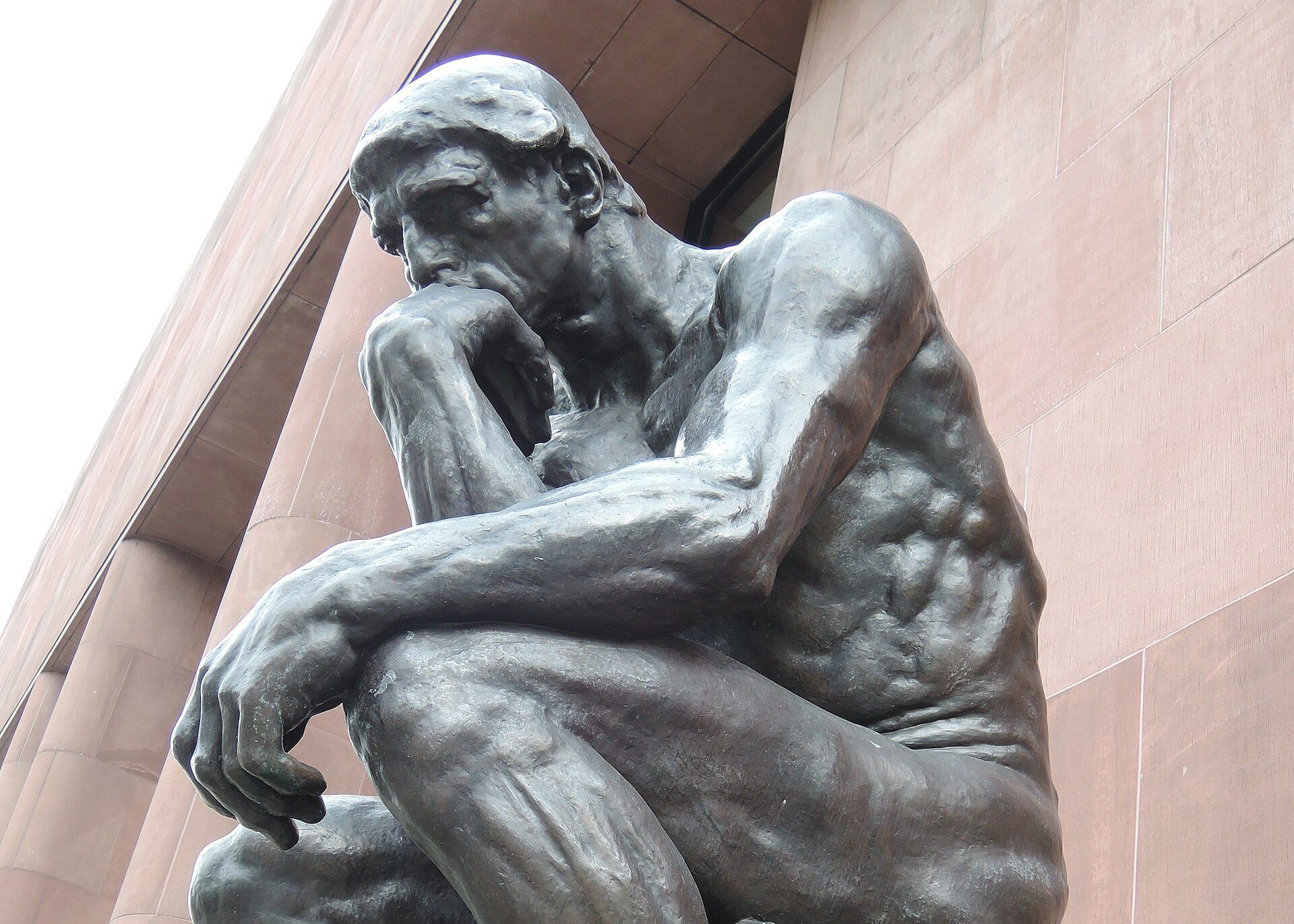
Image: Auguste Rodin, The Thinker, photographed by Kaisching (detail)