In a long-awaited decision on the Voting Rights Act, the Supreme Court may have split the baby … but not precisely in half. In fact, the Left may only be left with a dirty diaper.
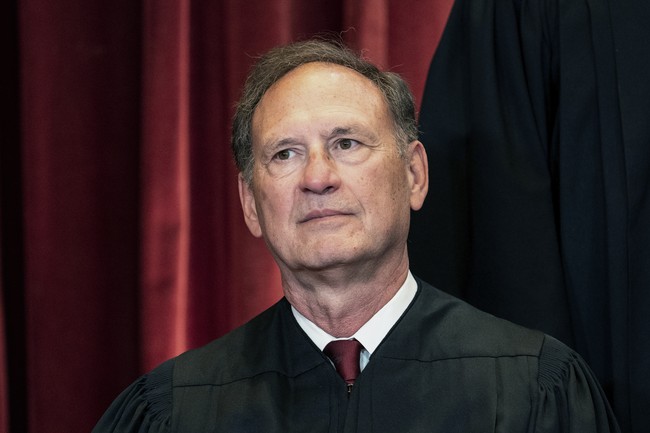
Conservatives had hoped that the court would strike down Section 2 of the VRA to end a gerrymander in Louisiana. Progressives had demanded that the court stick with the traditional reading of the section to enable more racial redistricting to support their power base. Justice Samuel Alito and the five conservative justices instead chose to require strict scrutiny on all such applications of Section 2, overturning the redistricting in Louisiana v Callais in a decision published early enough to impact the midterms:
The Supreme Court has weakened a key tool of the Voting Rights Act that has helped root out racial discrimination in voting for more than half a century in a case concerning a Black majority congressional district in Louisiana.
The court’s conservative majority found that the district, represented by Democrat Cleo Fields, relied too heavily on race. Chief Justice John Roberts had described the district as a “snake” that stretches more than 200 miles (320 kilometers) to link parts of the Shreveport, Alexandria, Lafayette and Baton Rouge areas.
The impact of this decision goes well beyond this district, however, and the court knows it. While the 6-3 majority did not overturn Section 2 entirely, they made clear that the use of it had to be limited to intentional racial discrimination and not just unpreferred outcomes. This is clear from the beginning of the summary in the majority ruling:
Because the Voting Rights Act did not require Louisiana to create an additional majority-minority district, no compelling interest justified the State’s use of race in creating SB8, and that map is an unconstitutional racial gerrymander. Pp. 17–36.
(a) The Constitution almost never permits a State to discriminate on the basis of race, and such discrimination triggers strict scrutiny. The Court’s precedents have identified “only two compelling interests” that can satisfy strict scrutiny: “avoiding imminent and serious risks to human safety in prisons,” and “remediating specific, identified instances of past discrimination that violated the Constitution or a statute.” Students for Fair Admissions, Inc. v. President and Fellows of Harvard College, 600 U. S. 181. The question presented is whether compliance with §2 of the Voting Rights Act should be added to this very short list of compelling interests. The Court now holds that compliance with §2, as properly construed, can provide such an interest. A proper interpretation of §2 requires examining the statutory text to understand what it demands with respect to drawing legislative districts. Pp. 17–26.
When it comes to redistricting, which has been one of the key applications for Section 2, Alito sets the bar for strict scrutiny much higher than in the past. In order to pass muster, the proponents of racial gerrymandering will now have to prove that minorities did not get a meaningful chance to participate in previous redistricting:
(1) Under Section 2(a), the Court takes as a given that a legislative districting map may constitute a “standard, practice, or procedure” that may violate §2 if it “results in a denial or abridgement” of the right to vote “on account of race or color.” Section 2(b) establishes that a violation occurs when political processes are “not equally open to participation by” members of a racial group “in that [they] have less opportunity than other members of the electorate to . . . elect representatives of their choice.” The key concept is “less opportunity than other members of the electorate,” which sets a baseline against which to assess the opportunity of minority voters. That baseline—the opportunity that any given group of voters has to elect their candidate of choice—depends on the voting preferences of other voters in the district. For example, in a district where most voters prefer Democratic candidates, a Republican voter in that district will have a low chance of securing the election of his or her preferred candidate. The roster of voters who end up in a given district depends, in turn, on the districting criteria the State uses to draw a legislative map. Thus, the “opportunity” of these “members of the electorate” to contribute their votes to a winning cause is whatever opportunity results from the application of the State’s combination of permissible districting criteria. That is what a randomly selected individual voter and group of voters can expect regarding their opportunity to elect their preferred candidate. Under §2, a minority voter is entitled to nothing less and nothing more. Pp. 19–22.
In other words, districting by race is only constitutional under Section 2 when it remediates intentional discrimination by the state. Alito argues that the provision can only be interpreted that way in the context of the Fifteenth Amendment:
As the Court has long held, the Fifteenth Amendment bars only state action “ ‘motivated by discriminatory purpose.’ ” Reno v. Bossier Parrish School Bd., 520 U. S. 471, 481. So a law that seeks to enforce the Fifteenth Amendment by prohibiting mere disparate impact would fail to enforce a right that the Amendment secures. That is never “appropriate,” South Carolina v. Katzenbach, 383 U. S. 301, 308, because Congress cannot “enforce a constitutional right by changing what the right is,” City of Boerne v. Flores, 521 U. S. 507, 519. For this reason, the focus of §2 must be enforcement of the Fifteenth Amendment’s prohibition on intentional racial discrimination. When §2 of the Act is properly interpreted, it imposes liability only when circumstances give rise to a strong inference that intentional discrimination occurred. Properly understood, §2 thus does not intrude on States’ prerogative to draw districts based on nonracial factors, including to achieve partisan advantage. In short, §2 imposes liability only when the evidence supports a strong inference that the State intentionally drew its districts to afford minority voters less opportunity because of their race. Not only does this interpretation follow from the plain text of §2, but it is consistent with the limited authority that the Fifteenth Amendment confers.
What does this mean in practice? It has been decades since states intentionally excluded minority voters from participation in elections. Every state legislature has significant minority participation. The Louisiana state legislature has 27 black members, 26% of the seats available, while black people comprise 31% of the state’s population. That makes it impossible to justify a racial gerrymander to redraw a map in which minority voters had significant engagement through their elected representatives.
This decision keeps Section 2 alive, but only in a break-glass emergency. In practical terms, Alito’s ruling will prevent a resort to the VRA for absurd gerrymanders explicitly based on race from now on. There is no possible way to argue that the minorities these districts reward have been locked out of redistricting decisions, not recently and not for a long time. Alito underscores this point by observing the changes in state legislatures and politics over the past forty years since Thornburg v Gingles:
Four historical developments are of particular note. First, vast social change has occurred throughout the country and particularly in the South, which have made great strides in ending entrenched racial discrimination. Second, a full-blown two-party system has emerged in the States where §2 suits are most common, and there is frequently a correlation between race and party preference. Third, in Rucho v. Common Cause, 588 U. S. 684, this Court held that partisan gerrymandering claims are not justiciable in federal court, and this holding creates an incentive for litigants to exploit §2 for partisan purposes by “repackag[ing] a partisan-gerrymandering claim as a racial-gerrymandering claim,” Alexander v. South Carolina State Conference of the NAACP, 602 U. S. 1, 21. Fourth, the increased use and capabilities of computers in drawing districts and creating illustrative maps means that a §2 plaintiff can easily identify an alternative map that fully achieves all the State’s legitimate goals while producing greater racial balance, if such a map is possible. In light of these developments, the Court updates the Gingles framework and realigns it with the text of §2 and constitutional principles. Pp. 26–31
In other words, even if the Supreme Court had acted generously in the past to claims of remedial racial gerrymandering, the necessity for that has long since disappeared. This is similar to the approach taken by the Supreme Court with affirmative action, where Chief Justice John Roberts ruled – after warning about it twenty years earlier – that the only way to stop discrimination on the basis of race is to stop discriminating on the basis of race.
Justice Clarence Thomas wrote a brief concurrence that basically amounts to I told you so. He would have gone further and ruled that Section 2 has no application to redistricting at all:
I join the Court’s opinion in full. This Court should never have interpreted §2 of the Voting Rights Act of 1965 to effectively give racial groups “an entitlement to roughly proportional representation.” Thornburg v. Gingles, 478 U. S. 30, 93 (1986) (O’Connor, J., concurring in judgment); see ante, at 23–24. By doing so, the Court led legislatures and courts to “systematically divid[e] the country into electoral districts along racial lines.” Holder v. Hall, 512 U. S. 874, 905 (1994) (THOMAS, J., concurring in judgment). “Blacks [we]re drawn into ‘black districts’ and given ‘black representatives’; Hispanics [we]re drawn into Hispanic districts and given ‘Hispanic representatives’; and so on.” Ibid. That interpretation rendered §2 “repugnant to any nation that strives for the ideal of a color-blind Constitution.” Id., at 905–906. Today’s decision should largely put an end to this “disastrous misadventure” in voting-rights jurisprudence. Id., at 893.
As I explained more than 30 years ago, I would go further and hold that §2 of the Voting Rights Act does not regulate districting at all. See id., at 922–923. The relevant text prohibits States from imposing or applying a “voting qualification,” “prerequisite to voting,” or “standard, practice, or procedure,” in a manner that results in a denial or abridgement of the right to vote based on race. 52 U. S. C. §10301(a). How States draw district lines does not fall within any of those three categories. Holder, 512 U. S., at 922–923 (opinion of THOMAS, J.); Allen v. Milligan, 599 U. S. 1, 46 (2023) (THOMAS, J., dissenting). The words in §2 instead “reach only ‘enactments that regulate citizens’ access to the ballot or the processes for counting a ballot’; they ‘do not include a State’s . . . choice of one districting scheme over another.’” Ibid. (quoting Holder, 512 U. S., at 945 (opinion of THOMAS, J.)). Therefore, no §2 challenge to districting should ever succeed.
Justice Elena Kagan wrote the dissent, but had to immediately resort to a reductio ad absurdum hypothetical:
Consider the story of a hypothetical congressional district in a hypothetical State, subjected to a redistricting scheme. The example is admittedly stylized, but in its essence simulates the dispute before us, and clarifies the immense issues at stake. The district, let’s say, is a single county, in the shape of a near-perfect circle, sitting in the middle of a rectangular State. The State is one with a long history of virulent racial discrimination, and its many effects, including in residential segregation and political division, remain significant even today. The population of the circle district is 90% Black; the rest of the State, divided into five surrounding districts, is 90% White. And voting throughout all those districts is racially polarized: Black residents vote heavily for Democratic candidates, while White residents vote heavily for Republicans. The circle district thus enables the State’s Black community to elect a representative of its choice, whom no neighboring community would put in office. But that arrangement, in this not-so-hypothetical, is not to last. The state legislature decides to eliminate the circle district, slicing it into six pie pieces and allocating one each to six new, still solidly White congressional districts. The State’s Black voters are now widely dispersed, and (unlike the State’s White voters) lack any ability to elect a representative of their choice. Election after election, Black citizens’ votes are, by every practical measure, wasted.
Amusingly, that actually sounds like the stunt that Virginia Democrats just perpetrated by landing nearly half of its new districts in Fairfax County. However, the proper forum to fight that effort is the state legislature. If the state legislature has discriminated in such a manner as to eliminate any meaningful participation by minority voters, Alito’s ruling still leaves open the possibility of a Section 2 challenge. It’s very telling that Kagan has to resort to fantasy to make this argument at the top of her dissent.
In practice, though, racial gerrymandering is now dead. Louisiana has to redraw its map in time for the midterms, and any other state attempting to cook districts in absurd constructs like the one at issue here is likely headed for the scrapheap.
Editor’s Note: Do you enjoy HotAir’s conservative reporting that takes on the radical left and woke media? Support our work so that we can continue to bring you the truth.
Join HotAir VIP and use promo code FIGHT to receive 60% off your membership.