There are many moral problems in our world, but they are all arguably rooted in a lack of prayer, of regular communion with God. Here, then, at an opportune time comes a book about prayer: James Papandrea’s “Praying the Wisdom” teaches how to pray with the Bible.
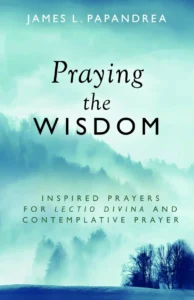
Praying the Wisdom: Inspired Prayers for Lectio Divina and Contemplative Prayer, by James L. Papandrea (Sophia Institute Press, 218 pages, 2026)
 There is a crisis in the world, and it is a crisis of prayer. There are many moral problems in our world, of course, but they are all arguably rooted in a lack of prayer, of regular communion with God. Our world offers endless distractions from prayer, from being alone with God. I strongly suspect that many of our friends and family members, even many of the people sitting next to us in the pew, simply do not pray. I mean meditative prayer: serious, sustained, private prayer apart from participation in the liturgy. If I were a priest, I would abandon all biblical exegesis for one Sunday and devote my homily to instructing the parishioners on how to pray and what sort and amount of prayer they should be doing every day. I believe too many people are in the dark about this. They do not need commentary on current events. They need to know how to pray. On an even more basic level, they need to be reminded to pray, reminded of the importance of prayer, because prayer is simply the soul’s food and water.
Here at an opportune time comes a book about prayer. More specifically, James Papandrea’s Praying the Wisdom teaches how to pray with the Bible. For many years now, my preferred form of prayer every day has been lectio divina—an ordered way of praying with passages of scripture. Lectio divina is private prayer, but by meditating on the scriptural passages for the day’s liturgy, you are also praying with the whole church. (This is one of the reasons why I also enjoy praying the Liturgy of the Hours, which is similarly richly loaded with scripture.) In Praying the Wisdom, church history professor Papandrea has newly translated passages from the Old and New Testaments that can be used as personal prayers.
There is a wide variety of prayers here, from Abraham’s Prayer Before His Death to Job’s Prayer of Confession, numerous of the Psalms (Papandrea has also written a book specifically about praying the Psalter), the Blessed Virgin Mary’s Fiat and Magnificat, and Jesus’ Fiat in the Garden of Gethsemane. There are prayers asking for blessings of various kinds, for wisdom and discernment, for mercy, and much more. Papandrea has helpfully included a thematic index, so you can find prayers appropriate for different purposes or states of mind. In addition to the canonical scriptures, Papandrea has included passages from such extrabiblical sacred writings as the Book of Jubilees and the Odes of Solomon, which will be new to the majority of believers. There are also occasional footnotes clarifying theological points that demonstrate Papandrea’s deep scholarly knowledge.
It is instructive to be reminded that a prayer need not be a petition or a thanksgiving, but can also be confessional in nature—a statement. An example is St. Peter’s First Confession (John 6:68–69):
Lord to whom could we go?
You have the words of eternal life
And we have come to believe, and know
That You are the Holy One of God.
We might not think of a passage like this as something that could be appropriated as prayer, but there is no earthly reason why not. Or what about Peter’s even briefer Second Confession, from Matthew 16:16?
You are the Christ
The Son of the Living God.
When we remember that one of the simplest prayers on earth is the Jesus Prayer (“Lord Jesus Christ, Son of God, have mercy on me, a sinner”), we will be well disposed to incorporate these brief, direct prayers into our daily lives. One of my favorites in this vein, which I love for its simplicity and irony, is the prayer of the father in Mark 9:24. I flipped through the book to make sure Papandrea had included this, and indeed he did not forget it:
I believe
Help my doubt.
This is a prayer of which I certainly have great need. As declared in the title, this collection of prayers is geared to lectio divina, a wonderful method of prayer which more believers should know about. The method consists of a series of steps. First, you choose a scriptural text and read it slowly and reverently (lectio). Then you reflect on it, including applying it to your own life situations (meditatio). Next you pray on the text, i.e., use the text’s subject matter as the subject of your prayer (oratio). At last, you cease to pray with words and simply rest peacefully in God’s presence (contemplatio); this last stage is pure contemplative prayer, a loving resting with and gazing at the Lord without specific words or thoughts. This is only a bare outline, of course, but it is enough to convey the essence.
I can tell you from experience that this process is wonderfully cathartic and satisfying to both the heart and the mind. Any of the prayers in Praying the Wisdom can be used for lectio divina. Papandrea also recommends the practice of “breathing prayer,” an excellent way to slow down and enter into the sacred rhythm of prayer, working with the parallel structure of the biblical poetry. While many rail against “moral therapeutic deism” in our culture—and it is troublesome—we are apt to forget that biblical faith, properly understood and practiced, is deeply therapeutic.
One of the curious things about this book is that it contains a good many blank pages. That is because Papandrea is inviting us to use the book partly as a journal to record our own thoughts, private reactions to the content of the prayers, and perhaps compose our own prayers. I have no immediate plan to do this, but who knows? This is a book whose spareness will force you to slow down, empty your mind of excess, and concentrate on the essence of what these prayers convey. Papandrea’s translation style (I assume he is expert in Hebrew and Greek) is sensitive to context and pastoral needs. He stresses that translation of biblical text is not rigid, that more than one word or phrase can be used to render the Greek or Hebrew. The words in the Psalms can be applied in a number of ways: for example, “enemies” can be interpreted as spiritual enemies instead of enemies on the battlefield. When a given prayer has “me,” Papandrea sometimes renders it as “us” instead, so as to give it a wider scope including one’s family.
I am puzzled as to why Papandrea’s collection does not include the Song of Simeon (the Nunc dimittis), a beautiful prayer traditionally said as part of Vespers or evening worship. Too, I think Mary’s Canticle, the Magnificat, should have been included in its entirety, instead of only an excerpt. The book is particularly strong on prayers from the Old Testament, which will help believers to ground their faith in the salvation history of Israel; that is certainly much needed.
Meditative prayer can be mysterious to those outside, but it doesn’t have to be if you pray with the words of scripture, appropriating the thoughts and imagery already there in the text. Apart from anything else, praying with God’s Word solves the perennial problem of finding the right words. For those who have trouble just getting started in prayer, there is no better way in.
And there are other benefits. Someone who prays with scripture consistently for a length of time will find scripture’s language not only informing their own spontaneous prayer but becoming part of their very mind and imagination. Nowadays when I send a random prayer upward, it is more often than not a Psalm-like utterance, complete with David’s turns of phrase. And this is the long-term gift of a book like Praying the Wisdom: that we become vessels of God’s word.
The Imaginative Conservative applies the principle of appreciation to the discussion of culture and politics—we approach dialogue with magnanimity rather than with mere civility. Will you help us remain a refreshing oasis in the increasingly contentious arena of modern discourse? Please consider donating now.