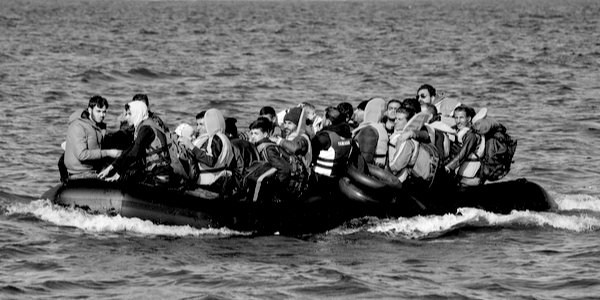
YOU don’t have to be the sharpest knife in the box to realise that illegal immigration, in the form of the Channel boatmen, is reaching crisis proportions.
Rarely out of the news, it is stretching beyond breaking point the credibility of the Starmer regime which is increasingly demonstrating its impotence when confronted with tens of thousands of young men from Muslim and African countries looking for ‘better lives’ at the expense of British taxpayers.
It must be a measure of the singular lack of faith that we have in our ruling classes, therefore, that when they actually start noticing, this is actually treated as news.
But that seems to be exactly the case. The Home Secretary, Shabana Mahmood, is showing signs of having woken up to the scale of the crisis and has the Telegraph headlining the declaration that the ‘UK has lost control of its borders’, then going on to say that ‘failures on migration are eroding trust as she calls for international response’.
I mean to say, who knew? Who knew that the rash of demonstration outside asylum hotels, the rise and rise of Reform UK and the constant complaints on social media and elsewhere, actually meant that the population was getting a tad vexed? Apart, that is, from about 40million or so people outside the Westminster bubble?
Mahmood is set to outline what is being called ‘one of the frankest assessments yet’ of the risks the regime is running if it fails to get a grip on the migration crisis.
Yet she is not yet able (or willing) to state the obvious: that the only sure way for the UK – as an end destination – to keep the illegal immigrants from the doors is to eliminate the ‘pull factors’, removing any possible advantage these people might see in coming here.
That requires the UK to take a hard line, reinstating the Tory law that blocked illegal immigrants from ever applying for British citizenship and thereby closing off a loophole which allows them to bypass UK immigration law.
Alongside that, we have to treat these people as what they actually are – criminal chancers, employing organised criminal gangs to assist them in breaching the law. Forget the hard luck stories – they all have one of those – and bear in mind that most of the arrivals here have paid thousands of pounds for the privilege of rocking up to a free hotel. Penniless refugees, these are not.
But to put a complete stop to this flow of chancers, we have to equip ourselves with austere, remote and secure detention centres, so that illegal arrivals learn that entering the UK illegally is a one-way ticket to lifetime detention unless they can arrange their passage back home or to another country that will accept them.
Despite Mahmood’s epiphany, she is not actually into such solutions – not just yet. Instead, she is going to bleat about ‘international co-operation’ as the sole means by which countries can secure their borders, focusing on the Western Balkans smuggling route through which almost 22,000 people passed last year.
Even if the whole of that traffic was destined for the UK it would account for only a fraction of the arrivals. In fact, by far the bulk of the illegal migrants come via Malta and Italy, thence to France and the Calais region from which they cross the Channel.
Traffic along the Western Balkans route, although increasing, is largely destined for Germany and the Netherlands. Where illegal immigrants come to us via that route, the UK may be the second choice, with the migrants trying their luck in Germany or other European countries first.
Specifically with Germany – but also with Denmark – the federal government is tightening the rules, which is having the effect of displacing some migrants to the UK.
If Mahmood wants to preach ‘international co-operation’ to the Balkan countries, they may point out that they are largely transit countries and if the UK eliminated the ‘pull’ factors, a lot of their problems would disappear.
What is particularly striking about the West Balkans route is the degree to which the trafficking has been taken over by organised criminal groups. According to Europol, Frontex and other international agencies, this lucrative business is distinguished by the increasing involvement of diverse international actors, often drawn from migrant populations. Criminal groups now include smugglers from Iraq, Syria, Afghanistan, Morocco, Algeria, Turkey and the Netherlands, who collaborate across borders to co-ordinate the movement of migrants from conflict zones to Europe.
Significantly, the recent dismantling of a smuggling ring in Bulgaria, which led to the arrest of eight people, illustrates the crucial role of foreign actors in orchestrating illicit operations along the Balkan route. That network, run by Syrian and Jordanian nationals, operated with considerable sophistication, co-ordinating the transit of migrants from Turkey into Bulgaria and further into Europe, charging up to €6,000 (£5,200) per person to be smuggled to Bosnia and Herzegovina, and €4,000 (£3,500) more to be transported to Serbia. Foreign operatives allegedly worked alongside Bulgarian accomplices to facilitate transportation and logistics, demonstrating the collaboration of local and international actors in enhancing operational reach. The network also recruited drivers from Moldova.
In November 2024, a German-led EU operation dismantled a major suspected criminal network, which had since 2021 allegedly engaged in migrant smuggling, arms trafficking and document fraud along the Balkan route. Supported by Europol and authorities from various European countries, including Austria, Bosnia and Herzegovina, Germany and the Netherlands, the investigation led to 25 arrests (including six in Serbia and three in Bosnia and Herzegovina). Three high-value targets were among those arrested. One suspect, an Iraqi believed to lead a related smuggling network, was arrested in the UK under a European arrest warrant from Poland. The group operated in 20 countries, subcontracting local groups for the transport and accommodation of migrants, primarily Syrians, to final destinations mainly in Germany, the Netherlands and the UK
The network was also allegedly violent towards migrants and aggressive in protecting its criminal market share, reportedly charging €4,500 (£3,900) to €12,000 (£10,400) per person. Both migrants and smugglers used the hawala money transfer system in Turkey, making it extremely difficult for the authorities to track payments.
In this case, international law enforcement co-operation revealed a network responsible for facilitating the illicit transport of 750 migrants, but further investigations suggested that as many as 2,200 may have been smuggled into Germany, generating more than €3.4million (£2.95million) in illegal profits.
To a very large degree, this is outside the scope of UK authorities. Much of the criminal activity and most of the actors are offshore. Furthermore, the criminal tentacles spread into Russia, Belarus, Ukrainian and other Eastern European countries, where UK reach is extremely limited.
Individuals recruited in these countries are employed as drivers in operations smuggling migrants. They also serve as intermediaries, offering accommodation, forged documents and access to bribery networks to facilitate transit. Smuggling networks own private companies abroad (including import-export and car rental companies), which they use to interact with other car rental companies in the region, creating a facade to obscure the identity of the renter and their intentions.
All of this suggests that the UK’s input in disrupting the criminal gangs on the Western Balkans route can be only minimal. That much is evident from the fact that last year, then Home Secretary Yvette Cooper signed a deal with Balkan countries. It was aimed at increasing intelligence sharing and cooperation with Serbia, North Macedonia and Kosovo with the intention of breaking the gangs’ business models at source.
So far, this and predecessor deals have had no measurable effect. The UK’s main contribution – alongside other end-destination countries – must be demand reduction. If there are no benefits to be achieved from illegal migration, the criminal gangs who organise the traffic will cease to make profits and will look elsewhere. That is what will break the business model.
From the look of it, this is not on Mahmood’s agenda. The Guardian indicates (doubtless unwittingly) that the Home Secretary is aiming to put clear blue water between the Government and Reform UK. She is expected to criticise Farage of wanting to ‘turn inwards’ and seek solutions to migration without the aid of other countries and declare that illegal migration is a shared threat which requires a strong, joined-up international response.
Yet, in the broader context, this is just a rhetorical device for wrong-footing a political rival. As so often, when it comes down to doing something meaningful about illegal immigration, all we get are empty words.
This article appeared in Turbulent Times on October 15, 2025, and is republished by kind permission.