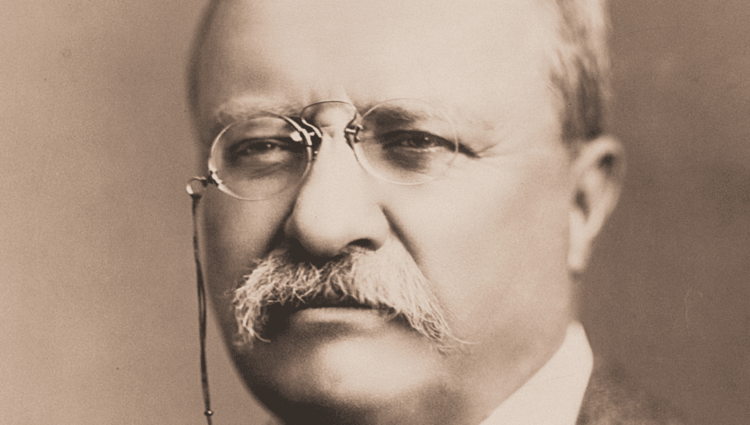
Theodore Roosevelt contributed to creating what amounts to a fourth branch of government that now works against presidential power—or at least it works against the presidential power of one of our two major parties.
 Theodore Roosevelt could be turning over in his grave. And maybe Woodrow Wilson is spinning right along with him. Why? Well, the progressive vision of government-by-expert has taken a major hit in recent days. Someone like Anthony Fauci wasn’t exactly what either of them had had in mind. Or was it?
And just what was it that those presidents claimed to have had in mind? Disinterested expertise. That would be disinterested as in neutral, rather than disinterested as in uninterested. Agencies as advice-givers and agencies as umpires was the idea. And that was that, as far as they were concerned. Or was it?
The Constitution of 1787 might have been a great starting point—at least for TR. Maybe not so for Wilson. Possible differences aside, both of them thought that life in the early twentieth century had already grown too complicated for mere elected officials to handle. Divided government might not yet be a thing of the past, but a modern American government surely needed help when it came to steering the country in a progressive direction. Why not then turn to experts? Congressmen and presidents couldn’t–and shouldn’t–managing things alone. After all, the drafting, debating, passing and signing of legislation somehow ought to be beyond the grubby business of politics.
Therefore, they thought it was high time that the original Constitution of the late eighteenth century give way to a “living constitution” for the twentieth century and beyond. That certainly was Wilson’s preferred term. Of course, it wouldn’t be necessary to bother with a series of constitutional amendments to achieve this. Such would be a lengthy process at best. Besides, that very clumsy process was little more than an eighteenth-century relic.
Yes, they did bother to secure a constitutional amendment to bring about the direct election of senators, rather than their appointment by state legislatures. But that was it. And at least they were willing to retain the senate, as opposed to some current progressive calls for its elimination.
In other words, the original progressives were generally content to keep the Constitution and simply work around it when necessary. Speaker of the House Joe Cannon put it this way: “Roosevelt had no more use for the Constitution than a tomcat had for a marriage license.” The president himself once said—and for public consumption—“to hell with the Constitution.” Why? He had deployed the military to keep coal mines open in the middle of a labor strike, because “the people need coal.”
Wilson was less profane when it came to his utterances on the Constitution, but he was no less willing to do end-runs around it when he thought it was necessary. In fact, there is plenty of evidence that he presumed that government could become a much more efficient government, courtesy of administrative expertise. In any case, to one degree or another both Roosevelt and Wilson were determined to build an extra-constitutional federal bureaucracy—and to do so in the name of aiding, rather than replacing or circumventing, representative government.
It’s also important to keep in mind that the progressive movement was a bipartisan affair—and not simply because Roosevelt was a Republican and Wilson was a Democrat. Each major party had a progressive wing and a conservative wing. And certainly the progressive wings of neither party anticipated that the federal bureaucracy would essentially become a powerful arm of one party rather than the other. Remember their goal: creating permanent professional cadres of neutral experts.
Both presidents promoted the creation of regulatory agencies that remain important today, agencies that paved the way for the creation and staffing of many more such federal institutions over the course of the century since then. The Food and Drug Administration (under Roosevelt) and the Federal Trade Commission (under Wilson) are prime examples.
The number, power, and reach of these agencies has grown exponentially since the original progressives began to legislate them into existence long ago. The result is what some call the “deep state” and others call the “administrative state” today. More than that, the Supreme Court, via what has been called the Chevron doctrine, has endorsed deference to the opinion of federal bureaucrats when ruling on the constitutionality of this or that piece of legislation or bureaucratic interpretation of that legislation.
To be sure, in recent years the Court has begun to chip away at that deference, but this contest between elected and unelected officials is far from over. Maybe the recent non-testimony of Anthony Fauci, coupled with what we now know about the thoughts and knowledge of Dr. Fauci during what might be termed the COVID era, will contribute to ending that deference. It certainly should.
Did Roosevelt and/or Wilson anticipate a Dr. Fauci? Probably not, although Wilson as college professor and later as wartime president was quite taken with the possibilities of government-by-expert.
Did they ever anticipate that a disinterested federal bureaucracy would essentially become an arm/ally of one party rather than the other. Surely not. But that is precisely what has gradually happened over the course of better than a century since their terms in the White House.
Nor did they anticipate that members of that bureaucracy would be less than truthful with either elected officials or the American people. And yet we now know that was very much the case with Anthony Fauci. It’s now quite apparent that the private Fauci knew the truth about COVID, while the public Fauci hid the truth. And this is not just the case with the question of the origins of the COVID virus, but with its spread, effect, and impact as well.
For that matter, neither Roosevelt nor Wilson anticipated that the federal bureaucracy would, in effect, become an interest group all its own. And yet that is also what has happened over the many years since the original progressive era was dominant.
Does anyone doubt that Fauci has interests of his own? Along the same lines, does anyone doubt that he is the tip of a very large iceberg. It’s hard, nay impossible, to conclude otherwise.
According to the original progressives, the job of disinterested professional experts was to provide disinterested professional advice to elected officials. That’s not what Mr. Fauci provided to President Trump in 2020. Thanks to the Fauci diary, we now know that. Diary? Not really. These were entries on a government computer. As such, they deserved a public airing.
And thanks to Anthony Fauci himself, we also know that the federal bureaucracy does not function as it was intended to function—or at least as it was advertised to function. Surprise, surprise. Rather than serving as an independent source of authoritative information, the bureaucracy has goals and interests all its own.
More specifically, it has goals and interests that often seem to coincide with the goals and interests of one political party rather than the other. This much should now be obvious as well. What we do about all of this remains very much up in the air. But something serious and something different must be done about the handiwork of Roosevelt and Wilson and their progressive allies.
Ironically, two powerful progressive-era presidents contributed to creating what amounts to a fourth branch of government that now works against presidential power—or at least it works against the presidential power of one of our two major parties. Wilson might not object to this, but Roosevelt surely would.
__________
John C. “Chuck” Chalberg taught at Normandale Community College and writes from Bloomington. For years he performed in Minnesota and elsewhere as Theodore Roosevelt.
The Imaginative Conservative applies the principle of appreciation to the discussion of culture and politics—we approach dialogue with magnanimity rather than with mere civility. Will you help us remain a refreshing oasis in the increasingly contentious arena of modern discourse? Please consider donating now.
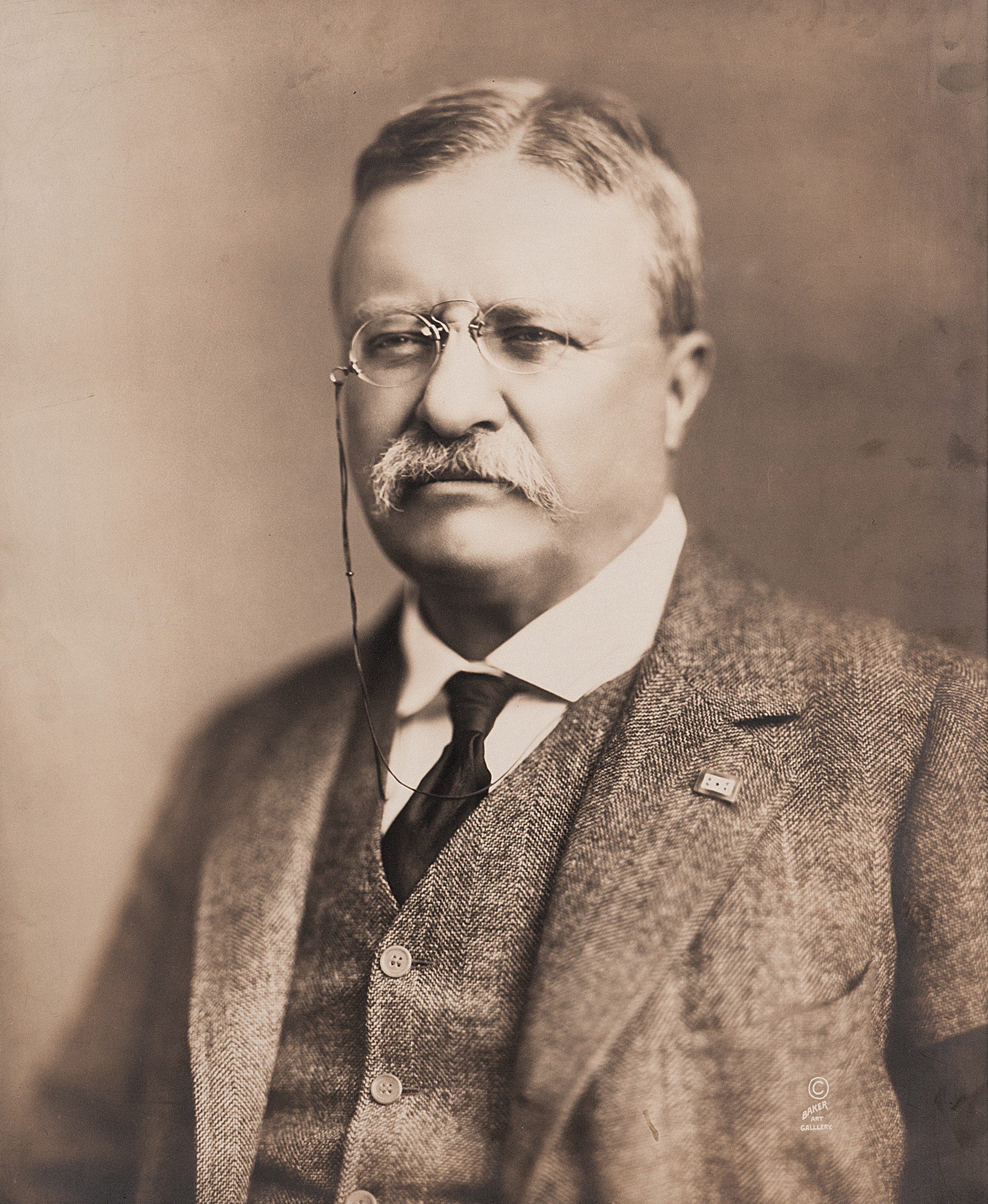
The featured image is “Silver gelatin photograph of Theodore Roosevelt” (1918), and is in the public domain, courtesy of Wikimedia Commons.