AS TCW draws to a close, we repeating a few articles by Alan and Margaret Ashworth. This is a double bill, with the first article published on March 17, 2020.
READING in yesterday’s Times that Lord Glendonbrook, the former owner of the airline BMI, is to fund Gilbert & Sullivan productions around the country gladdened my heart.
The G & S operettas were wildly popular in Victorian days but are now regarded by the snobbish elite as vulgar and low-brow. Millions of pounds is thrown at opera, which attracts a tiny and well-heeled audience (I bet most of them are bored, too) but trying to get Arts Council funding for a run of The Gondoliers is harder than flying to the moon.
Lord Glendonbrook said: ‘Gilbert & Sullivan are part of our national musical heritage.’
Well said! It all took me back to my time at grammar school in the 1960s. In those days the summer term didn’t end in May before you took your O-levels and A-levels, it ran on until the middle of July with the whole school in attendance. The period after the public exams ended in June was given over to all sorts of activities, such as counting books, sport, and for those in the Senior Choir, aged 16 to 18, the annual G & S. Many more girls were roped in for backstage jobs. And if you haven’t been to a girls’ school production of G & S, you haven’t lived.
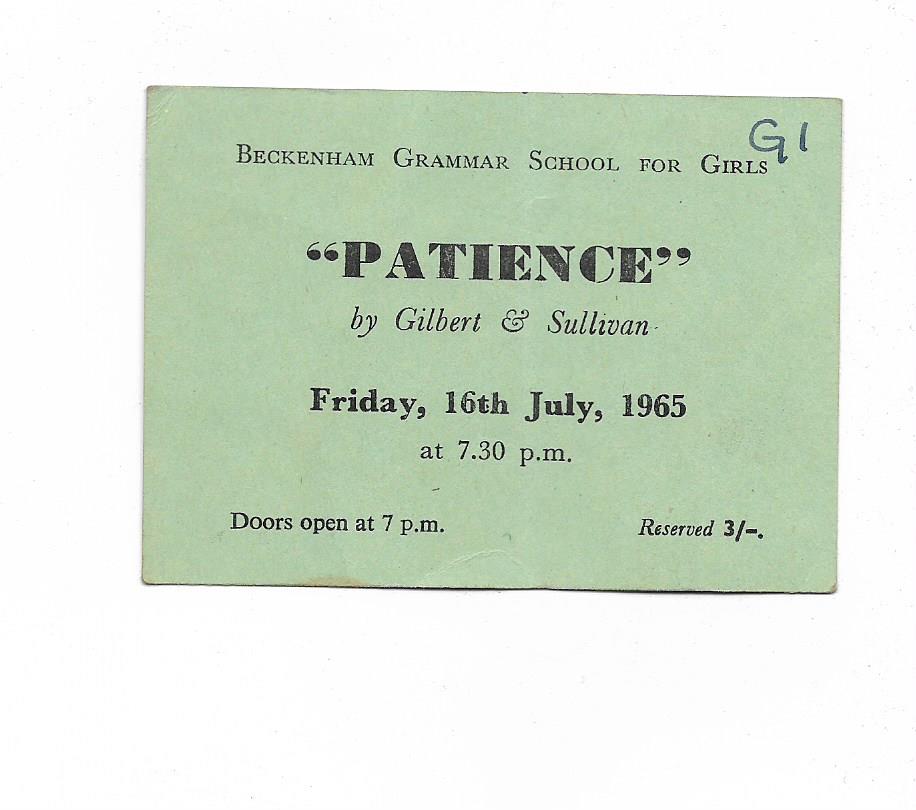
In 1965, when I was in the fifth form, we did Patience, which has remained my favourite.
Looking back I don’t know how we did it in the time. Work started only after the exams ended. Then there was scenery to build and paint, costumes to make and fit, the music and dialogue to be learned and rehearsed (an orchestra was put together for the occasion comprising pupils, staff, parents and friends).
The leading roles were taken by the sixth-form girls, and there were some great talents among them, both in singing and acting. The fifth-formers were the chorus, divided into Officers of the Dragoon Guards and Rapturous Maidens on the basis of height. I was tall enough to be a Dragoon.
Here are the Dragoons (I couldn’t remember which one was me, but my 16-year-old self had the surprising foresight to write the names on the back, and I am seventh from the left):
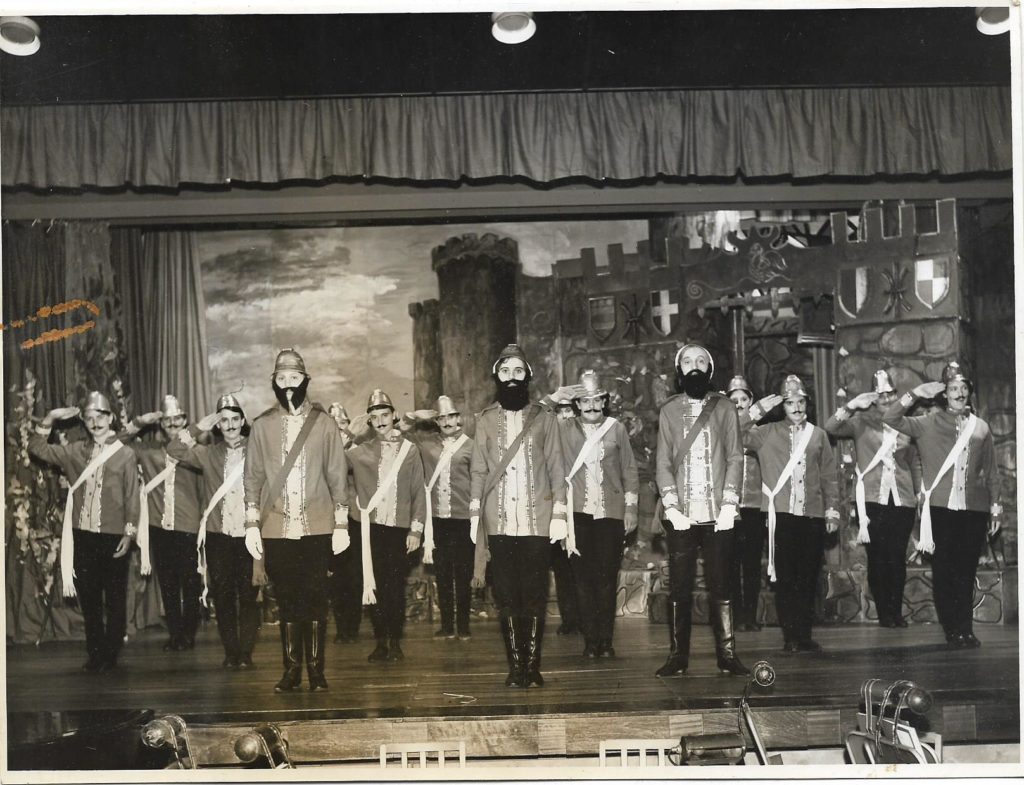
Rehearsals went on all day every day for soloists and chorus, with piano accompaniment, while the scenery and costumes were made by girls who were not in the choir. I see from the programme that there were about three dozen performers, which is a lot of costumes to whip up in a few weeks. The Dragoons were relatively simple, a red jacket with gold braid and a sash, but the maidens’ dresses and principals’ outfits were quite elaborate. Some girls learned how to do stage make-up.
We did not sing with the orchestra until the dress rehearsal. It was a thrill to have the full sound. I don’t suppose it was perfect, but it sounded great to me. This is a picture from the dress rehearsal of the end of Act One:
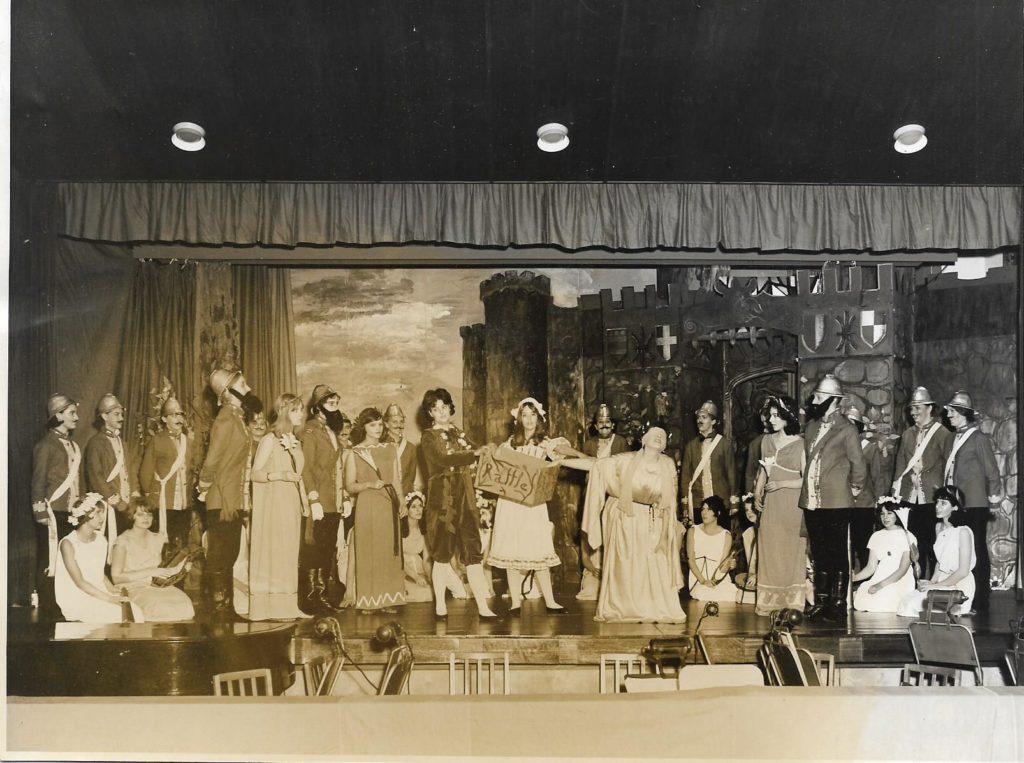
Then it was the first night. The school gym was close to the stage in the hall, so that was turned into a vast dressing room, where we all changed and had our make-up put on (and beards, in the case of the Dragoons). The maidens were in the first scene so they were on stage behind the curtain as the orchestra tuned up then went into the overture. In the gym we Dragoons were silent, waiting for our cue to hurtle up the stairs and into the wings.
I am the least eager person to perform in public you will ever find, but being in a chorus was the greatest fun imaginable. The show raced along and it seemed we were taking the curtain call after only five minutes. The buzz afterwards was like nothing else – I could not sleep for excitement.
There were another two performances (all sold out as I remember) then it was all over. A day was spent taking everything to pieces and putting away costumes that could be saved for another production.
Here is a review from one of the two local papers (no quarter given for being schoolgirls):
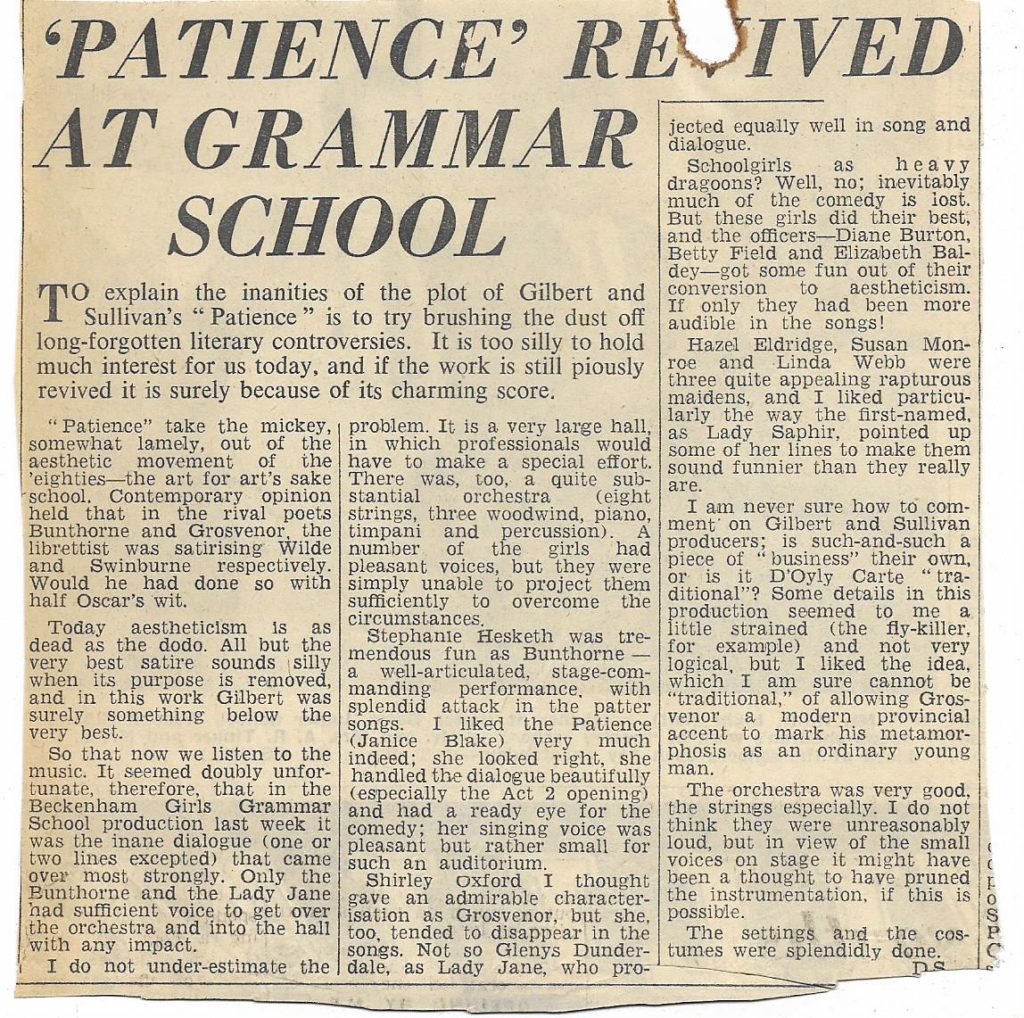
The staff involved must have been ultra-dedicated, but I think they enjoyed it too. I often wonder if today’s teenagers, surgically attached as they seem to be to their screens, will have a store of memories like ours to look back on nearly 50 years later.
***
This article was first published a few days later on March 22, 2020.
ON Tuesday I wrote about the sheer joy of taking part in a school production of Gilbert and Sullivan, and this made me think of a couple of Sullivan’s serious compositions.
He wrote the part-song The Long Day Closes in 1868, three years before he met Gilbert, and it became one of his most popular works. The lyrics were by Henry Fothergill Chorley (1808-1872), a prolific art, music and literary critic and rather unsuccessful opera librettist and novelist.
These are the words:
No star is o’er the lake
Its pale watch keeping,
The moon is half awake,
Through grey mist creeping,
The last red leaves fall round
The porch of roses,
The clock hath ceased to sound,
The long day closes.
Sit by the silent hearth
In calm endeavour,
To count the sounds of mirth,
Now dumb for ever.
Heed not how hope believes
And fate disposes:
Shadow is round the eaves,
The long day closes.
The lighted windows dim
Are fading slowly.
The fire that was so trim
Now quivers lowly.
Go to the dreamless bed
Where grief reposes;
Thy book of toil is read,
The long day closes.
It used frequently to be sung at funerals of members of the D’Oyly Carte Opera Company, which produced the G & S operettas.
There are dozens of performances on YouTube, and I think this rehearsal by Tenebrae is one of the best. It was recorded in the church of St John the Evangelist, Upper Norwood in south London, which has such sublime acoustics that it is used by many choirs for recordings. You can read about the church here – unfortunately like many buildings on London clay it is suffering from subsidence.
I am a sucker for brass bands so here is an arrangement by the prolific composer Eric Ball (1903-1989), whom you can read about here, played by the Northern College of Music Brass Band.
It was orchestrated by Carl Davis for the great Mike Leigh film Topsy Turvy (1999)about Gilbert and Sullivan.
The other piece I would like to highlight is Yea, Though I Walk, from the oratorio The Light of the World. Sullivan wrote it in 1873, after his first collaboration with Gilbert (the opera Thespis, first performed on December 29, 1871, but now mostly lost) but before their second (Trial by Jury, 1875). The Light of the World was first performed at the Birmingham Festival on 27 August 1873.
Sullivan wrote the libretto, based on the New Testament, with the help of the music scholar George Grove. It follows the whole life of Christ, told mostly in the first person. It was an ambitious idea, given the inevitable comparisons with Handel’s Messiah and other great works. The Standard commented: ‘Considering the difficulties of precedent with which Mr Sullivan had to deal, in Handel’s Messiah and Bach’s Passion music, not to mention Mendelssohn’s unfinished Christus, he may be said to have entered the lists against an array of giants. To say that in the face of these he has held his own ground, if he has not encroached on theirs, is to bestow praise of the highest significance.’
The Light of the World was widely performed during Sullivan’s lifetime, but seldom since then.
These are the words of Yea, Though I Walk:
Yea, though I walk through the valley of the shadow of Death,
I will fear no evil,
for Thou art with me,
Yea, though I walk through the valley of the shadow of Death,
I will fear no evil,
for Thou art with me,
Thy rod and thy staff comfort me,
thy rod and staff comfort me.
Yea, though I walk through the valley of the shadow of Death,
I will fear no evil,
for Thou art with me,
Yea, though I walk through the valley of the shadow of Death,
I will fear no evil,
for Thou art with me,
for Thou art with me,
art with me.
It was written as an unaccompanied quartet but I can’t find a recording on YouTube. This one is by the choir of Keble College, Cambridge.
And here is a lovely vintage recording from 98 years ago.