
WHILE politicians and media keep telling us we are ‘losing the race’ to Net Zero, the rest of the world has not even got off the starting blocks!
The latest Review of World Energy from the Energy Institute (formerly the BP Energy Review) confirms that emissions rose yet again last year.
These are the key points:
- CO2 emissions rose 0.8 per cent year-on-year and now stand 10 per cent higher than when the Paris Agreement was signed in 2015;
- Wind and solar power supplied just 3 per cent of the world’s energy last year and only 5 per cent in China;
- Fossil fuel consumption rose by 0.8 per cent in 2025 and now provides 86 per cent of the world’s energy;
- In China, wind and solar output rose by 1.6 exajoules, but fossil fuel consumption also increased by 1.4 exajoules;
- Non-OECD countries now account for more than two-thirds of CO2 emissions, making whatever the West does irrelevant.
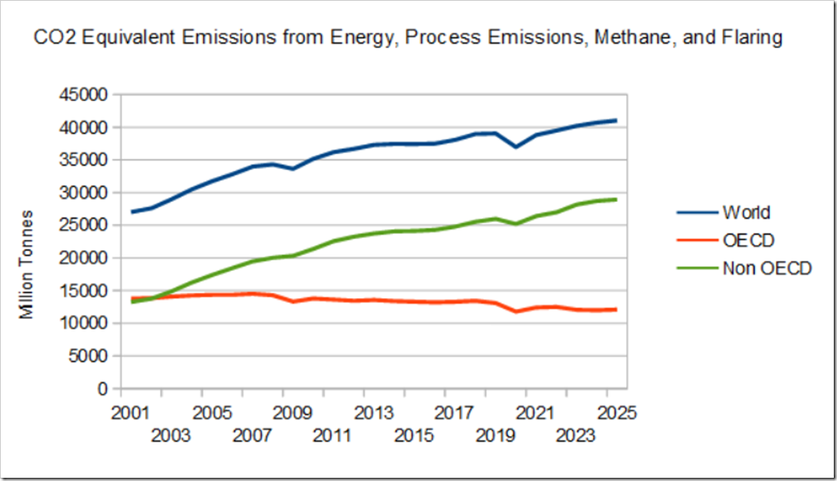
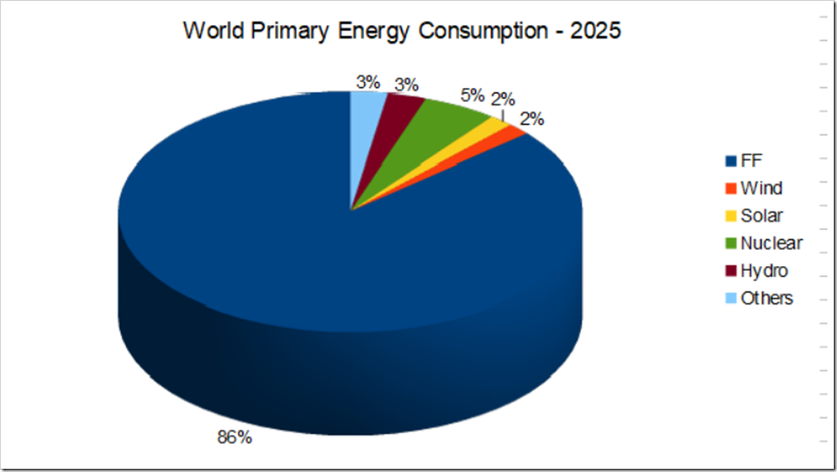
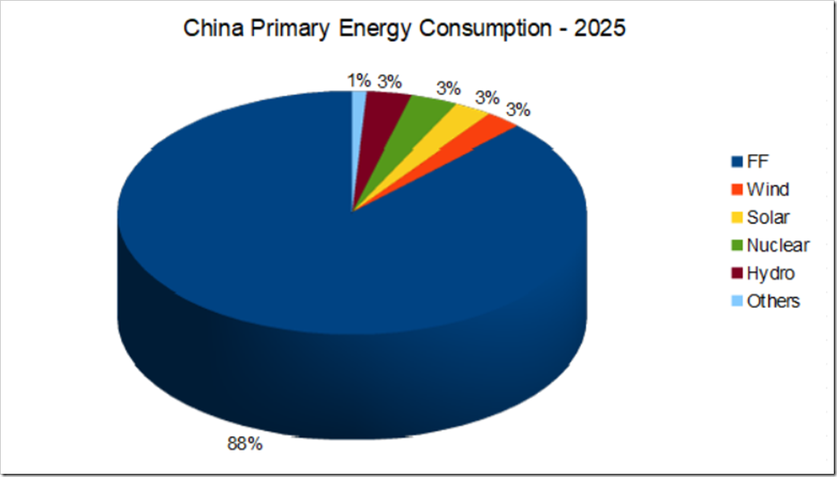
It’s the same story year after year. I might as well use the same template!
The graph below sums the whole thing up:
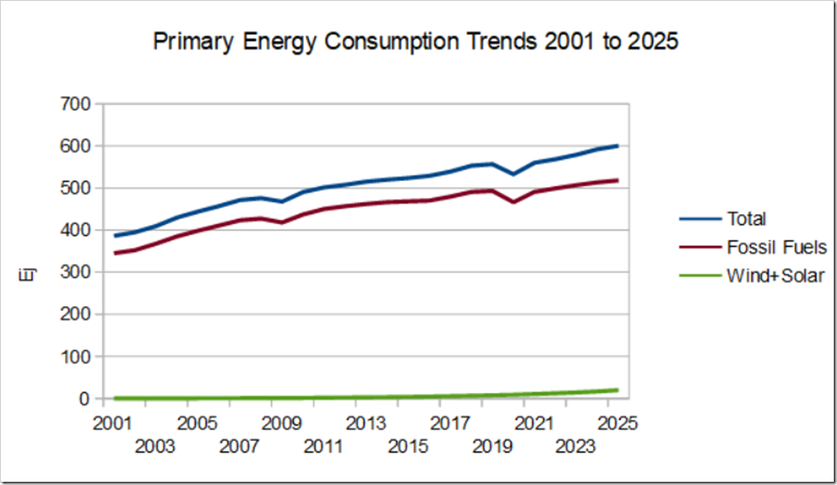
The increase in renewables each year is not enough to meet increasing energy demand, never mind eat into the share of oil, coal and gas consumed.
And there is a very good reason for this. Despite the delusion of the West, the rest of the world knows that you cannot run modern economies on intermittent renewable energy.
The Energy Institute Review is here. https://www.energyinst.org/statistical-review
UK emissions have barely fallen at all
THE bill for cutting UK emissions of greenhouse gases (GHGs) already stands at well over £100billion, but what difference has it actually made?
The Government have published the latest annual assessment of the UK’s carbon footprint, and the findings suggest that the money spent to date has had little effect. They have measured what are known as Consumption Based Emissions, which include emissions embedded in imported goods and services, minus of course those embedded in UK exports.
The figures we normally see are based around territorial emissions, those physically produced within the UK’s border. These say that we have cut GHGs by 55 per cent since 1990. It is these territorial emissions that are targeted in Carbon Budgets. And it is these that must be eliminated by 2050 by law to achieve Net Zero.
But the new figures show that our real emissions have really fallen by only 15 per cent between 1996 and 2023. All that has happened is that we have offshored our emissions, especially to China. According to DEFRA: ‘Consumption-based GHG emissions associated with imports from China have increased substantially over time, and especially since China joined the World Trade Organisation in 2001. These emissions now represent both the largest in terms of absolute tonnages from a single source region in 2023 and the largest percentage increase since 1996. In 2023, emissions embedded in goods and services imported from China were 93 MtCO2e, more than four times as high as in 1996. This means that in 2023, China accounted for 25 per cent of the UK’s import-related emissions, up from 8 per cent in 1996. These emissions now account for 13 per cent of the UK’s total carbon footprint, up from only 2 per cent in 1996.’
The figures show the full impact of imports, which account for about a half of total emissions. Since 1996, household heating and vehicle emissions have barely changed:
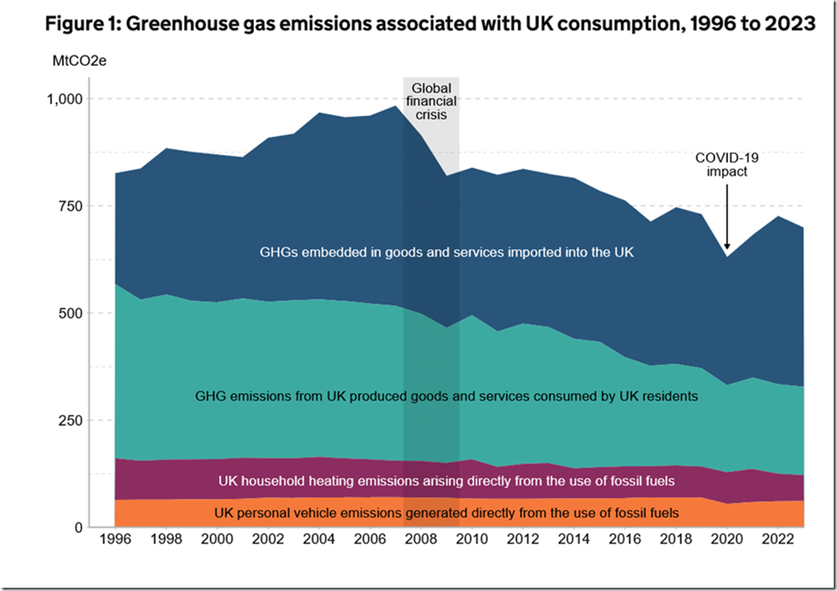
Arguably much of the reduction in consumption-based emissions came as a result of the 2008 crash, rather than climate policy. Since 2009 imported emissions have risen slightly.
What these latest figures show is that Net Zero is a mirage. No matter how many wind farms we build, we will never eliminate all emissions.
The only way it can be achieved is by a drastic reduction in consumption and a ban on all imports which cannot be certified as zero carbon – an impossibility.
Given all of this, why on earth are we proposing to spend hundreds of billions on an impossible dream?