
TWO new studies have shown just how far down the gutter climate science has gone.
1) Marine food webs under threat from climate change
A press release from the Plymouth Marine Laboratory is headlined: ‘Detected from space: 20 years of data shows declining photosynthesis in UK and surrounding waters.’
It reads: ‘A new study by scientists at Plymouth Marine Laboratory (PML) has revealed a significant long-term decline in ocean productivity across large parts of the north-east Atlantic. This raises concerns about the future health of marine food webs, fisheries and the ocean’s ability to absorb and sequester carbon dioxide.
‘Using more than two decades of satellite observations, researchers analysed changes in microalgae net primary production – the process by which microscopic marine plants convert sunlight and carbon dioxide into organic matter, which forms the foundation of marine ecosystems.
‘The study, led by PML’s Dr Gavin Tilstone and Dr Peter Land, examined satellite data spanning 1997 to 2018 and found that, after a brief period of increasing productivity in the late 1990s and early 2000s, primary production declined steadily across much of the region, particularly in north-west European coastal waters, the Irish Sea, North Sea, western English Channel and parts of the Norwegian Sea.
Like so many other climate studies, this one takes a microscopically short period of data, 21 years, and pretends that trends during that time have any significance whatsoever. As scientific experts in the Atlantic climate have long known, ocean temperatures and currents there regularly undergo massive climatic shifts. During the last century alone, the North Atlantic has swung from cold to warm, warm to cold, and back again to the warmer climate we have enjoyed for the last three decades.
It is not coincidental that the Atlantic Multidecadal Oscillation switched to warm phase in the mid-1990s just when this latest study began its analysis.
The graph below is key to the study’s findings that plankton production is declining:
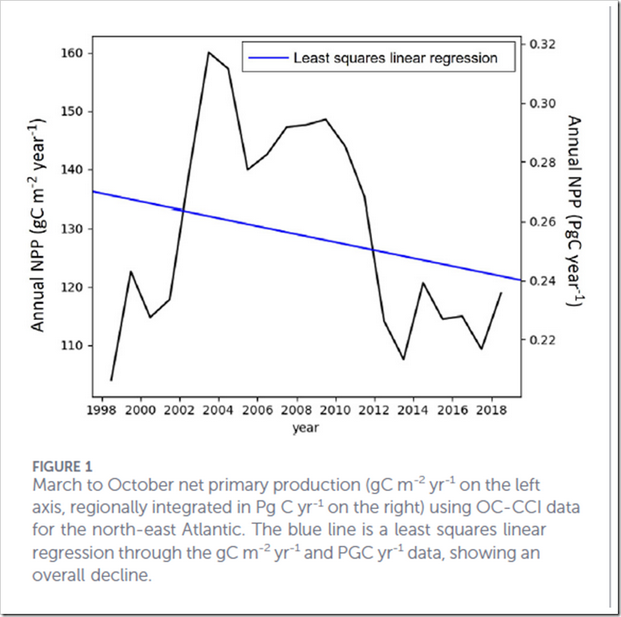
But, hey! What we see is a huge increase in Net Primary Production, NPP, between 1998 and 2003, followed by a drop back to its levels in the first few years of the analysis. Most of the increase in fact took place in just one year. Moreover, since 2012, NPP has been stable; this fact alone should nullify the authors’ claims that rising sea temperatures are reducing phytoplankton production.
The slope trend line is spurious and meaningless; over the period as a whole, there has been no decrease. The downward trend is simply a product of the timing of that spike – if it had occurred in 2013, instead of 2003, the trend would be up, not down.
There is no mention in any of this either of the accuracy or otherwise of the satellite data fed into their models. Tucked away in the main body of the paper though is the admission that: ‘These studies show that when the NPP model is applied to SeaWiFS and MODIS-Aqua the differences over these regions are between 15 per cent and 35 per cent.’
In other words, the error margins are massive and make any conclusions virtually worthless.
2) Millions of homes at risk from climate change!
Millions of homes are at risk from climate-related subsidence, according to an analysis by the British Geological Survey (BGS).
The Guardian reports: ‘As hotter, drier summers driven by global heating become more frequent, the ground under houses can shrink and drag down a property’s foundations. The most vulnerable areas include London, Essex, Kent and a tranche of land from Oxford up to the Wash on England’s east coast, according to scientists, who say mitigation measures will be needed.
‘Anna Harrison, a scientist at the BGS, said: “By combining geotechnical information about volume change potential with data about projected rainfall and temperature scenarios for the coming century, we have been able to identify the areas of Great Britain most likely to become susceptible to shrink-swell subsidence.”
‘In 2025, the UK experienced the warmest spring on record and the driest in more than 50 years. There were £153million of subsidence-related insurance claims in the first six months of the same year. With climate crisis projections indicating that hotter, drier conditions are likely to become increasingly frequent over the coming century, the number of properties susceptible to subsidence-related shrink-swell is on the rise.
‘Harrison said: “Dry weather and high temperatures are a major factor in the emergence of shrink-swell subsidence. Looking ahead, these increases in hotter, drier summers are projected to continue.”’
I am not quite sure why they are mentioning one dry spring last year. Extremely dry springs used to be much more common:
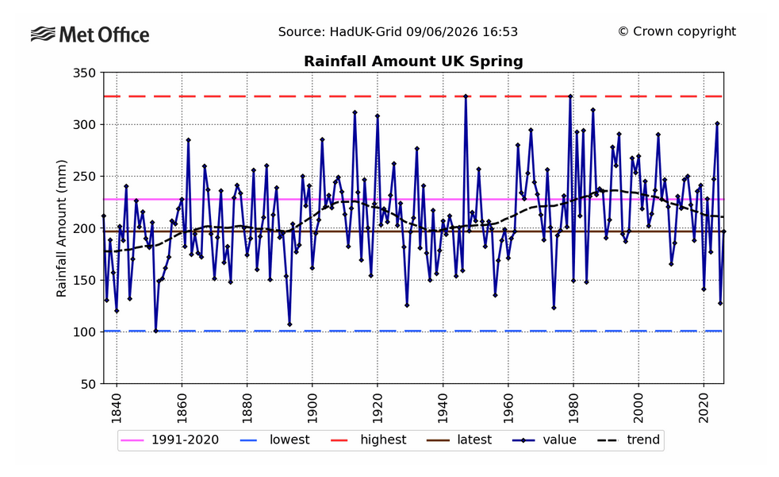
Read the Guardian excerpt again. It is all about what might happen in future. There is no attempt to analyse existing trends and no evidence provided to suggest subsidence is getting worse. Subsidence, of course, is a problem that has long existed in areas such as the Tertiary London Clay formation. It is made worse by the weight of buildings above and water extraction, which you might have imagined would be the focus of the BGS study.
It will come as no surprise that the BGS calculations have all been based around the Met Office’s UKCP18 climate projections, which have now been well and truly discredited. UKCP18 was built around the most extreme of emissions scenarios, RCP8.5, which has now been formally abandoned by the IPCC as ‘implausible’. Still, however, the Met Office refuses to withdraw its projections, which are a central plank of its effort to push its Net Zero agenda.
According to the BGS, more than 4.2million homes could be affected by clay shrink/swell by 2070. But, as it admits, this figure is based on RCP8.5. It also predicts 1.8million homes at risk under the medium emissions scenario, RCP4.5, which is barely more credible.
Back in the real world, summers are not getting drier in London and the South East. Indeed, the last really dry summer was in 1995:
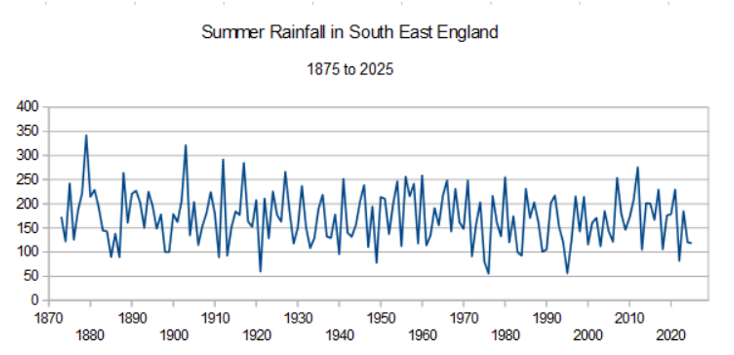
If a PhD student presented this study, he would be told to go back to the drawing board.
We are unfortunately used to seeing the Met Office prostitute themselves on the altar of Net Zero. It is, however, sad to see the highly regarded British Geological Survey now apparently following suit.