
THE Government has signed up to a legal target to cut the UK’s greenhouse gas emissions by 87 per cent by 2040, Ed Miliband has announced.
The rather bland press release from the Department for Energy Security and Net Zero (DESNZ) states: ‘Families and businesses across the UK will continue to reap the benefits of the clean energy transition, as the Government sets a new emissions target to further protect family finances, grow the economy and tackle the climate crisis.
‘As Britain faces its second fossil fuel price shock in five years due to the war in Iran, the Government is pursuing policies which deliver tangible improvements to the lives of working people – centred on getting Britain off the roller-coaster of fossil fuel markets and on to clean home-grown power.
‘Today (Tuesday 2 June) the Government has set out its proposed level for the seventh Carbon Budget, which sets a science-led target of ~87 per cent emissions reduction in the period 2038 to 2042 – endorsed by the Environmental Audit Committee and the Climate Change Committee.
‘It comes as an independent report from the Energy and Climate Intelligence Unit, supported by analysis from the Confederation of British Industries Economics, today shows that the net zero economy supports over one million jobs in the UK, adding £105billion in gross value added (GVA) to the UK economy in 2025 alone, as it continues to thrive as one of the UK’s fastest-growing economic sectors.
‘The new target is based on evidence-based assumptions about how the country will take a consumer choice-led approach to the adoption of technologies such as solar, batteries and EVs that will cut bills for families.’
It all sounds bureaucratic and, of course, it’s all for our own good. The reality, though, is that the plan, which needs parliamentary approval, will change our lives radically and for the worse. DESNZ’s talk about ‘consumer choice-led’ is sheer hypocrisy and is the opposite of the truth.
The cut of 87 per cent is measured from 1990 levels, but in practical terms it means a reduction of 74 per cent from current emissions.
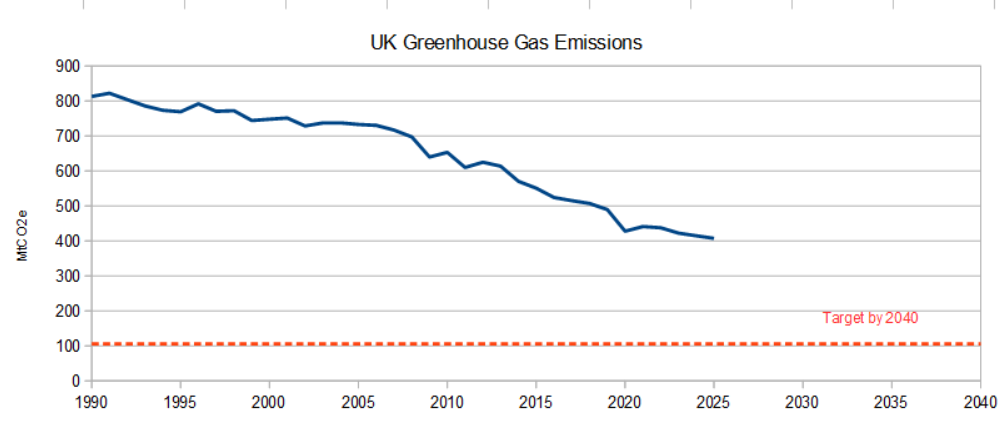
So how will this enormous reduction be made?
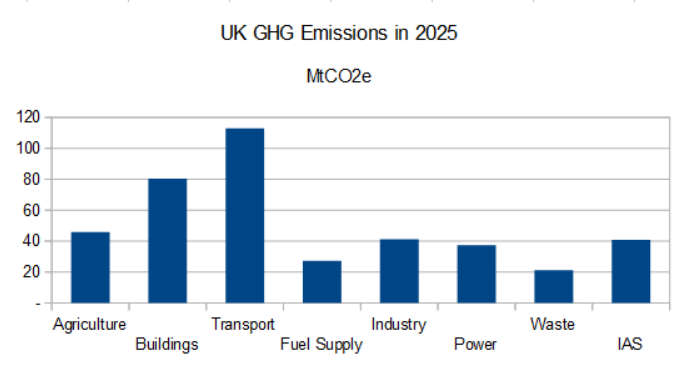
(IAS = international aviation and shipping). Electricity supply accounts for less than a tenth of UK emissions, so Miliband’s ambition to decarbonise the power grid won’t make much difference overall. Bear in mind, as well, that it will cost £20billion a year to achieve this.
The largest sector is domestic transport, running at 113 MtCO2e (million tonnes of carbon dioxide equivalent) a year. Even with the rollout of electric cars, the most that can realistically be saved is about two-thirds of this figure because HGVs are more difficult to electrify and millions of older petrol/diesel cars will still be on the road well after 2040.
So, the power and transport sectors give potential savings of about 100 MtCO2e, but Miliband’s plan demands a total cut of 300 MtCO2e by 2040.
The only other obvious potential saving is residential heating, which accounts for about 50 MtCO2e a year. But given the 20-year life of a typical gas boiler, they would need to be banned now in order to have any real impact by 2040.
Other sectors will be much harder to decarbonise. Large emission cuts would, for instance, devastate the agricultural industry, including the abolition of most of our dairy sector. Arable farming will not escape lightly either, as it is highly dependent on mechanisation and fertilisers.
Emission cuts for industry will inevitably mean loss of jobs and factory closures. Firms simply do not have the money to replace efficient, cheap fossil fuel-powered processes with electrified ones. It needs to be remembered that electricity costs four times as much as natural gas.
We have little say in what happens with international shipping and aviation. Any cuts will therefore have to be achieved by shrinking air travel and restrictions on imports.
It is often pointed out that we have already halved emissions since 1990, with the implication that decarbonisation is an easy task. But this ignores two things.
Emission cuts so far have targeted the low-hanging fruit. Most of the saving has occurred in the power sector, largely as a result of the closure of coal power stations that used to supply half the country’s electricity.
Emissions from industry have plummeted by three quarters since 1990. But this apparent saving disappears when consumption-based emissions are calculated.
This second point is especially important. Consumption-based emissions, which take into account emissions associated with imported goods as well as UK-made goods, have fallen by only 27 per cent since 1990, compared with the official figure of 50 per cent. Emissions have not fallen because industry is more energy efficient but because factories have shut.

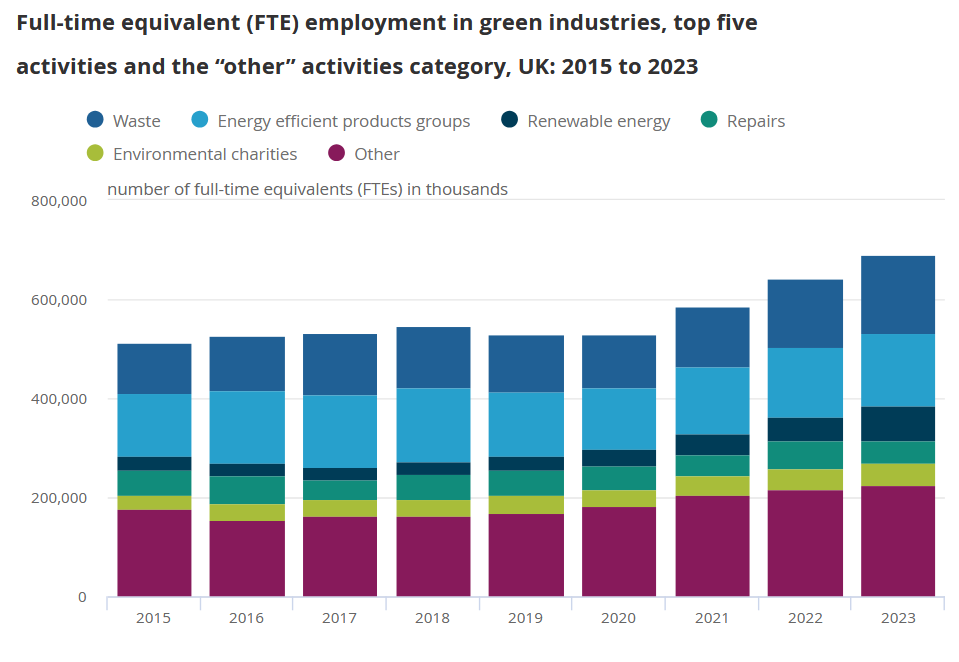
The Government attempts to sell this economy-destroying proposal with the promise of thousands of ‘good jobs’, claiming that the Net Zero economy supports more than one million jobs in the UK.
It’s the same lie they wheel out every year. But the Office for National Statistics showed last year that most ‘green jobs’ are already long-existing jobs, which have absolutely nothing to do with Net Zero – waste, energy efficiency, forestry, water and so on, or re-badged jobs, such switching from the petrol car assembly line to the electric car.
Thousands of new jobs have been created in the green blob – environmental consultants, charities, lawyers, finance, education and governmental. But the true number of new green jobs, ie those which actually add value, has been vanishingly small.
Far from ‘continuing to reap the benefits of the clean energy transition’, as DESNZ claim, we all face a poorer, colder future as a result of this plan.