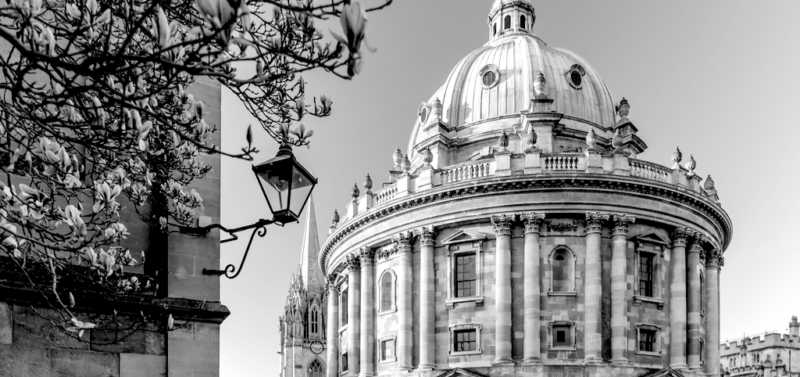
I STAND to begin my lecture before an audience of academics and students at an Oxford University college. The college has no idea that I am that evening’s lecturer, nor what the lecture is about. It is on my concept of ‘Woke Eugenics’. This is the idea that wokeness is a selection event wherein everybody except the genetically religious and conservative (both markers of genetic health) are drawn into not passing on their genes. The lecture is happening in secret and has been organised by a secret university society of the intellectually curious who want to know the truth; not simply the woke-curated ideas that are permitted in mainstream academia.
Oxford University is far from the only university with such a society and, a few days later, I give the same lecture at a university in the north of England. In the last 30 years or so, something fascinating has happened to academia in the UK and beyond. There is now ‘mainstream academia’, in which ideas which challenge woke dogmas either cannot be discussed or are very dangerous to discuss, and there is a kind of ‘para-academia’ centred around scholars who have been ‘cancelled’ by the mainstream or who have never even been part of it beyond their doctorates. The latter flourishes online, in the form of YouTube channels and substacks. In particular, in its anti-woke stance, it focuses on the strongly taboo issues of human biological differences, the genetics of psychological traits (they’re all partly genetic), and dysgenics: how we are becoming less intelligent and less healthy due to breeding patterns.
This academic split has happened before, of course. Until 1870, you had to be a committed member of the Church of England to study or work at the English universities. In many ways, these religious dogmas were the ‘woke’ of their time, with actual ‘science’ being frowned upon and excluded. Now, the universities don’t exclude science, but they do exclude looking at the full consequences of our being an advanced form of ape. It is blasphemy to assert, for example, that race differences might extend to the brain or even that there are sub-species within humans.
The result, in the 18th and 19th centuries, was that the really daring and ground-breaking research took place outside of the English universities: gentleman scholars such as Charles Darwin; enthusiastic amateurs such as the Aberdeenshire shoemaker and mollusc expert Thomas Edward; then there were the dissenting academies wherein the educational standards were considered superior to those of the English universities. Some Anglicans sent their sons to them for that reason, with oxygen being famously discovered at Warrington Academy. Other clever English students went to the Scottish universities (specifically Edinburgh, Glasgow and Aberdeen), or to those in the Netherlands (higher education still being in Latin), as these explored science and weren’t so bound by religious dogma. Eighteenth century British Prime Minister the Earl of Bute was exclusively educated at Dutch universities. Now, Eastern European universities are more receptive to non-woke academics.
As I argue in my book The Past is a Future Country: The Coming Conservative Demographic Revolution, universities seem to go through a ‘priestly cycle’. The universities are founded by genius-types who are highly intelligent and autistic and relatively anti-social, meaning they are obsessed with the truth (and discussing it) above all else. Due to genius-type innovations, universities gain prestige, meaning they attract normal intelligent people. Intelligence is associated with conformity: intelligent people comprehend the benefits of conforming and have the effortful control to force themselves to do so. They are also socially skilled. These people take over the university and turn it into a branch of the Church; of the dominant ideology. This pushes out the genius-types, the university stops doing cutting-edge research, it loses prestige and it goes into decline. It reforms, bringing the genius-types back in – from 1871 dissenting academies were absorbed into Oxbridge, religious entry requirements were dropped – and then the cycle starts all over again.
For those who are part of the Cathedral of Woke academia, people who are genuine truth-seekers must be driven out as they will show them up as the cowardly ideologues wrapped in the cloak of the science that they are. Hence, in 2018, there was a mini-moral panic when it was revealed that the London Conference on Intelligence, which looked at forbidden topics, had been meeting at University College London for years. Members of para-academia are simply frightening. Their very existence – challenging the guild’s monopoly on new knowledge – means that normal, polite scholarly engagement can be eschewed.
This happened last month with Harvard biologist David Reich and his team. In 2024, an Italian independent scientist called David Piffer looked at ancient genomes and proved that there had been genetic selection among Europeans for intelligence and pro-social traits across time. This was published in an academic journal. In April, David Reich and his team published very similar results in Nature – in a study called ‘Ancient DNA reveals pervasive directional selection across West Eurasia‘ – as though they were ground-breaking, and without acknowledging Piffer’s work at all. When Piffer complained to them, they admitted they knew about his work but decided not to cite it because they thought it was ‘methodologically inadequate’.
Piffer, it should be noted, is very much ‘para-academia’. He is part of a group of researchers, including myself, who explore forbidden topics such as race differences and dysgenics; he is not part of the academic establishment. Such is the perceived danger of people like this that I have received double-blind anonymous peer-reviews suggesting that it will damage the credibility of my study to cite their research, or telling me that I shouldn’t cite studies in Mankind Quarterly and other journals which are known not to be beholden to woke academics and which are, therefore, ‘pseudo-scientific’.
But clearly, the most original research in human biological differences is not happening in mainstream academia and it is so obviously accurate that, eventually, a team at Harvard has, in order to remain cutting-edge, published very similar research, albeit without acknowledging that it was done in para-academia first, albeit via different methodology. It is akin to an Oxford don, ordained in the Church of England, publishing his theory of Evolution by Natural Selection in 1861, and being interviewed in all the newspapers about it, without acknowledging that gentleman scholar Charles Darwin published something very similar in 1859 called On the Origin of Species. ‘Darwin’s study was methodologically inadequate,’ the Reverend Professor might later claim. Perhaps, but shouldn’t the Reverend Professor reference it if Darwin (at least overtly) did it first?
The Piffer controversy, and the secret academic societies, may well indicate that we are now in the ‘winter’ of this cycle of universities. The Church’s control is under threat, a section of students are hungry to genuinely understand the nature of the world, and they know that the ‘Guild of Science’ (as represented by mainstream academia) is actively preventing them from doing this.
English students must pay absurd tuition fees and take out loans with outrageous interest rates for a qualification from this knowledge-suppressing guild. And this qualification is increasingly worthless. It is worthless because so many people in their cohort have degrees and because woke academia teaches them not to think critically, rather than to think critically, and employers realise this. Due to the fact that the students are paying the exorbitant fees themselves, university panders to students’ prejudices, rather than challenge them, and indoctrinates them with woke, making them overgrown children focused on their own sense of grievance, and employers realise this too. Better to employ an intelligent-seeming non-graduate.
As I stood there giving my lecture to some of the brightest and the best of their cohort, I did have a sense of hope. The very fact that I was there (even in secret) and talking about the subject that I was, implies that something is shifting among the cleverer members of the younger generation.