The Dead Sea Scrolls can only be interpreted in the light of faith as an amazing gift from God at a time when faith needed strengthening and a return to its historic roots.
 Selections from the Dead Sea Scrolls are being exhibited at the Museum of the Bible in Washington, D.C., this year. Seeing the show has given me a chance to reflect on the relevance of this great archeological find to Christian faith and culture—a relevance that has only grown stronger as years of study have revealed more of the Scrolls’ secrets.
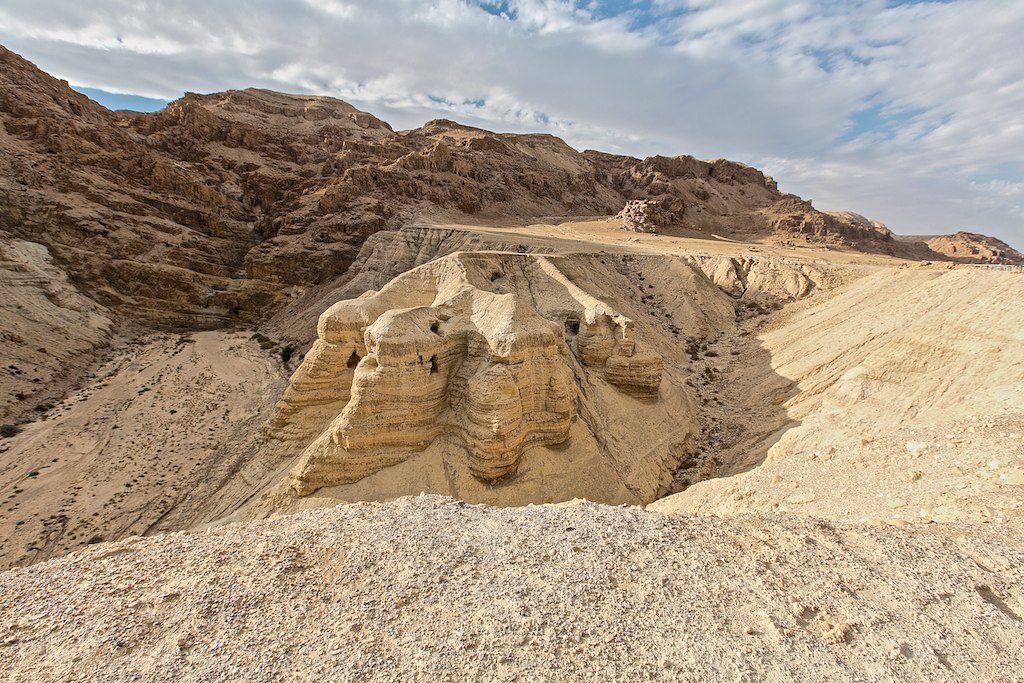
The Dead Sea Scrolls are a group of mostly Hebrew texts discovered in a cave near Qumran in the Judean wilderness in 1947. Written on papyrus, leather, and copper, the texts are believed to have been produced by members of the Essenes, a Jewish religious movement that had settled in Qumran. The Essenes were an ascetic, Messianic, and eschatologically oriented group of Jewish believers (mostly male, though female Essenes may also have existed). They believed that the arrival of the Messiah was at hand, and they separated themselves from the world and from conventional Jewish society to wait for his coming kingdom. The Essenes of Qumran had many characteristics in common with a monastic community in the later Christian tradition. They practiced celibacy and a minimum of natural comforts, spending their time in prayer, worship, and the copying of sacred texts. In fact, as we shall see, Qumran prefigures key aspects of Christian experience and civilization. These cave people existed along a continuum of religious history from Israel to the church.
The community’s literature provides insight into its beliefs and group organization. More broadly, the Scrolls provide a treasure trove of insight and information about religious life and thought in the centuries surrounding the birth of Christ. They have strengthened the ties of early Christianity to the Judaism of the time and debunked many of the cherished assumptions of skeptical scholarship.
Here is an example. In the past, scholars took it for granted that the Gospel of John was written generations after the apostles, because its “high” Christological view of Jesus could not possibly have been enunciated in the first century. But read in light of the Dead Sea Scrolls, John’s Gospel fits perfectly within a first-century context. In fact, there are strong hints suggesting ties among John the Baptist, John the Apostle, and the Qumran community. The Baptist preached just a few miles away from the Qumran caves and may himself have been raised as an Essene, as suggested by certain aspects of his lifestyle. John the Apostle appears to have been a disciple of the Baptist before he met Jesus. Some turns of phrase in John’s Gospel strongly echo language in the Dead Sea Scrolls. Liberal Bible scholars like Rudolf Bultmann argued that John’s emphasis on “light and darkness” and other mystical motifs reflected later Platonic or gnostic strains of thought, not anything from Jesus’ time. But the Scrolls contain striking parallels with these motifs, showing that they were in fact common currency in the Judaism of the day.
The connections go further. A number of puzzling details in the gospels make sense if we view them in light of the Essenes, who were present in Jerusalem as well as in the wilderness at Qumran. To take one instance, generations have puzzled over the man carrying a jar of water whom Jesus instructs Peter and John to follow in order to prepare the Passover (Luke 22:10–11). Carrying water was typically a woman’s task. And when we remember that the Essenes were an all-male community who performed menial services for each other, there is a strong possibility that the man was an Essene, and that the “upper room” he led the disciples to was an Essene guest house.
Positing an Essene connection to Passion week solves more enigmas besides, including the famous question of when the Last Supper occurred and the apparent discrepancies of timing among the gospels. (The Essenes, as it turns out, used a different liturgical calendar from the official one promulgated by the Jerusalem leaders.)
This brings us to one of the most remarkable parallels of all. As we know, Jesus’ sacred meal in the Upper Room the night before he was arrested did come not out of a void; it built upon well-established Jewish precedents, most notably the Passover meal. Before the discovery of the Dead Sea Scrolls, a lot of our information about the Essenes came from such contemporary writers as Josephus, Philo, and Pliny. Josephus seems to have spent some time among the Essenes, so he had firsthand experience of their rituals. He describes the Essenes as assembling in the evening, bathing in cold water, dressing in white garments, and sharing a meal of bread and wine accompanied by liturgical prayers and hymns. In Josephus’s description we see both hints of baptism and of the Eucharist. The meal had eschatological significance, being an anticipatory ritual of the Messianic age to come.
The literature of Qumran has strengthened this early evidence for the group’s beliefs and practices. From the Damascus Document we learn that the group was waiting for two Messiahs: a priestly Messiah, descended from Aaron, and a kingly Messiah, descended from David. Some scholars believe that the community was itself founded and led by a certain “Teacher of Righteousness” who is mentioned in some of the Qumran texts. This may have been none other than the high priest of the Jerusalem Temple, who was forced out of office in 152 BC. According to theory, the high priest fled to the wilderness at Qumran and founded the Essene community there. The “Teacher of Righteousness” may have written some of Qumran’s distinctive literature, including a group of thanksgiving psalms. If not a Messianic figure himself, he appears to have been aware of a distinctive vocation from God to announce the Messiah’s coming.
The Qumran people saw themselves as the faithful remnant of Israel, waiting for a new and permanent covenant. Severing themselves from the religious establishment of Jerusalem and its official Temple liturgy, they conducted their own worship and lived a life apart from society in anticipation of the age to come. They were nothing less than the “Temple of Adam,” a new beginning for humanity.
Jesus is presented in the gospels as someone who fits Messianic expectations (and goes beyond them). But there were many different Messianic expectations in the first century, many different criteria for what the Messiah was to be. What is surprising, when we read the gospels in the light of the Scrolls, is how Jesus’ Messianic identity is defined in terms that match the checklist of the Qumran community very closely. He is one who forgives sins and delivers people from evil spirits, thus proclaiming “the year of the Lord’s favor” that was associated with the Jubilee. Jesus takes on the mantle of both a priest and a king, thus uniting in his person the two Messiahs expected by the Qumran people and calling back to Melchizedek, the priest-king of the Old Testament.
It would be easy, given the startling parallels between the Qumran community and the early church, to suggest that the early church was no less than the heir to the Essene movement and that Jesus was himself an Essene. In fact, some commentators have gone that far. John Bergsma, a professor of theology at the Franciscan University of Steubenville and an authority on the connections between the Scrolls and Christianity, takes a much more restrained view. The parallels between Qumran and the early church are just that—parallels. Jesus’ movement was adjacent to Essenism rather than coming directly out of it. Both movements reflected broader currents in Judaism of the time. There were also serious differences between Jesus’ preaching and Essenism. The Essenes were an exclusive group, rejecting an alliance with Gentiles. Jesus, by contrast, welcomed Jew and Gentile alike. The Essenes emphasized ritual purity according to the law of Moses, while Jesus announced a new covenant no longer based on those requirements. If Josephus is to be believed, the Essenes also held a very Greek-Platonic view of the soul–body relationship that is incompatible with the New Testament.
But the main weakness of the Qumran people was their rejection of union or association with the Gentiles. This marks the decisive break between the message of the Essenes and that of Jesus. Further, the Essenes did not foresee a Messiah who would suffer, any more than Jesus’ disciples did. Nor did their thanksgiving meal include any sense that the Messiah’s own body and blood were being consumed in the bread and wine. Jesus’ actions went well beyond the Qumran community’s expectations. Yet their expectations and aspirations were fulfilled in Jesus. And as we have seen, many scholars believe it is probable that Jesus moved in Essene circles.
What Jesus brought was more than what the Qumran community believed. But it certainly was not less. There is no doubt that the people of the Dead Sea Scrolls are fellow travelers-in-waiting for God’s salvation and the Messianic age, just as we all are today.
As always, Jesus did not reject a people or group (any more than he did the Samaritans) but simply carried out his mission, fulfilling others’ deepest religious aspirations while going beyond their wildest imaginations. He did not destroy; he built up on the existing foundations. Jesus was the Messiah the Qumran people were waiting for—although he took his Messiahship in directions they did not foresee.
There remains the puzzling fact that the Essenes are nowhere mentioned by name in the New Testament, while other groups (like the Pharisees and Sadducees) are. This can be explained on the grounds that the Essenes lived in relative isolation and thus had little to do with the official religious affairs that are the main center of attention in the gospels.
The Scrolls are not inspired literature and should not be treated as such. But the Qumran community is a phenomenon that points toward the reality of Jesus and the gospel. The substantial overlap of New Testament with the Scrolls testifies to the texture of the religious life of that age. In all their imperfection, and the imperfection of the group that wrote it, the Scrolls bear witness to the truth of the New Testament.
The Dead Sea Scrolls also serve an important purpose simply as texts that have survived a very long time. The scrolls include books of the Bible as well as prophetic literature distinctive to the Qumran people. The Bible scrolls (including Isaiah, Genesis, the Psalms, and many others) are some of the oldest copies we have of any biblical literature, and the readings are extremely close to their current-day versions, showing the endurance and integrity of the biblical text across space and time. At a time when many people doubt the authority of religious teaching, the Scrolls provide a powerful witness of consistency across more than 2000 years.
The simple, communal lifestyle at Qumran parallels the descriptions of the early church in the book of Acts. And the impulse to retire from the corruption of the world and live a purer kind of life would continue to be a major theme throughout Christian history. Often such seclusion would include the preservation of the literature and wisdom of humanity through copying manuscripts, just as the Essenes did. But the Essenes’ seclusion also had an eschatological edge: they were convinced that the Messianic age was at hand, that something momentous was about to occur that would change the world forever. They were correct. And in them we find a parallel to ourselves and our own hopeful waiting at the end of the age.
Since the Scrolls’ discovery, some people have questioned whether they in any way destroy or compromise Christianity’s uniqueness. This question is raised whenever scholars find (or think they have found) some similarity between Christianity and another ancient religion. But there is no reason to fear because the Scrolls only shed light on, and do not compromise, the uniqueness of the Christian faith. This is principally because God works through the mediums of history and culture. Christianity did not come out of a void, and it stands to reason that other people and groups than the ones most familiar to us would have acted to “prepare the way of the Lord.”
We don’t hear much from the Essenes after the Roman legions destroyed Jersualem in AD 70, and this has led scholars to believe that they were wiped out in that conflict. In fact, the people of Qumran may have stashed their scrolls away as their last act, to preserve them from the coming destruction. Their foresight has enriched us in ways they could not have known.
Pope Leo XIV recently issued a letter on Christian archeology, noting that the discipline demonstrates for us how “faith is embodied in time, place, and culture.” Just as history strengthens our bonds with past generations, Christian archeology helps connect us with our ancestors in faith. As the pope reminds us:
Christianity was not born from an idea, but through flesh. It was not born from an abstract concept, but through a womb, a body and a tomb.… This is what archeology uncovers and makes tangible. It reminds us that God chose to speak in a human language, to walk the earth and to inhabit places, houses, synagogues and streets.
His Holiness goes on to say that archeology is a “school of humility” that “teaches us not to despise what is small or seemingly secondary.” This certainly applies to the Dead Sea Scrolls, for it is thanks to a Bedouin shepherd boy who threw a rock into a cave in 1947 that we now understand more than ever before about origins of our faith. The Dead Sea Scrolls can only be interpreted in the light of faith as an amazing gift from God at a time when faith needed strengthening and a return to its historic roots. We can be thankful for that the story and artifacts of Qumran have been studied, analyzed, and made available to the public for the enrichment of our faith and understanding.
Pope Leo characterizes archeology as a “school of hope” because it always promises new discoveries, ennobling small and seemingly insignificant fragments of the past: “Behind every object there is a person, a soul and a community.” Although the scrolls of Qumran have been studied for almost 80 years, their lessons are hardly exhausted. What insights about Christian faith and civilization might still be hiding behind scrolls, pottery, and other ancient artifacts? The noble and exciting quest continues.
__________
The Imaginative Conservative applies the principle of appreciation to the discussion of culture and politics—we approach dialogue with magnanimity rather than with mere civility. Will you help us remain a refreshing oasis in the increasingly contentious arena of modern discourse? Please consider donating now.
Sources:
John Bergsma, Jesus and the Dead Sea Scrolls: Revealing the Jewish Roots of Christianity
Flavius Josephus, Jewish Antiquities, 13.5.9; 18.1; The Jewish War, 2.8
Pope Leo XIV, Apostolic Letter on the Importance of Archaeology, on the Occasion of the Centenary of the Pontifical Institute of Christian Archaeology
The featured image, uploaded by Lux Moundi, is a photograph (taken 19 November 2012, 12:27) of the caves where the Dead Sea Scrolls were found. This file is licensed under the Creative Commons Attribution-Share Alike 2.0 Generic license, courtesy of Wikimedia Commons.