So who was this John C. Calhoun, someone who has so many sticky burrs attached to his reputation? And why turn our attention to him in this year of 2025?
I. Constitutional Federalism
 Is a system whereby a written constitution divides and shares powers between a General Government and constituent state governments with each having it own guaranteed authority to govern. The United States Constitution, for example, outlines the division of power between the General Government and the states with powers not explicitly given to the General Government reserved for the states by the Tenth Amendment.
Some examples:
The General Government’s powers are limited to specific areas such as declaring war, regulating interstate commerce, printing money, and foreign policy.
The powers reserved for the states include local infrastructure, police departments, public education, and, yes, drivers licenses.
Such is embedded in the United States Constitution and is not just an historical development. In essence, the purpose is to ensure that power is both centralized and decentralized allowing for governance at different levels while maintaining a unified framework under the Constitution
II. It’s History, Is It Not?
We know that in 1835 Henry Clay and a select committee proposed to amend the Tenure in Office Act which among other things would require the President to provide an explanation to the Senate for the removal of any executive branch officers. Clay’s speech was prudent and directed toward an “overshadowing superstructure of executive power” such that we “can now deliberately contemplate the vast expansion of executive power” acting freely “from embarrassment” and “instead of having a balanced government with three coordinate departments we have but one power in the state… which is the will of the President.”
A prudent argument and wise to keep up-to-date in the public square of public opinion.
Thus, even to treat of impeachment is a mockery since the powers of the president without check are those of a monarch.
Clay’s solution?
A constitutional amendment limiting the veto power of the President.
That of course was the Jacksonian era with, perhaps, little reference to our contemporary circumstances.
But to which John C. Calhoun argued that there ought to exist several other powers of veto especially upon numerical majorities.
Consider also an early warning system from James Tallmadge who on February 14, 1819 rose to make a speech in which he made the argument that slavery could possibly lead to a sectional crisis or even a civil war. Tallmadge had attached a controversial anti-slavery amendment to the Missouri statehood debate. The point was to prohibit the influx of more slaves into Missouri. In this speech, Tallmadge remarked that it would be an insult to the “august” House body should any member rise and make the argument that slavery was a good thing, largely not held by the Founders most of whom about this time had passed or were about to pass from this earth.
Southerners began to oppose Tallmadge’s argument expressing the view that slavery was not an evil but a good thing.
The bone of contention circled around the third section of the fourth article of the Constitution which says that new states may be admitted by the Congress into this “Union.’
But there’s some silence in the rhetoric.
If Congress owns the right to admit states can Congress also prescribe the time and the terms of this admission?
The tenth section of the first article also says that the ”migration or importation” of such persons as any of the States now existing shall think proper to admit, shall not be prohibited by the Congress prior to the year 1808.
The Tallmadge Amendment when read in full aims to protect the rights advantages and immunities of citizens of the United States. The logic is extended therefore to protect the free enjoyment of liberty, property, and religion.
Here then is the nub of the issue:
If the rights of a citizen in Louisiana guarantee such a citizen the right to remove to Virginia that citizen is legally allowed take his slaves, his property, with him.
If on the other hand, that citizen removes to Indiana he cannot take his slaves with him because of the injunction whereby no person can be held in manumission in Indiana.
Tallmadge concludes his argument by noting that the decision was of moral consequence and pregnant with important political results.
And he spoke the truth.
What did John C. Calhoun think?
Well, as one can easily see much is afoot and requires some clear-eyed thinking.
III. Transcending The Ephemeral Debates Of A Passionate Hour
It’s been thirty-three years since Clyde N. Wilson published The Essential Calhoun, an anthology of selections from writings, speeches, and letters, and if one might be bold enough to declare, well, an inspired interpretation of one of the more neglected political philosophy theorists produced in America. The problem, Professor Wilson makes clear, is the lack of depth and context in understanding Calhoun and but to bring matters more up to date, an enthusiastic vilifying by various and sundry.
The problem has become further compounded largely by the South Carolina Heritage Act which led to the removal of Calhoun’s statue located in Charleston’s Marion Square in the early hours of June 24, 2020. The statue was removed since Calhoun was a defender of slavery and white supremacy and his statue served as a divisive symbol for many.
More on that in a bit since there’s some divisiveness with some cheering and others expressing concern about the historical implications of the statue’s removal.
I should also add there’s a forward in Professor Wilson’s anthology by Russell Kirk who notes that as he is writing his forward twenty big volumes of The Papers of John C. Calhoun “face me.”
He might have written “interrogate.”
Because one wonders whether there’s a substantial paradox in Calhoun’s public statements which very often seem not tied to a defense of slavery unless coupled with his argument for states’ rights as in his speech on the Oregon Bill.
The reasoning—Kirk’s that is—is to follow Calhoun’s abiding concern with the manner and means of maintaining a proper balance between power and liberty in a democratic society by which Kirk meant holding all governments in their proper spheres and resisting all encroachments on the Constitution unless by amendment and public consensus.
Good government in that respect governs by maintaining the authority of the laws and the Constitution against all revolutionary movements.
Kirk, in his wonderful Ciceronian manner, notes that around 1842 Calhoun was arguing that the “Government” was approaching nearer and nearer to the one absolute power, the will of the greater number and as a consequence of this action the Republic was becoming more and more disturbed and irregular; faction, corruption and even anarchy was more and more abounding and patriotism was decaying. Affection and reverence for the “Government” was growing weaker and weaker.
Interesting, no?
Kirk was writing about Calhoun’s own age but may have been thinking, too, of his own time while worrying about twenty-five years or more into the future.
Kirk adds, paraphrasing Calhoun, that what we know as states could become nothing more than provinces within the Empire. I facetiously refer these days to my retirement home as within the province of South Carolina.
With that in mind, Kirk notes that the American Republic has ceased to be a nation of states and that the rising generations were unaware that most of this centralization did not occur until the administration of, well, who else but President Lyndon Johnson.
The statue, by the way, has been removed from a somewhere warehouse and to be re-erected at an un-named somewhere although not within Charleston city limits. There’s a rumor, perhaps untrue, that it was offered to California but California declined.
IV. One Might Argue They Were Essential
They were called the “Immortal Trio,” three statesmen who dominated American politics in the 1800s at least until the War Between The States: Henry Clay, Daniel Webster, and John C. Calhoun. One might say that as representatives of the two-party system, they eclipsed the first generation, the Founders, who again were “dying out”; they also opened a new era in American politics. The three were understood to represent opposing viewpoints over the increasing 1800s population with Webster the staunch defender of the Union and northeastern business interests and opposing the nationalist interests of Clay, the National Whig/Republican leader from the west and exponent for what was known as the “American System”; and Calhoun who objected to the tariff of 1828 arguing that it benefited the industrial North at the expense of the South and was furthermore unconstitutional believing that tariffs should only raise revenue and not protect certain industries at the expense of others. Equally so was his argument that they were a way for the General Government to oppress one section of the country for another. Add to that his argument that the American System benefited the North and the West while placing a financial strain on the South by the authority of the General Government forcing a state to abide by laws that caused that state harm. We know this as the beginning of sectionalism. Calhoun thus became the spokesman for the agrarian South and slavery.
Why mention this?
Well there’s that word, “tariff” and about more in a bit, but there’s more, much more.
V. Calhoun Vilified…. And With Cause
Consider the following as a first example: In 2016 Yale renamed residential Calhoun College to Grace Hopper College. The reason? Calhoun’s legacy as a white supremest and a national leader who promoted slavery as a positive good. As in other instances, the argument is that Calhoun’s legacy conflicts with the college’s mission and values. So, with that renaming Yale undertook a process of erasing what should speak to generations surely not as a positive good but an intimate evil.
The example of Yale is one among many examples including renaming Lake Calhoun in my home province of Minnesota.
Of the three, only Calhoun has been vilified, and more so these days in his home province and for his belief that slavery was beneficial for the enslavers and the enslaved, and in a political economy sort of way, essential to the Southern way of life and cultural manners which are also political. The consequence has led to efforts to remove various monuments and public symbols once erected in his honor and which have been, well, warehoused.
There are, then, numerous instances in which Calhoun defends the institution but for brevity’s sake best to mention his speech on the Oregon Bill June 27, 1848 and in which he rejects two principles: natural liberty and natural equality both of which are embedded in the Declaration of Independence. His argument is unique in as much as he states that the territories are the property of all the states and any attempt by the northern majority to deprive the southern minority of their right to emigrate with their property violated the right of Southerners. What’s usually understood is that the argument was long-standing with Calhoun in that the states were equal in sovereignty to what he calls the “General Government,” and thus had the right to nullify federal laws.
More on that also in a bit.
I should mention at the beginning here that in the course of this article discussion needs to be made illustrating ante-bellum pro-slavery arguments. Briefly the arguments presented slavery once again as a positive good for both slaves and slave-holders. It’s hard to imagine that this “ideology” further argued that an enslavement-based society was superior to a northern free society based upon labor and pittance wage-earning. In the southern society, slavery was not seen as morally indefensible but benevolent and paternalistic and was, after all, the natural condition of man.
Among those making this defense was again John C. Calhoun who believed the argument against slavery not much from a negative philosophical point of view since slavery was a great benefit for an inferior race that owned no ability to exercise freedom positively.
Thus, as for the Declaration: as it stood was an anti-slavery document and wrong in its premises. And as he argued, he was not afraid to attack error which had become entrenched.
In brief: stating that all men are born equal is untrue; infants are born and grow to become men and women. And they are not born free and equal but are born subject to their parents.
His logic, if that’s the right word, is that people “rise” and receive reward bestowed by their mental development. Having arrived at such a generalization, Calhoun elaborates by arguing that Jefferson’s declaration created an utterly false view of the subordination of the black to the white race, the former utterly unqualified to possess liberty and thus hardly entitled to both liberty and equality.
Had Calhoun’s argument prevailed, well, slavery would not have been excluded from the territory northwest of the Ohio.
His role in advocating nullification, furthermore, is these days often thought as a doctrine paving the way for secession and the War Between The States, a modern perspective arguing for his bigotry and contribution to the Confederacy which became the name for the “union” of Southern states.
Overall his legacy has become negative and for good reason.
Here’s a closer-to-home example:
There’s Clemson University, where one can find Calhoun’s Fort Hill home and also the site of his slave-operated plantation preserved and debated. The problem is that the home is a declared National Historic Landmark arising from the historical fact that Calhoun’s will stipulated that 814 acres of the Fort Hill estate were to be bequeathed to the State of South Carolina for an agricultural college and with the stipulation that the dwelling house never be torn down or altered and shall always be open for the inspection of visitors.
What’s interesting are the inventory records and accounts of some of the enslaved who openly resisted their slavery including at least one of whom “ran away” was captured, jailed, and given 30 lashes.
The point here is that Calhoun again promoted the idea that slavery was a positive good that benefited both the enslavers and the enslaved, a shift from necessary evil albeit more inventory than “human.” Slave owners were thus understood as figures providing care and guidance while offering credence to the Southern paternalism ideology. Furthermore, born and raised in a society that took slavery as a given, Calhoun likely followed what one might call racial etiquette practiced throughout the south which meant at that time how to preserve the cash value of a slave which could be listed as if on an appraisal and/or bill of sale suggesting again that the slave was nothing more/nothing less than inventory.
One’s sense, however, is that Calhoun was neither a Thomas Sutpen nor a Simon Legree nor a young adolescent lazying over a river bank fishing with and elderly black man.
And so, what was it really like?
So, as we work in this essay to consider what is essential in the ideas of John C. Calhoun it’s important to define his racial ideology which is couched in mild paternalistic terms but is much darker, the social integration of which is white racism which as we know becomes in time a serious existential threat.
For example: little known or mentioned these days in South Carolina history but during the summer of 1822 (at which time Calhoun was Secretary of War appointed by President Monroe) Denmark Vesey, a free Black Protestant Charleston pastor planned a slave uprising throughout the state. He sought to slaughter slaveholding families of Charleston. When the plot was revealed, Vesey and thirty five others were tried and executed, largely, I should also add, without due process but with the interesting argument that much of the blame was laid on “black religion.”
What’s at the heart of this is the fact that much of this impetus for the uprising had been spread through written messages and anti-slavery pamphlets. Slaveholders moved to eliminate the ability to read from the enslaved.
Even churches, Catholic and Protestant alike, were forbidden but continued the education of enslaved children in the rudiments, shall we say, of Christianity.
One more point: In 1822 the South Carolina legislature passed the “Negro Seaman Act” which required Negro seamen to be jailed for the time their ships were in port. The act was ruled unconstitutional by a federal court but what’s interesting is that the “Act” became an issue in the later clash between South Carolina and the General Government over states’ rights, the latter an important political philosophy issue for John C. Calhoun.
A personal note: not long after moving to the Upstate of South Carolina there was news about a developer about to begin home building on forty acres. Unknown to the builder was a family cemetery dating back to ante-bellum times. When discovered by ground-penetrating radar it was obvious there were two grave areas, one for the small plantation family and one for the enslaved family, one separated by distance from the other, and the former nicely ordered but the latter, well, haphazard.
There’s a social significance here as well as historical. Some research discovered the names of the plantation family including the fact that one of the graves held the remains of an eighteenth-century War for Independence officer of some reputation. No amount of research discovered the names of the enslaved remains.
VI. But Is There, Then, Something to Rally Around?
So who was this John C. Calhoun, and why turn our attention to him in this year, 2025… and someone who has so many sticky burrs attached to his reputation?
Leaving aside the issue of slavery, what emerges is a universality which assures Calhoun a high position as an American political philosopher. We know bis education was superb, first with his father, Patrick Calhoun, who opposed the Federal Constitution on the grounds that the endowed powers granted to the General Government could in time be destructive.
Early, then, he attended a log cabin school and then matriculated to a school administered by a relative, Moses Waddel, famous as a minister and educator in the strictest classical manner.
Calhoun was well-prepared to enter Yale and in two years completed the requirements for a bachelor’s degree.
His biography surveys the time at Yale where he studied under Timothy Dwight, then president at Yale, a Federalist and often a strong anti-unionist and like other New Englanders proposed secession as a solution for sectional conflict.
The issue might best be stated this way:
The anti-unionist states’ rights doctrine developed from the idea of a divided sovereignty. Hamilton had argued in Federalist 9 and again in Federalist 32 that the plan of the convention aimed only at a partial union or consolidation or, yes, confederacy. Kindly note that Hamilton’s contextual purpose was aimed at the widespread fear of the total consolidation of power by the General Government.
Call it a balancing act and he did concede in Federalist 28 that there are instances in which military force could be used to enforce federal law as with instances of true insurrection.
So, the states were to retain all the rights of sovereignty which they before had and which were not by constitutional edict delegated to the General Government of these United States. Thus, each state in the Union is sovereign as to all the power reserved whereas the United States are sovereign with the powers actually surrendered.
As to what might happen in case of a conflict, well, the Constitution did not specify and the silence became deafening. What’s interesting, then, is the Supreme Court 1793 decision in Chisholm v. Georgia followed by the Eleventh Amendment followed by the Fourteenth Amendment, and section 5 and the strong statements in both the Kentucky and Virginia Resolutions.
Lest, though, we become too distracted.
Calhoun followed his years at Yale with a year’s study of law at the fledgling law school in Littlefield, Connecticut.
So what?
Well, Margaret Coit has written in John C. Calhoun, American Portrait in 1950 that it wasn’t slavery nor the South but Yale and Littlefield that made Calhoun a nullifier. In that sense, the right of secession was the only refuge for minorities not as something desirable but what became in Calhoun’s mind no doubt as to its legality.
In brief, then, what was Calhoun nullifying?
When he became a member of the United Sates House of Representatives, one issue became important for Calhoun: the 1816 Dallas Tariff, the first protective tariff in United States history enacted to protect national infant industries from foreign competition.
So what?
Well, the 25% tax was placed on all wool and cotton goods imported as textiles and resented by Southerners because the tariff raised the costs of imported foreign goods and invited retaliatory foreign tariffs that lowered foreign demand for Southern agricultural exports, cotton especially, which was being exported at about 57% of its annual production.
So, a conflict was emerging, and nullification was developing as a concomitant of the doctrine of states’ rights which was a doctrine assuming several forms depending upon circumstances. One might note, for example, that ten years after the adoption of the Constitution Virginia and Kentucky declared the Alien and Sedition Acts invalid, the states viewing the powers of the General Government limited by the plain sense of the “instrument” or so thought Madison and thus establishing some precedent.
One might add that the legislature of Massachusetts found the 1807 Embargo unjust, oppressive and unconstitutional. And then there’s my favorite from the moment in time when the Federal Government called out the Connecticut military to serve under Federal officers which led to the legislature passing a resolution announcing that Connecticut is a free, sovereign and independent state, and that the United States is a confederacy of states and not a consolidated republic.
With the tariff of 1828, however, Calhoun published anonymously his “South Carolina Exposition and Protest” later known as “Calhoun’s Exposition.”
It begins in the following way:
As a substitute for the rightful remedy, in the last resort, against the encroachments of the General Government on the reserved powers, resort has been had to a rigid construction of the Constitution.
He goes on to add that a system like that of “ours,” of divided powers, must “necessarily give great importance to a proper system of construction; but it is perfectly clear that no rule of construction, however perfect, can, in fact prescribe bounds to the operation of power. All such rules constitute… but an appeal from the minority to the justice and reason of the majority; and if such appeals were sufficient of themselves to restrain the avarice or ambition of those vested with power, then may a system of technical construction be sufficient to protect agains the encroachment of power.”
And so the problem he addresses is rather than the exercise of proper powers the General Government has so extended its powers so as to leave the states scarce a right worth the possessing except for drivers licenses.
The conclusion?
Still early on, Calhoun is arguing presciently that the General Government’s tariff of 1828 was harmful to the Southern economy which again early advanced the theory of nullification which asserts that individual states had the right to veto federal laws deemed unconstitutional within their borders.
If the minor interests of the states are not protected, then the rights of the states must become a “nullity” against that majority such being the reserved right of the states themselves. But the states must be called into action to protect their powers and with simple but demonstrative arguments on the relations existing between the states and the General Government.
And at least for South Carolina, the tariff was an abomination, and the response is Calhoun’s early articulation of a states’ rights theory to declare federal laws null and void. The context, furthermore, begets economic and political division between the South and the industrial North. Calhoun advanced these ideas again with the instance of South Carolina’s nullification of the 1832 tariff which led to his argument that such a law created burdens almost exclusively on the agricultural South. His point, again, was economic; the South produced staples, cotton, rice, indigo, but only one quarter disposed in the United States. The other three quarters were exported making the South’s very life, culture, and welfare dependent upon foreign markets now profoundly hindered.
More so, the volume of staples disposed argued that the South was the principle exporting section of the United States.
When unsuccessful in effecting a reduction in the tariff rates in the Act of 1832, South Carolina adopted the “Ordinance of Nullification” declaring that it would not be lawful for any of the “authorities” to enforce payment of those duties. And then this, a warning: Attempts to enforce the tariff laws in South Carolina would be tantamount to the State of South Carolina absolving further obligation to maintain or preserve political connection with the people of the other states and would proceed to organize a separate government and engage in all the appropriate acts and things which sovereign and independent states may own an independent right to do so.
Go it, one might say, go it whole hog!
Apart from what has been noted regarding slavery, the “tantamount” issue for states’ rights is nullification, and secession developed primarily from a profound conviction that a Southern economic system had become endangered by the political majority. Equally so is the argument from Madison as far back as Federalist 51 in which he pointedly wrote that if a majority be united by a common interest, the rights of the minority will be insecure.
The “Ordinance,” however, drew little interest in the South apart from South Carolina. Then President Andrew Jackson ham-handedly requested the legislature to pass a “Force Bill,” anticipating the need to use military force to collect revenue in South Carolina. Almost simultaneously the Tariff Act of 1838 was reduced bringing lower duties and some relief to South Carolina.
But still a bitter after-taste.
VII. One Hundred and Seven Carefully Reasoned Pages
Turn we then to Calhoun’s “A Disquisition on Government” written over six years when Calhoun was a United states Senator and published posthumously in 1851, and his companion piece, “A Discourse On The Constitution And Government Of The United States.”
The dilemma and his argument?
In the “Exposition,” Calhoun declared that through the tariffs the South’s contribution to the treasury was $16,500,000. That’s a very large amount and of course the produce of the South’s labor and at the disposal of congress but one point was very certain: a very small share has been disbursed back to the South.
Most of which had therefore gone elsewhere and to the South’s peevishness.
All of which gave more credence to the “Ordinance of Nullification,” but the issues became more complicated when over the years the North gained increasing financial, industrial, and political power. That and with the increasing population moving west this abundance of finance united East (Webster) and West (Clay) while isolating the South. More and more, the Union Calhoun believed in was departing from the Federalism upon which he believed the Union was originally based. The South was becoming impoverished while the power of the General Government was becoming more and more enhanced threatening the interests of the South and the section to which Calhoun was so loyally a part.
Thus: aware of sectional interests and his argument for nullification, it became for Calhoun a belief that the Union would not survive unless a new political arrangement could be effected which would permit a balance of majority and minority interests. It was with this dilemma in mind that he set forth what he called “the doctrine of the concurrent majority.”
And if I may interject a personal note: “a beautiful piece of writing.”
But how to phrase the argument?
First arrive at an argument about the nature of man without unrealistic assumptions. The general premise would begin with man is a social being with innate inclinations that impel him to associate with his own kind, and such a man has never been born and found to be living in any state other than social. On the other hand, such a man also possesses a self-centeredness expressed in an animated existence which is much like a law of self-preservation.
So, no rosey-Rousseau idea of a natural man owning an innate goodness and without the Hobbesian brutality.
At issue then is the argument that since man is never found in any state other than the social what holds that social state together is government which in turn argues that government is what allows that man full development of his faculties and does not exist as an impediment.
Which begs the question unless Calhoun continues his argument by refuting a government functioning as a democracy.
Turn we then briefly to his “Discourse On The Constitution And Government Of The United States,” often called a deep look at the nature of man and the nature of government and how to protect the rights of a minority against a persistent majority. What we find here is Calhoun’s originalist reading of the Constitution and limits on powers as articulated and intended by the Founders.
Here he argues that in order to form a more perfect Union, the intention was to regard the Union as a federation of governments constructed of the separate governments of the several states, and of one common government of all its members called the government of the United States.
To which he adds that the former preceded the latter. And each of the states was framed by a constitution and generally following the same model dividing the government in separate powers, legislative, executive, and judicial.
What was the result?
The entire or total powers of government are divided between the two with those of a more general character delegated to the United States and all other not delegated reserved to the states in their separate character. Neither is perfect without the other but combined form one entire government.
The result, he adds, is a Federal Republic and this Federal Republic is in contradistinction to a pure democracy, an aristocracy, or a monarchy. There are no titles of nobility and again in contradistinction to a democracy which would be a government of individuals socially united into what is usually called a social compact. The Union is, rather, Federal and is again in contradistinction to national. It is Federal because it’s the government of States united by the community of states and not the government of a single state or nation.
And here he adds the high authority for this argument is the convention which framed the Constitution and the plan submitted by George Washington who calls it “the general government of the Union” and “the federal government of these States.”
Taking this into consideration, the plain meaning of the government proposed would be a common union of states in their united character and such would again be a federal government. If the term national had prevailed the whole import of the Constitution would change as would the fundamental law of the land as would the powers that carry that fundament law into effect.
Imagine, then, what matters would be like if this General Government would come into being and exist based simply on population and with mere numbers its only characteristic. A numerical majority would be its single controlling power and thus in brief a democracy and anathema to Calhoun.
At its core, then, although there is ugliness in his commitment to slavery, Calhoun’s political philosophy of federal republicanism in both his “Disquisition On Government” and “Discourse On The Constitution And Government Of The United States” are separate from secession and slavery but made a bit awkward when the theory, as it were, dubbed the “concurrent majority”might more fully capture the “essence” if we use the phrase “concurrent constitutionalism” since with the latter we come to believe that political liberty requires a constitution which even with a complexity and diversity was the only way in which the sections of a community could give voice and/or concurrence to government actions or frankly for that matter veto the actions of government.
With that in mind, compromise between these sections of society would become a political necessity and the fundamentals of political art.
The point being, in other words, that perhaps some Calhoun’s terms get in the way of flexibility and adaptability of concurrent constitutionalism.
Even so, one should note that Calhoun was issuing a “hoped-for condition” arising less from his notion of a national union and more from a federal republic and a means to resolve the problem of minority insecurity. If not, there would be no means by which a “will in the community” could exist apart from the majority and by community he means society itself. And of course, he had the South in mind while noting that each sectional majority or each major interest majority would have the constitutional power to veto acts of the General Government, which if enacted favored the numerical majority, and which more often than not would be adverse to the welfare of minority sections or interests.
One might note at the conclusion here that Calhoun was not explaining matters as if they were hypothetical. The more enlarged the power of a General Government the more likely that liberty would become less secure. Constitutional Federal Government, on the other hand, more perfectly combines power and liberty and is better calculated to do so than the numerical, Constitutional Federal Government is best suited to prevent government from passing beyond its proper limits.
The tendency of government to pass beyond its proper limits is what exposes liberty to danger and renders it insecure. He adds only that power is also moral which must not be overlooked as an augment to liberty. As such it bestows on a people elevation, self-reliance, energy and enthusiasm.
Taken as a whole, the result has an almost irresistible impetus.
And so, heed it well shipmates.
__________
The Imaginative Conservative applies the principle of appreciation to the discussion of culture and politics—we approach dialogue with magnanimity rather than with mere civility. Will you help us remain a refreshing oasis in the increasingly contentious arena of modern discourse? Please consider donating now.
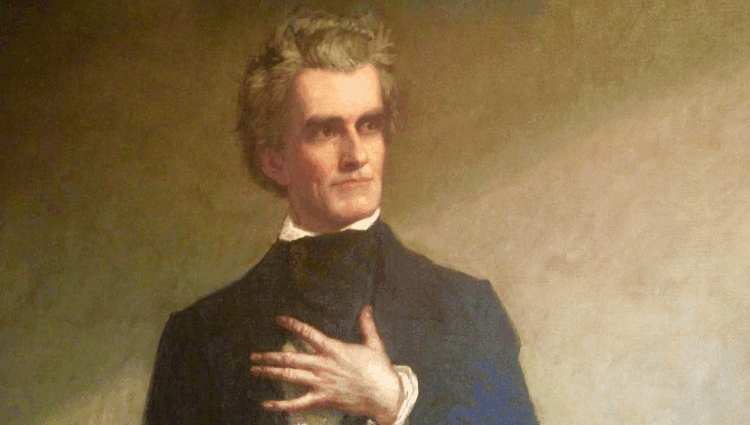
The featured image is G.P.A. Healy’s portrait of John C. Calhoun, Charleston City Hall, and is in the public domain and appear here courtesy of Wikimedia Commons.