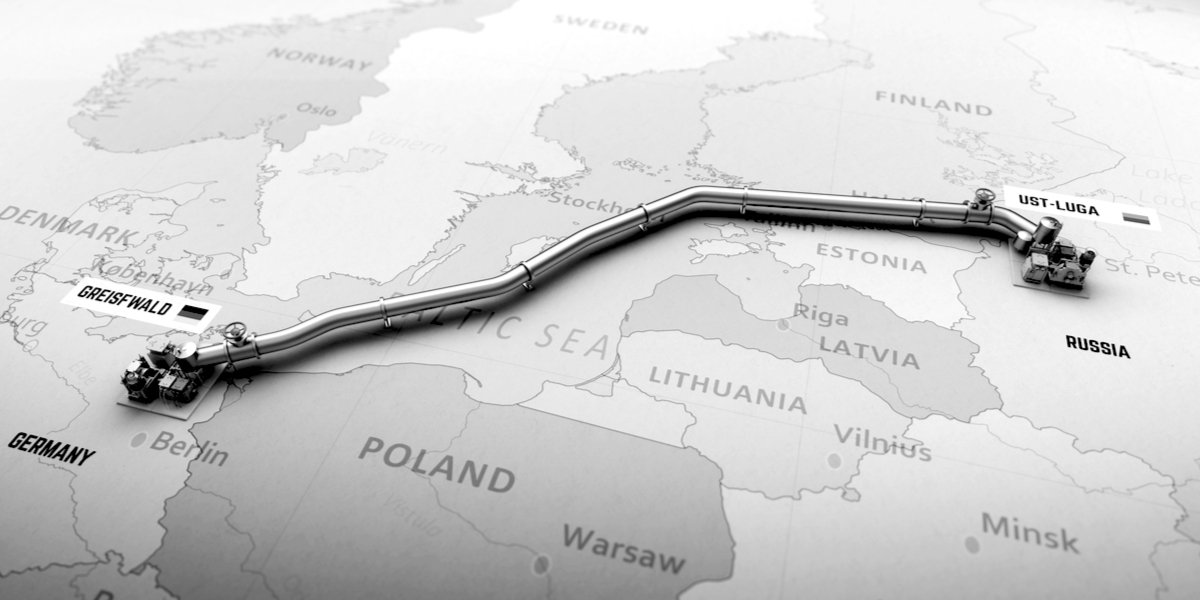
A WARSAW court has thrown out a German attempt to extradite a Ukrainian on charges of blowing up three of the four Nord Stream pipelines supplying gas from Russia to Germany in 2022.
The judge ruled that even if Volodymr Zhuravlyov did it, the act was justified in time of war.
The Germans are not happy. But the Poles are. They have a bit of history with German-Russian pacts and had consistently opposed the construction of Nord Stream. Even Donald Tusk, the most Germanophile prime minister in Polish history, opposed the extradition. ‘The problem with Nord Stream is not that it was blown up, but that it was built,’ Tusk posted on X.
So 46-year-old Volya is a bit of a hero in Poland. He is also, to my mind, a bit of a superman. Or would be, if the alleged facts are true.
Why do I detect a mackerel behind the radiator? Let me explain. I am a former professional diver, and among many humiliations in my career, one episode stands out. Our job was to land some concrete/sand mattresses each about the size of three double beds side by side, on a pipeline about 12 or 16 inches diameter.
They never told us mushrooms why but I guess the idea was to repurpose the pipe to carry gas instead of oil, hence the need to have something to weigh it down to stop it floating. Gas pipelines are coated with concrete for this reason to keep them stable on the sea bed. In the case of a 40-inch line like Nord Stream the concrete would be 6 or 8 inches thick with wire mesh reinforcement around a 1 to 2 inch steel pipe thickness.
Working from a 300ft dynamically positioned purpose-built diving support vessel with satellite guidance and heave compensated cranage to drop a big weight on a small pipe should be easy, right? Wrong. There are delays between the information from GPS and the thrusters compensating for a bit of drift, so the load suspended above the pipe could move randomly by two or three metres before we could land it. Add in the delay between giving the command to topside and topside commanding the crane driver . . .
And after the silt clears you find it’s not straddling the pipe like it’s supposed to. Nowhere near. So you lift it up again, and discover that a small change in position of the ship has caused the load to swing about because it was not lifted perfectly vertically. Two or three tons of pendulum can’t be arrested by a diver weighing about as much as a pair of wellington boots so there is no chance of placing it correctly until the swing stops.
The first one took seven hours to get it across the pipe in an acceptable way, not evenly or aligned but good enough. Knowing that there was a little underwater robot filming my every failure did not improve my mood.
Oh well, it turned out that every other team had the same problems. We did get a bit better at it over a couple of weeks, going from seven hours to five or six. Once we managed to place a mat in only three, but this was sheer dumb luck.
Realistically a similar vessel would be required to place explosive charges on three pipelines to a greater degree of accuracy than I ever achieved. Satellite and ship tracking data show that no such vessel was anywhere near in the months before and after the invasion of Ukraine. No, this operation was all apparently done from a small hired yacht, the 50ft Andromeda, with no satellite GPS, no DP ability and no crane, no saturation system, no continuous gas supply but only with SCUBA equipment.
So you can see why I am in awe of semi-retired diving instructor Volodymr. He and his team managed to place explosives in turbid water in exactly the right place in . . . er . . . seven minutes.
That’s how long you can work at 220ft of seawater without needing to decompress in stages on the way back to surface. Our hero is also an expert in mixed gas diving, because below about 150ft depth nitrogen narcosis starts to be a complication, leading to poor decision making and disorientation. Tweaking the oxygen in a tri-mix (nitrogen, helium and O2) might allow for an extra few minutes under water.
How much explosive would be required? I don’t know, but at a guess: a lot. Arches are very strong in compression and crushing a pipe from the outside is equivalent to overloading an arch, one made of reinforced concrete and structural steel. The job was done within view of Bornholm island, so there was no possibility of resupply. It’s a wonder the overloaded Andromeda didn’t sink as soon as it left port.
Why choose a location 220ft deep? This is another bizarre element in the mystery. Setting the bombs closer to landfall would have allowed the saboteurs to operate in say 60ft of water, giving them a whole hour for the task with no need for fancy SCUBA breathing mixtures.
We should also remember that the sabotage was carried out in the early stages of the war, when Ukraine was desperate for German support and the pipelines had just been shut down anyway. It would have been a diplomatic and military disaster if the special forces diving instructors had been caught red-handed before they had begun their mission. There are plenty of pipelines crossing the Black Sea; it would have been logistically simpler to bomb some of these with less risk of diplomatic fallout.
Somehow I am persuaded that Volodymyr Z is not Superman. And fellow Ukrainian Serhiy Kuznetsov, arrested in Italy as the alleged mastermind of the plot, even less so. Imagine pitching this cockamamie scheme to your superiors in the military chain! Redeployment to the front line or a secure psychiatric institution, I wonder.
If this case had ever got to trial in Germany, it would have collapsed faster than the next French government. Quite apart from the implausible method alleged, an average defence lawyer would have asked whether the German court even had jurisdiction. The crime was not committed in German territorial or even economic waters. The two Nord Stream 2 pipelines are 100 per cent owned by Gazprom (officially Nord Stream AG, based in Zug, Switzerland). German involvement is limited to 9 per cent of Nord Stream 1, and one of the pair of pipelines was left undamaged. So mounting the prosecution based on 4.5 per cent of the harm seems ambitious. More of a civil case for vandalism, m’lud.
Another intriguing oddity is that there appear to be no plans to repair the pipelines. One day peace will be arranged and Germany will want to import cheap Russian gas in preference to expensive LNG.
Repairing Nord Stream wouldn’t even be difficult. Even 30 years ago pipeline tie-ins with hyperbaric welding were pretty routine. The deepest one I was involved in was at three times the depth of the Nord Stream job. (I baled out when they replaced welders with robots, realising that my own speciality would be next.) Compared with billions of dollars flowing every month, a few million to spend on making it happen again seems like a no brainer. The US, which is exporting significant quantities of LNG, is probably putting the thumbscrews on to delay any repairs.
Then whodunnit? Joe Biden’s autopen is surely in the frame. The Polish foreign minister texted ‘Thank you USA’ a day after the event. The US promptly denied responsibility. The taps had already been turned off and the US has Germany in its pocket so the notion that a US submarine was equipped to deploy pipeline busting bombs seems far-fetched. The Poles themselves? Probably no more technically competent than the Ukrainians. The Norwegians? Technically capable from a surface vessel, which wasn’t in the area, being deployed elsewhere to accelerate the climate emergency. The UK? Oh, come on. I know some countries think of us as a sort of occidental Fu Manchu, but seriously? HMS Challenger, anyone?
As indicated above, much less explosive would be necessary to blow up the pipes from the inside than from the outside. A pig packed with TNT would do. (In the early days of industrialisation they used live pigs to run through pipes to check for obstructions, and the name stuck.) But this also fails the ‘why’ test. Only Russia or Germany could introduce the bombs, against their own interest. Out of spite? Part of Putin’s black ops to destabilise the West?
Finally there is another hypothesis. The pipelines contained a lot of gas, with the resulting formula:
40 inch pipe X 1,200 kilometres X 4 pipes X 80 bar pressure = a lot of money
When you depressurise a vessel great care is required, as the gas laws predict that the temperature will drop. Water freezes, clathrates (a sort of methane and water compound) become unstable.
Russia has a lot of thieves, and the temptation to siphon off the gas, pass it back into the domestic grid and collect the money shown on the meter would be irresistible if you had the right connections. However, the temptation is also to do the theft as quickly as possible, and this perhaps explains why the scheme blew up. (It also explains why no trace of explosives was found at the undamaged Nord Stream 1.)
To repeat. I do not know the answers. I’m just a mushroom, but I reckon I can tell that the official line we’re being fed is nonsense. And if Volodymyr Z is guilty then he’s a genius, a superman, and I hope he can be best man at my wedding to Sydney Sweeney.