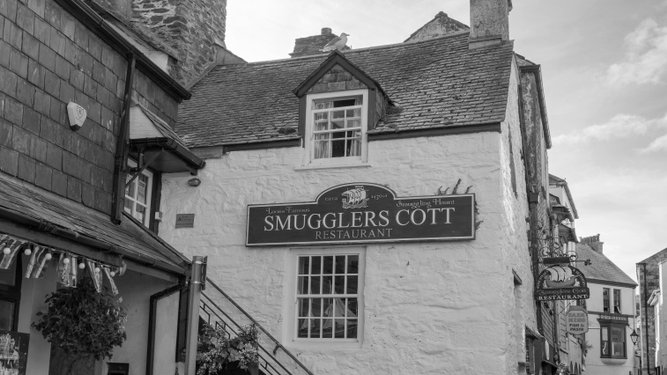
SUSSEX, the county I have made home, has a rich heritage of resistance, with its bonfires of vanity and barrels of illicitly procured brandy. In a tradition lasting for several hundred years, predating the Gunpowder Plot, effigies of unpopular rulers are set alight. The motto of the Sussex bonfire societies, which were formed in every town, was ‘we burn for good’. Meanwhile the Sussex coast was one of the most prolific sites of smuggling.
I knew little about this enterprise until recently, when I began research on the history of inns and taverns in my area. Landlords were heavily involved. Smuggling, to be sure, was not piracy or plunder but a means of averting ruinous taxation.
Cross-Channel smuggling began in the 13th century, when King Edward imposed tax on wool exports. Pevensey and Romney marshes are vast sheep-grazing pastures, and fleeces were taken directly to France rather than through the customs at the docks. Instead of returning empty, smugglers brought high-duty produce such as wine, brandy, tea, tobacco and lace – much of this cargo finding its way to London.
Smuggling became more lucrative in the eighteenth century, when taxes were increased to fund Great Britain’s wars with America and France. My speculation is that the tax regime had an unwritten purpose. Obviously money was needed for the Army and Navy – for ships and guns, and also to feed and clothe tens of thousands of men. This was taking from rather than contributing to the nation’s wealth. But there was perhaps an ulterior motive, forcing labourers into poverty. Enlisting with the armed forces was thus made more appealing.
Would it surprise you if the government used the same strategy today, if or when war beckons?
Landing the contraband was like a military operation. A lugger or fishing smack, having a large hold, and dark sails to reduce visibility, carried goods bought from French merchants. Several landing places were planned, as contingency for the presence of armed excisemen. To check that the coast was clear, a spotman on board lit a lantern and waited for a positive response from land. The vessel entered a cove where the goods were swiftly taken from the hold and carried ashore in small boats.
At St Leonards is the pub The Bo-Peep, with an unusual inn sign bearing two different images. On one side is a depiction of the nursery rhyme; on the other is the true meaning of ‘bo-peep’: a smuggler’s lookout.
Rye, a thriving Cinque Port, was a hub William Holloway, a local historian in the nineteenth century, wrote of being ‘informed by a gentleman who was born in Rye in the year 1740, that he remembered when the Hawkhurst Gang of smugglers were at their height of their pride and insolence, to have seen them (after having successfully run a cargo of goods on the sea shore) seated at the window of this house carousing and smoking their pipes, with their loaded pistols lying on the table before them’.
Batmen, armed with poles, bats and sometimes muskets, were posted at the landing area.
Tubmen took the barrels to a safe house, typically an inn or farm buildings, sometimes a vicarage. Excise officers and dragoons were posted in areas of smuggling activity, but these men were typically too old or unfit for military service, and they were enticed to look the other way rather than confront fearless ruffians.
Coastal surveillance was better manned and equipped in the late 18th century. As they intimidated local communities to maintain secrecy, smugglers became more feared than revered.
Justice was exemplary. Smugglers risked being shot or arrested and sent to the gallows. Their corpses were publicly displayed after execution of the death sentence in hanging gibbets. Gang members, when caught, were made an offer that they couldn’t refuse: to inform on fellow miscreants. Later the common punishment for smugglers was transportation to Australia.
However, magistrates were often lenient, sometimes not only dismissing the case against the smuggler but ordering imprisonment or flogging of the arresting officer. It helped the suspect if the justice had been in regular receipt of foreign liquor. Magistrates today, sadly, have no sympathy for the working class – as we saw after the protests about the Southport murders last year.
Rudyard Kipling lived at Rottingdean in Sussex, 50 years after the smuggling trade ended, speaking to many older residents about past exploits. His verse A Smuggler’s Song is evocative:
If you wake at midnight, and hear a horse’s feet
Don’t go drawing back the blind, or looking in the street
Them that ask no questions isn’t told a lie
Watch the wall my darling while the Gentlemen go by
Five and twenty ponies
Trotting through the dark
Brandy for the Parson, baccy for the Clerk
Laces for a lady, letters for a spy
Watch the wall my darling while the Gentlemen go by.
One of the most iconic images of English tourism is that of the Seven Sisters cliffs between Seaford and Eastbourne. In the latter days of smuggling, derricks were positioned on the cliff-top to raise goods from the beach below, an awkward task necessitate by the watch on every cove. A seemingly out-of-place row of cottages at Birling Gap was originally for the coastguard to prevent this activity.
Smuggling became too risky by the 1830s, when it faced overwhelming force, as occurred at the Battle of Sidley Green in 1828. But in a way the smugglers won: taxes were reduced as the government followed the free-market principles of Adam Smith, boosting the economy and employment prospects for county folk.
The chief smuggler nowadays is the government, bringing hordes of men from Africa and Asia into the country and accommodating them in luxury hotels. So whereas smugglers evaded government taxes, today the government smuggles illegal immigrants at taxpayers’ expense.
Martin Luther King said that ‘one has not only a legal but a moral responsibility to follow just laws’, and ‘conversely, one has a moral responsibility to disobey unjust laws’. How much will ordinary people take from this corrupt establishment before they grab the pitchforks?
To be proud of one’s country does not necessarily mean being proud of our rulers and their deeds, fair or foul. Instead of loyal subjects, the English have a history of irreverence, ‘cocking a snook’ at authority, and occasional revolt. As Sussex folk say, ‘we wunt be druv’.
This article appeared in Niall McCrae’s substack on October 19, 2025, and is republished by kind permission.