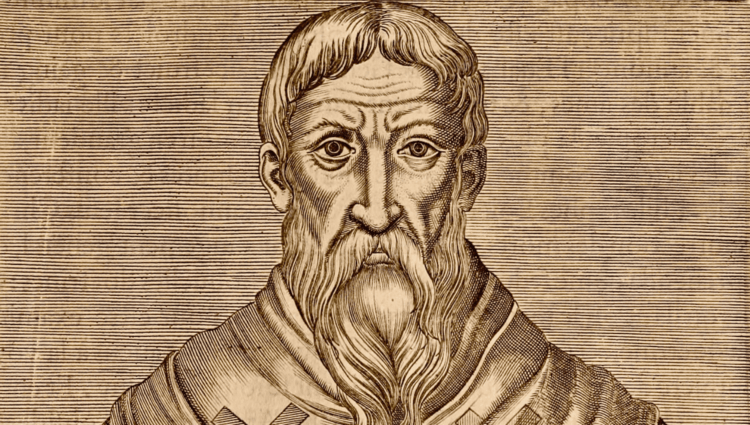
While Dionysius the Pseudo-Areopagite was busily employed in deceiving Christians into believing in his Neoplatonic mysticism without Christ, St. Maximus the Confessor was suffering terribly for his orthodoxy at the hands of the Areopagite’s fellow Monophysites.
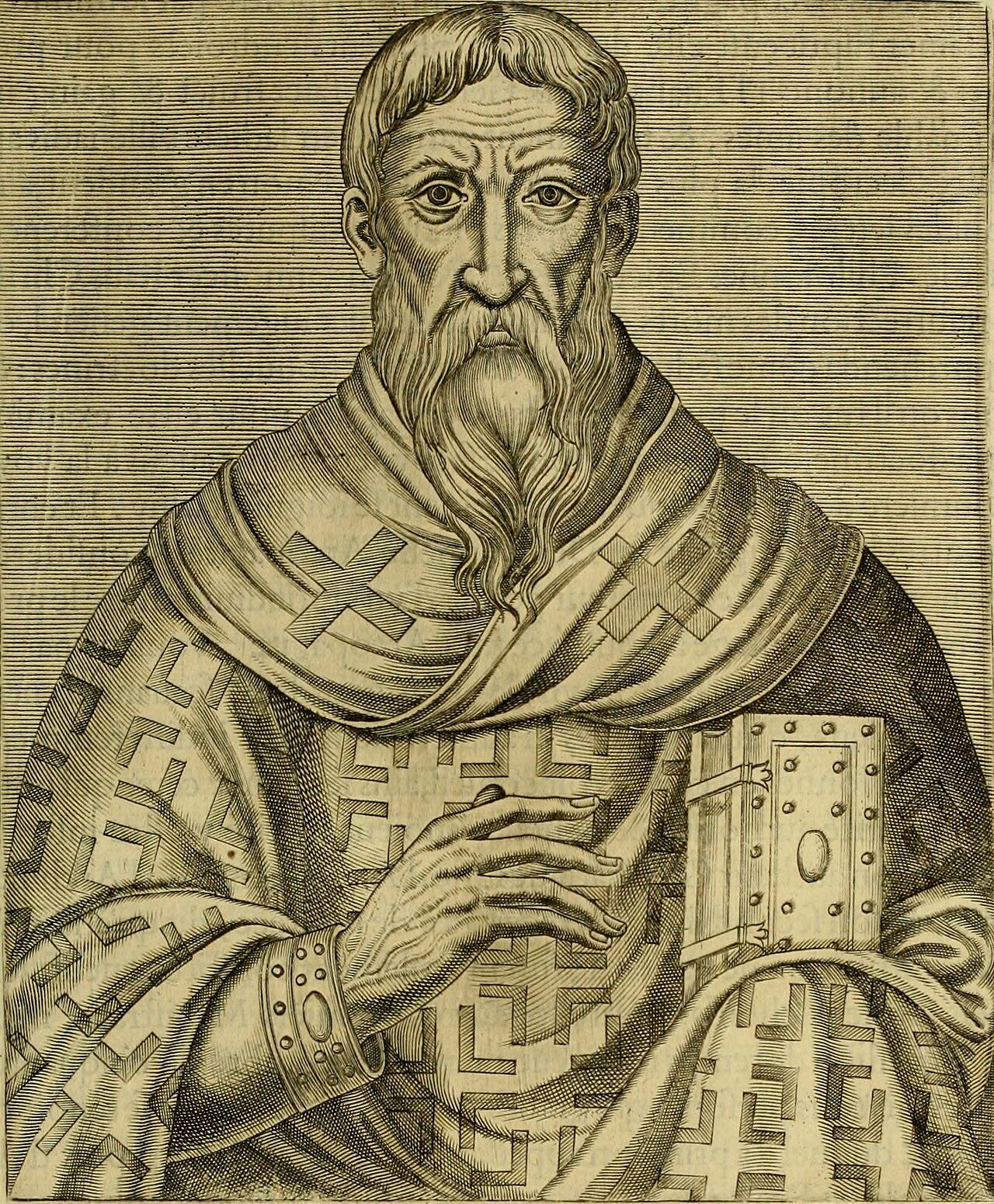
Dionysius the Pseudo-Areopagite
Before moving on to end this book with some simple practical examples, and what I call the “ascetism of the heart”, I would like to pause for a moment to warn my readers of a fraudulent mystic, who has been called the father of counterfeit mystical theology.
There were two very important thinkers born within a hundred years of each other who were later called saints and mystics. One was the real thing, the other was the counterfeit. St Augustine was born in the fourth century after Christ, the counterfeit mystic a hundred years later. They were both converts to Christianity from Neoplatonism. The old Platonists followed the teaching of the Greek philosopher, Plato who believed that you could find all life, all truth, all beauty and all goodness in God. This meant that it was possible to glimpse something of God’s transcendent glory in the glory of his creation.
Like St Augustine many of us have had such experiences. They are so well known that they have come to be called “natural mystical experiences”, or experiences of the “numinous”, as the Romantic poets called them. St Augustine writes about such an experience when converting from Neoplatonism to Christianity.
I tasted you, and now hunger and thirst for you. You touched me, and I have burned for your peace. So, I set about finding a way to gain the strength that was necessary for enjoying you. And I could not find it until I embraced the mediator between God and man, the man Christ Jesus, who is over all things, who was calling unto me and saying, I am the way, the truth, and the life.
Many people have experienced God in this way, most especially in their youth. While some spend their lives trying to transpose these experiences into words or capture them in sublime poetry like the Romantic poets, Augustine rushes on to seek the source from which they came. His search led him to Jesus Christ for he finds in him the Masterpiece of God’s creation. The fragments of God’s beauty and goodness and truth that are scattered in the rest of creation are to be found fully in the Masterwork. Finally, in, with and through Christ he was led on to a Union with God that drew him into a profound contemplative stillness. When Augustine was led on to experience ever more deeply the presence of God in mystical contemplation, the light of love that reached out to him all but blinded him. It made him realize like so many before and after him that he would have to undergo a deep and penetrating purification before he could come closer to the God with whom he yearned and wished to be united. This is how he put it:
“I knew that I was far from you in the region of unlikeness, as if I heard your voice from on high. I am the food of grown men; grow and you shall eat me.”
After many years of journeying on in what St John of the Cross later called the Dark Night of the Soul, what Augustine was able to experience more fully and understand more deeply, was the profound contemplation about which he was able to write like none before him. Sadly, for him and for us, the counterfeit mystic either had not heard of St Augustine’s mystical journey, or he ignored it and remained so locked up in his Neoplatonic philosophy that he simply did not progress like Augustine in the authentic mystic way. For, while the original Platonists were purely philosophers, reasoning about the God of beauty, truth, and goodness, the Neoplatonists wished to come to experience him, as far as this would be possible. St Augustine found the way, in with and through Christ. The counterfeit mystic, otherwise known as Dionysius the Pseudo-Areopagite, did not, as Christ played no part in his mystical journey. If this is not made eminently clear by a quick reading of his Mystical Theology then let me quote from A History of Philosophy by the famous Jesuit historian, Frederick Copleston.
The Neoplatonists objected to the Incarnation and although we cannot be justified in asserting that the Pseudo-Dionysius denied the Incarnation, his acceptance of it does not well adapt itself to his philosophical system nor does it play much part in his writings. One may well doubt whether his writings would have exercised the influence that they did on Christian mediaeval thinkers, had the latter not taken the author’s pseudonym at its face value. (Vol 2 Chapter 9)
Fr Copleston is referring to the fact that in order to pass off his clearly Platonic method of contemplation as Christian, he deceives his readers into believing that he was writing, not in the middle of the first millennium about AD 500, but more than five hundred years earlier in Apostolic times. He claimed to be St Dionysius the first Bishop of Athens, friend of St Paul and the other Apostles.
Dionysius was in fact a pagan convert from Neoplatonism who wrote somewhere between AD 490–530, four hundred years after his supposed friendship with St Paul. These works are heavily dependent on the writings of the Neoplatonism of his previous pagan teachers. He was writing long after the Church’s reaction to Arianism had created a completely different spiritual landscape from that which prevailed in the aftermath of Christ’s Resurrection. He was as far away from Apostolic times as we are from Tudor times, but in order to give a false credence to his pagan philosophical ideas he pretends to have lived in apostolic times himself, and to have been on familiar terms with many great Christian personalities whom we rightly revere. To do this, Dionysius assumed the name and the persona of a wellknown personality and saint – the first bishop of Athens, who was acquainted with St Paul.
It is one thing to write in another person’s name; this is not an uncommon convention for a writer and is usually quite harmless. But to do it in such an emphatic way, in order to deceive readers into believing in the quality and in the orthodoxy of all that is said, is taking the matter too far. This deceit has had the most pernicious consequences for the Christian mystical tradition. The veneration that was given to this man and his writings in the Christian West where his works were translated into Latin, cannot be exaggerated. For many hundreds of years almost all Western mystical writers looked to him as to one of the Apostolic Fathers, whose works therefore were even more authoritative than the Fathers of the Church and hardly less sacred than the scriptures themselves. He was even referred to as St Denis.
He did not just claim to be the Bishop of Athens and friend of St Paul, but a friend too, of St John, Timothy, Titus, Justin, Carpus and Polycarp. He claimed to have known Mary the mother of Jesus and although he did not profess to have been at the Crucifixion, he did claim to have witnessed the solar eclipse mentioned by Matthew (27:45) and Mark (15:33) that took place when Jesus was dying on the cross. There are many more deceits in his writings, and all with one aim, to fool others into accepting his own Neoplatonic presentation of Christian theology that is aeons away from that of St Augustine and the mainline Christian tradition. The great sadness is that in the aftermath of the heresy of Arianism, the Christ who was so obviously the Way, the Truth and the Life for St Augustine, whom he called the “mediator between God and man”, had all but disappeared from sight, compared with the way in which he had been at the heart and centre of early Christianity.
In his History of the Catholic Church, Monsignor Philip Hughes simply describes Dionysius, not as a convert to Catholicism but to Monotheism (History of the Catholic Church Vol 2 pages 164– 5). In other words, Dionysius, does not believe in the Hypostatic Union, namely the divine and the human natures, indissolubly united in the person of Christ. Naturally therefore, Christ and his love can play no part in his mystical theology which is in fact no more than the Neoplatonic philosophy of the cult from which he partially converted. The only way to union with God therefore is by some strange form of mystical knowledge that first consists of emptying one’s mind of all images, thoughts, and desires that normally reside in the mind, so that what he calls “unknowing” resides there instead, enabling some sort of esoteric intellectual intuition to rise to God. No later Catholic mystical writers would deny the need to empty the mind when the Holy Spirit leads them into contemplation, but not to fill it with “unknowing”, but rather with acts of love to pierce through the unknowing caused by our human sinfulness.
The authentic Catholic Tradition righty insists that it is only love that can unite two different persons together. Knowledge may inspire a person to desire union, but it can never bring it about. What is true of human relationships is equally true of divine relationships. Human loving may unite human beings with each other, but only divine loving can unite human beings with God. Divine loving comes to us through Christ, and Christ alone. As Christ plays no part in Dionysius’ mystical theology it is condemned to do no more than lead searchers into a dead end. Nevertheless, his impeccably assumed credentials fooled many later Catholic thinkers to believe that the intellect could do for them what only the heart can do. That is what the two new commandments of Christ are all about, not knowledge, but love – the love of God and the love of others (Matthew 22:36–40). As Christ himself said, everything else depends on the practice of these two commandments (Matthew 22:36–40).
The great canonized Catholic saints and their followers who refer to the Pseudo Areopagite and even use some of his language in later years, replaced his obscure esoteric intellectual intuition with “love”. The great French Philosopher Étienne Henri Gilson put it this way. “It was one of the major problems of the later scholastics to give Denis an orthodox interpretation without baldly declaring him to be in the wrong (cf. p 85, and p. 588). The authority of the pseudo convert of St Paul was too great for it to be possible to ignore him. It was all the more necessary to find a way around him which is why we find so many commentaries on his works from Hugh of St Victor to St Thomas Aquinas himself whose aim (not admitted in deed and perhaps even unconsciously), was to extract the poison from him” (Gilson op. cit. 80 cf. pp. 80–9).
The first great Saint to do this was St Maximus (died AD 662), Abbot of the monastery of Chrysopolis near Constantinople who is usually quoted by those eager to substantiate the Areopagite’s orthodoxy, because he appears to endorse all his teaching. In fact, Maximus does not do this, but the acceptance of his false credentials induced him to commend his philosophical ideas about God, and the asceticism needed to contemplate him. However, he was emphatically not a Monophysite like the Areopagite. For St Maximus the journey, not only takes place in, with and through the Christ who plays no part in the Areopagite’s “mysticism” but with our love and Christ’s love as one, making possible what is otherwise impossible.
The great spiritual historian Père Pourrat makes this abundantly clear in the first volume of his History of Christian Spirituality by quoting the words of Maximus directly.
The end of contemplation is union with God by rendering us like him and in a manner deifying us. This deification is brought about by love. Through love the will of man and the will of God become one and the same thing. But this assimilation of the human will and the divine will is realised first in Christ. In him the two distinct wills exist, contrary to the teaching of the Monophysite heresy. Christ is thus the model of our own deification. The word ‘incarnate’ is therefore the one centre of the theology and the spirituality of St Maximus.
While the Pseudo-Areopagite was busily employed in deceiving Christians into believing in his Neoplatonic mysticism without Christ, St Maximus was suffering terribly for his orthodoxy at the hands of the Areopagite’s fellow Monophysites. They brutally scourged him, cut off his hand and pulled out his tongue to make sure that he could do nothing more to oppose their heresy. While St Maximus slowly died a martyr’s death, because he refused to abandon orthodoxy, the Pseudo-Areopagite used orthodoxy to hide his heresy and spread it down subsequent centuries to the present day.
___________
This essay is chapter sixty-one of The Primacy of Loving and is published here by gracious permission of the author.
The Imaginative Conservative applies the principle of appreciation to the discussion of culture and politics—we approach dialogue with magnanimity rather than with mere civility. Will you help us remain a refreshing oasis in the increasingly contentious arena of modern discourse? Please consider donating now.
The featured image is “Denis the Areopagite, first apostle to the Gauls”, from book 1, folio 1 recto of Les vrais pourtraits et vies des hommes illustres grecz, latins et payens (1584) by André Thevet, and is in the public domain, courtesy of Wikimedia Commons.