
EUROPE is rapidly transitioning from a civilisation shaped by natural change and continuity to one that will be defined by immigration-driven replacement.
That’s the central message from several new bombshell studies of how Europe’s population is being radically transformed.
The population of the UK is being completely overhauled, despite no democratic consent from the people.
But once you step back and look at the much bigger story that’s unfolding across Europe then you’ll see a picture that’s just as astonishing.
According to new figures from Eurostat, the people of Europe are experiencing the most profound demographic shift in their history.
Between 2010 and today, in only 16 years, the share of foreign-born residents in Europe rocketed from 40 million to more than 64 million.
In other words, Europe’s ruling class added 24 million foreign-born residents in only 16 years — with nearly three-quarters coming from radically different cultures and nations.
The changes in specific nations are striking. Between 2015 and 2024, Germany’s immigrant population exploded from 11 million to more than 17 million. In Spain, it surged from 5.9 million to close to 10 million.
As in the UK, immigration is now the only reason Europe’s population is growing. Why? Because Europe’s people are no longer reproducing themselves naturally.
Europe has now recorded more deaths than births every single year since 2012 – with Latvia, Bulgaria, and Lithuania suffering the sharpest falls.
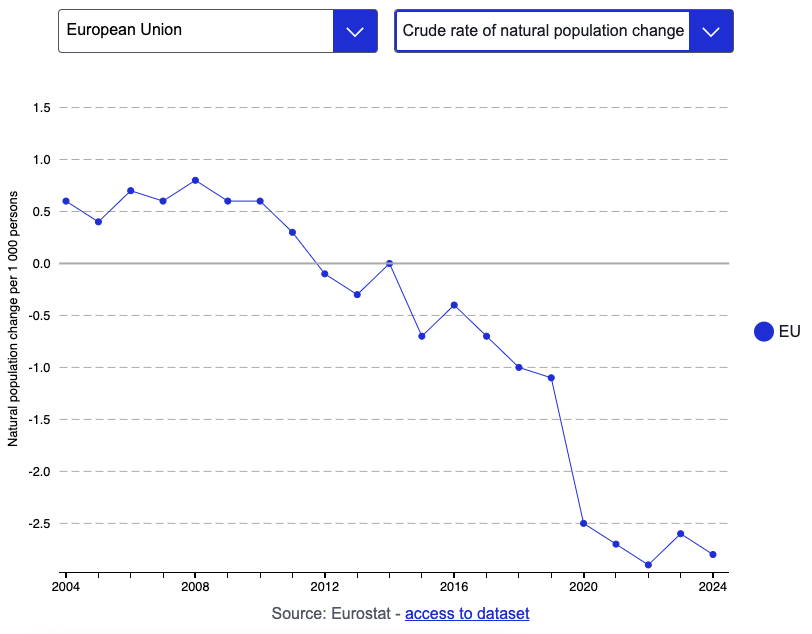
Last year, in just one year, Europe’s natural population collapsed by 1.3 million people, while net immigration added 2.3 million.
And these trends will only accelerate unless Europe finds a way of encouraging its native population to have more children, which looks unlikely.
The average fertility rate across Europe has slumped to only 1.34 children per woman, sharply down from 1.46 in 2004 and well below the ‘replacement rate’ of 2.1 – at which a population is considered stable.
Europe’s fertility rate today is now broadly the same as the rate in the UK, where it’s just slumped to 1.39, and where 40 per cent of all children now have one or two foreign-born parents.
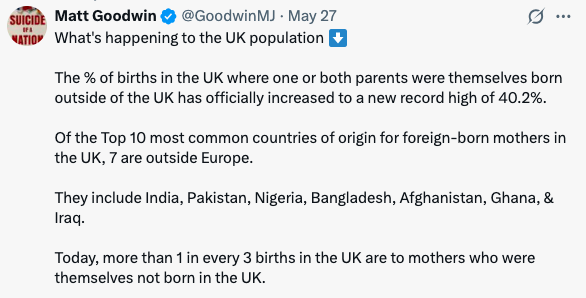
In specific nations, demographic collapse is nothing short of astonishing.
The fertility rate in Malta is 1.06. In Spain, it is 1.10. In Poland, 1.14. In Italy, 1.18. In Ireland and Sweden, it is 1.4.
These nations will simply not survive in any recognisable form over the longer-term unless they find a way of boosting fertility rates among their native populations.
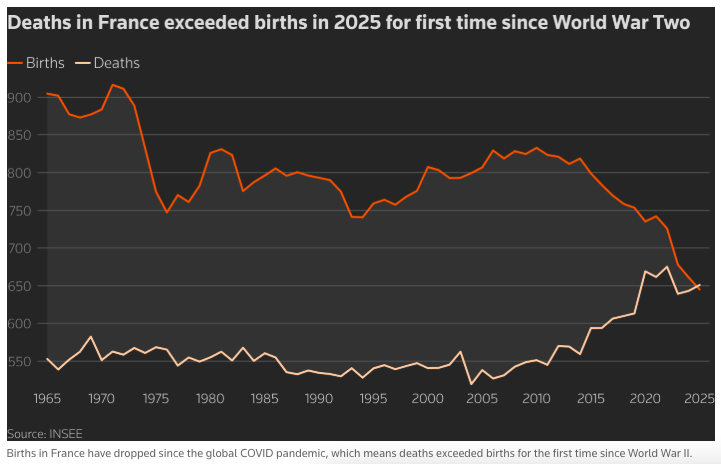
Even France, once seen as a demographic success story, now has a fertility rate of 1.56. For the first time since the Second World War, it just recorded more deaths than births. The only reason France grew last year is because net migration added 176,000 people.
Many other striking trends reveal the sheer speed and scale at which Europe is now being radically transformed.
Last year, according to Eurostat, the number of people who live in Europe but were born outside Europe reached 47 million – an increase of close to two million people in just one year.
There are now 17.2 million foreign-born people in Germany, nearly 10 million in France and Spain, and nearly seven million in Italy.
Between 2010 and 2024, in just 14 years, the share of foreign-born people in Germany rocketed from 12.9 per cent to 21 per cent.
In Austria, it is 22 per cent. In Ireland, it is 23 per cent. In Sweden, it is 21 per cent. In the UK, thanks to the ‘Boriswave’, it is 20 per cent. In Spain, it’s 19 per cent.
These are all record highs and point to a continent that’s being transformed in terms of both its demography and culture.
In Vienna, for instance, 42 per cent of all pupils at state schools are Muslim, while in Berlin, Hamburg, and other parts of Germany more than half of all school pupils are migrants or the children of migrants (like parts of the UK).
Europe’s political leaders are also granting citizenship to increasing numbers of people from outside Europe.
In the most recent year for which we have data, 2024, European nations handed citizenship to more than 1.2 million people, with the two largest groups being Syrians and Moroccans.
And this is just the start. The projections by Eurostat show that even with ongoing mass migration Europe’s population will decline sharply in the coming decades as its native population gets older and fertility rates remain catastrophically low.
Look at Poland, for example.
While Poland’s been one of the most vocal critics of mass immigration, between 2005 and 2025 it also experienced the sharpest increase of all European nations in the share of pensioners, which rocketed from 13 to 21 per cent.
If the likes of Poland cannot find a way of boosting the fertility rate, then for how long will they be able to resist the same demographic pressures that are radically reshaping other nations?
What all this points to is clear. Instead of investing in pro-family policies, limiting migration, embracing new technology to reshape the economy, and encouraging the restoration of the native population, Europe’s ruling class has clearly decided that mass immigration is no longer just a temporary policy: it is now permanent.
In effect, Europe, like other Western nations, is using large-scale immigration to compensate for the demographic collapse of its native population.
And millions of ordinary Europeans can now sense and see what this means. Entire cities set to be transformed within just one generation. A growing gulf between metropolitan elites in the rapidly diversifying cities and ordinary Europeans who live outside them. A growing sense among millions of voters that they were never properly consulted about any of these changes. And a creeping awareness that migration is not just adding to Europe’s population but is replacing it, too.
As in the UK, where the same demographic shifts have sparked a strong political reaction, I expect these changes in Europe to power the ongoing rise of national populist movements that either demand an immediate halt to all further immigration or, as is now the case in Austria and increasingly Sweden, the ‘remigration’ of peoples from outside Europe, which is now advocated by major political parties.
Because beneath the more technocratic argument about the economic implications of all this lies a much deeper question that is more civilisational in nature: what is Europe actually becoming? What is happening to the people of Europe?
What happens when one of the greatest civilisations the world has ever known not only stops reproducing itself naturally but becomes fully dependent on demographic replacement in order to sustain its ageing population and workforce?
These are the central questions facing not just the UK but Europe and the West more generally. They are only becoming more urgent.
This article appeared in Matt Goodwin’s substack on May 29, 2026, and is republished by kind permission.