Had Our Lord’s offering been by way of some human act of little cost, then one would feel that humanity’s part in the expiation was barely more than a fiction. In fact Christ’s humanity gave all it had to give, for a man has not more to give than his life. What divinity gave was only what humanity could not give.
 The very heart of the doctrine of the Redemption is that the human acts of Christ were the acts of a Person Who was divine.
Everything that Christ did and suffered and experienced must be seen as done and suffered and experienced by God. God grew to manhood, God was a carpenter, God rejoiced, God sorrowed, God suffered, God died. It is the last two phrases that force us really to face the mystery and test our realization of it. Yet if God did not suffer and die, then no one did, for there was but the one person in Christ; that is, there was no suffering, no dying: no sacrifice, no redemption. The phrase “God died” gives us at first the greater shock, but afterwards is less profoundly mysterious than the phrase “God suffered.” The whole created universe, with everything in it from archangel down to electron, or any lower thing there may be, is held in existence from instant to instant solely by the continuing Will of God to hold it so. And the words God died seem to carry annihilation to all things that thus depend upon God. But it is by the operation of His divine nature that God sustains all things in being, and it is not in His divine nature that God the Son died but only in His human nature, the most glorious of created things, but a created thing for all that. Death is a separation of soul and body. The phrase God died means that for that three days’ space God’s Soul was separated from God’s Body: it was a real death but it left the divine nature totally unaffected.
But what are we to make of the phrase God suffered? Again the suffering was not in the divine nature, but in the human. Christ’s suffering, the fear and agony in the Garden for instance, was real suffering, that is to say someone really suffered it. And that someone was God the Son. How this can be, what indeed it means, we cannot fully know, indeed we can hardly feel that we know at all. The mind seems able to make no statement here. Yet it is literally true that, even if we cannot say it, there are momentary flashes of light, glimpses and glances, in which we half see it; and there is no measuring the fruitfulness of even this momentary half-seeing for sanctity; and not for sanctity only but for plain human consolation.
Summarizing this relation of nature and person in Christ’s atoning act, we see that because He was man with a true human nature He could offer a true human act in expiation of human sin, an act of total love to balance humanity’s self-love; and because He was God, the human act He offered was of infinite value and so could satisfy and more than satisfy for the sins of men. But stating it thus, we see another question. Any act of Christ must be of infinite value, since the person who does the act is God. Why then does Christ offer His death, when some lesser act would have been of infinite value and therefore totally sufficient? Might He not have offered His thirst when He sat weary from His journey by Jacob’s Well in Samaria? Or His patience under insult? Or any one of a thousand other things? Why did it have to be His death?
In one sense the answer is clear. He had come into the world to teach the truth—about Himself as God, for instance, about Himself as Messiah, about the Kingdom which was to be in the world but not of it, about the Gentiles who would come into it, about the failure of the leaders of Israel to grasp the essentials of their own religion. His execution was the natural consequence. Only a miraculous intervention of the divine power could have prevented it. Given that He was to die, it is hard to think of His offering some lesser thing than His death as the sacrifice that should save mankind.
But all things are in the power of God. God could have intervened to prevent His death. Or He might have chosen a way of life that meant no such direct challenge to the rulers. Why, we may ask in all reverence, did the divine plan include the death of the Redeemer?
The two answers that instantly spring to mind are that nothing could show the love of God so overpoweringly as His willingness to die for us, and nothing could show the horror of sin so clearly as that it needed His death to expiate it. Now it is true that Calvary is a proof both of the awfulness of sin and of the love of God, but it would not be so unless there was something in the nature of sin that required Calvary. If the sin could as well have been expiated by some act of Christ less than His death, then Calvary would not show the horror of sin but would in fact exaggerate it. The same line of argument would not so obviously apply to Calvary as a proof of God’s love, yet there would be something profoundly unsatisfying in the notion of God’s showing His love for us by a needless death. A moment’s reflection will show that there was something in what Our Lord had to do which made His dying the best way to do it. It is true that on the side of the Person who made the offering any act in the human nature, however small in itself, would have sufficed. But on the side of the nature in which the offering was made, can we feel that any act however small would have sufficed?
Obviously no. The sacrifice was a true act of human virtue offered in reparation for a human act of rejection of God. It is true that no act of human nature could by itself have sufficed to expiate, and that it was the divinity of His Person which gave the act of Christ’s human nature the efficacy which by itself it could not have had. But that is no reason for reducing the human element in the sacrifice to a mere token. For if it were so, we should be left with a sense of an unreal transaction in which God makes an offering to God. It was human nature’s offering, though it took a Divine Person to make it. The God who made the offering was man, too, and it was in His manhood that He made it. Human nature could not do all: yet it must do all that it could, leaving the divinity of the Person to supply for the remainder. In the profoundest sense humanity would want this. Expiation is something required not only by the nature of God but by the nature of man. There is something in man, which when his intellect is clear and his will right, longs to make expiation rather than merely have his sin forgiven out of hand. It belongs to human dignity that a man should want to pay his debt rather than have it written off. And if he cannot pay the whole of it, as in this supreme instance, he yet wants to pay all that he can. Had Our Lord’s offering been by way of some human act of little cost, then one would feel that humanity’s part in the expiation was barely more than a fiction. In fact Christ’s humanity gave all it had to give, for a man has not more to give than his life. What divinity gave was only what humanity could not give.
But all this discussion is academic. To discuss what the Redeemer might have done gives us certain lights upon the problem of our redemption. But they are as nothing to the light that floods out from what He did do. He gave all that He had upon Calvary: martyrs since have died in the strength of His death, knowing that even humanly speaking He gave more than they. He died: if He had not, we should not have had the Resurrection. By baptism we are buried with Him in His death, and rise with Him in His Resurrection. Only God knows what splendours might have been associated with some other way of Redemption; but we have seen the splendour of this.
_________
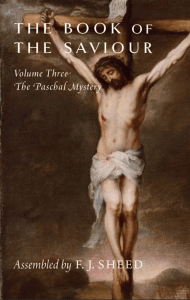
This essay is taken from The Book of the Saviour, Volume III. Republished with gracious permission from Cluny Media.
Imaginative Conservative readers may use the code IMCON15 to receive 15% off any order of not-already discounted books from Cluny Media.
The Imaginative Conservative applies the principle of appreciation to the discussion of culture and politics—we approach dialogue with magnanimity rather than with mere civility. Will you help us remain a refreshing oasis in the increasingly contentious arena of modern discourse? Please consider donating now.
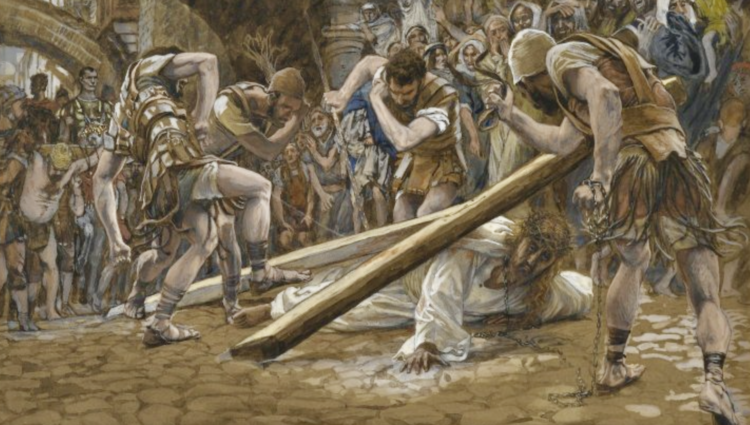
The featured image is “Jesus Falls Beneath the Cross” (between 1886 and 1894), by James Tissot, and is in the public domain, courtesy of Wikimedia Commons.