Iain McGilchrist’s “The Matter With Things” is a comprehensive diagnosis of the modern condition. We have returned to a Zeno-like perspective, rejecting the most important and meaningful parts of life based on data which can make no such judgement, and McGilchrist’s book is a voluminous call to sanity.
The Matter With Things: Our Brains, Our Delusions and the Unmaking of the World, by Iain McGilchrist (2987 pages, Perspectiva Press, 2021)
When I first introduce my physics stu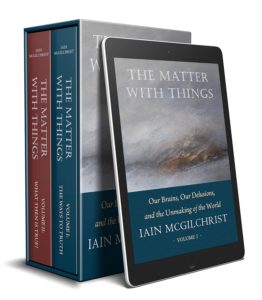 dents to motion, I tell them that I’m going to prove that they can never leave the classroom. I borrow an argument from Zeno, the ancient Greek philosopher, and begin by demonstrating that between any two points there are infinite points. Take any line, and cut it in half. That new half line can also be cut in half. That new half of a half can also be cut in half. And so on forever. Therefore, between any two points there are infinite points.
The next stage of the proof consists in pointing out that it is impossible to complete infinity. If I give you a book with infinite pages, when will you be done with it? Never. And so it is obvious that infinity cannot be completed in a finite time. Therefore, it is impossible to go from one point to any other point because that would necessitate completing an infinite number of points in a finite time.
Zeno‘s argument was meant to prove the theory of Parmenides that all change is an illusion. The logic says that motion is impossible, and therefore, all of our perceptions of motion must be an illusion. I ask my students if they are convinced that all motion is only an illusion, if they are convinced Parmenideans, and they say ,”No.” I ask them if they can find the flaw in the argument, and they cannot. Somehow they just know it’s wrong despite the fact that the logic seems to work.
In fact, most of them do not seem to be too bothered by it, and they are still trying to figure me out as a teacher, and they might be coming to the conclusion that I’m just crazy. In order to save myself from such a judgment and to keep them from giving up on reality and to save the study of physics, I tell them that Aristotle saved the day by pointing out that there are two kinds of infinity: infinity of division, like cutting up a line, and infinity of extent, like a book with an infinite number of pages.
What is really fascinating about the argument of Zeno is that Zeno himself and others found it convincing. This highly analytical argument was so convincing that he was willing to give up on all of the rest of his lived experience with reality.
G.K. Chesterton pointed to this kind of thinking, as well as the rest of the highly analytical and abstract philosophizing of the ancient Greeks, as the separation of the right and left lobes, “cloven and double,” because, while the philosophers were engaged in such abstract analysis, the playwrights and poets were engaged in a different kind of analysis (1953: 248). The efforts of Homer and Sophocles are no less of an attempt to understand the nature of existence, but they focus on different things and in a different way, what is it like to be a human being and to live in this world from the inside.
And so the philosophers and the poets seemed to be the left brain and the right brain of Ancient Greece, but there was no marriage between them. They ran parallel to each other, but not hand in hand. As Chesterton said, the mathematicians and philosophers were in danger of forever adding up numbers that amounted to nothing, and the painter were in danger of forever painting portraits of nobody.
Chesterton claims that it was the Christian religion that brought the two of them together and united the mystery of human existence with the clear, rational thought by philosophical methods. The Church produced theology as much as it produced cathedrals. In fact, cathedrals are sometimes thought of as theology written in stone in class. The Church engaged logic as much as it engaged in beauty, and it provided a solid ground for both in God.
In the spring of this past year, I ran across a couple of claims that The Matter with Things, by Iain McGilchrist, is one of the most important books written in modern times, perhaps even the most important. One endorsement called it the most important book of all time. Based on such recommendations, I bought the book to see what McGilchrist had to say.
McGilchrist does not begin in ancient Greece or the Middle Ages, but he clearly lays out, from a neurological and psychological standpoint, the difference between the two halves of the brain. His contention is that left-brain type thinking, along with all the left-brain dominant neuroses, has dominated western thought since the time of the so-called Enlightenment, and the suppression of the right brain has had negative effects on the way we as a society now experience and think about the world.
It is not his intention at all to denigrate the work and role of the left brain. In fact, his book and the study of neurology requires strong engagement of the left brain, but he strives to show the limitations of that hemisphere and its need for a subservience to the right. The same is true, he argues, for the paradigms with which we look at reality.
McGilchrist comes to his work with a background as a scholar of literature as well as a neuroscientist, and he pulls from both worlds and others throughout his 1400 pages of text. The bibliography alone is about 180 pages, and he includes works of literature, science, philosophy, and theology from many different ages and parts of the world.
The first part of his work focuses on the evidence of brain science to examine the left and right hemispheres, what they do, and their abilities. He summarizes it metaphorically as the action of the two sides of the brain as a master and an emissary, utilizing the title of a previous work. The right brain is like a master that sees the whole and takes in reality in all its mystery and complexity and gives certain jobs to the left brain. The left brain is very good at abstracted analysis, rote procedures, and attention to detail, but it suffers from overconfidence and can get carried away in its tasks. In thinking that it knows better than the right brain and tries to take over the job, as an emissary might become arrogant and believes that it can do the job better without the master.
The right brain recognizes the flow of time while the left brain sees snapshots of reality. The right brain is comfortable with mystery and paradox while the left brain requires certainty, and it cannot entertain the notion that it might be wrong. The left brain works with abstracted representations and pictures of reality; the right brain dominates when it comes to contact with reality itself. The consideration of other viewpoints and the effort, when necessary, to change one’s mind or look at things from a new perspective is a function of the right brain.
Most neuroses resemble the behavior of a person whose right hemisphere has been damaged or suppressed. “Almost all extraordinary distortions of reality follow from right hemisphere damage” (2025a: p133). For example, for a patient whose right hemisphere is suppressed, a valid argument with false premises and a false conclusion looks convincing, and the patient agrees with the conclusion even if it contradicts their own experience, much like Zeno and his denial of change.
McGilchrist himself summarizes part one of his work: “In part I, I showed that in relation to the main portals of access to knowledge – attention, perception, judgments formed on those perceptions, social and emotional intelligence, cognitive intelligence and creativity – while both hemispheres contribute, the right hemisphere is in every case superior to the left. Only in the business of grasping something in order to use it is the left hemisphere superior” (2025b: p1305).
The second part of his book examines the various ways in which we come to know truth and the claims that science, reason and intuition can make on truth. Throughout this section, he refers back to the first part and the role that the two hemispheres have in experiencing and evaluating the world. Even in science, which seems to be the domain of the left hemisphere, creativity, discovery, and the sense of beauty play central roles and are characteristic of the right hemispheric activity. While the left brain can abstract and analyze a picture, the right brain mediates our direct encounter with reality; the left brain cannot synthesize a picture of the whole.
Truth goes beyond a set of equations, and the most important truths are not subject to scientific investigations. “What history and classics and literature tell us is not to be found in the sciences anywhere. Nowadays we seem to have forgotten this crucial insight, on which the future of our civilisation nonetheless hangs” (p398).
In the third part of his work, in light of the various ways of knowing truth, especially including the contribution of the right hemisphere, he asks what is true? He works through topics like the coincidence of opposites, paradox, the flow of time, our understanding and experience of space and matter, value, meaning, purpose and the sense of the sacred. He considers the role of the right and left brain while pulling quotes and references from a wide variety of sources. In all cases, the work of the right brain provides the coherent synthesis.
That does not mean that the right brain produces an easily analyzable and completely understandable picture of everything because that is not the way reality is. This is McGilchrist’s whole point: if we dismiss an account because it does not match a left-brained, purely logical, completely comprehensible and digestible scheme, then we are missing out on a fully human encounter with the truth of the world and ourselves. The most important parts of our experience are not the things that can be broken down into parts.
His major thesis throughout the work is that since the Enlightenment, the over emphasis on left brain type thinking has led to a stunted view of reality. If it cannot be counted, if it cannot be measured, if the left brain cannot think it, then it is not real. Meaning, beauty, goodness, paradox, and value are all swept away as an illusion. Steeped in left brain ideology, our modern society also has a very difficult time thinking it could be wrong and seeing the value of looking at things from a different perspective. In other words, the old separation between the left and right brain of the ancient world has returned. What Christianity has joined together, man has since separated. Modern history is witness to a great divorce.
One small example can be seen in the very heavy emphasis on science education. Scientist celebrities are found saying things like science is the answer to the world’s problems, and all we need is a public that is better educated in science. Statements like this are repeated, quoted, and applauded. As a physics teacher, I too value science education, but I agree with McGilchrist that it is not the solution to all our problems. Education in the arts and humanities has a difficult time competing with this call for a predominantly scientific education, and defenses of literature, music, art, and history are reduced to comparisons to science.
The biggest problem of our times is not a lack of information. No amount of science education will get food to the hungry of the world or justify the distribution of such food; good people will. No amount of knowledge will free a teenager from an addiction to social media or give her reason to seek such freedom. Indeed, techniques and technology can help, but they do not provide the value, meaning, and morality necessary to inspire goodness. No experiment or set of data can prove that it is wrong to murder your neighbor or that life has meaning.
McGilchrist is not a trained philosopher, and he acknowledges it. A trained philosopher would have a lot of critiques to make, but it ought to be kept in mind that McGilchrist does not claim strict philosophical rigor and a firm metaphysical conclusion. His primary aim is to point out the current societal neuroses which follow the patterns observed in patients with an overactive left brain or damaged right brain. He is like a doctor who is diagnosing the disease and knows some components of the cure but not every detail. His book is valuable in diagnosing and evaluating the current intellectual climate and its deficiencies. He calls for a re-energization of the right brain in cooperation with the left brain. The two are not opposed, but complementary. Both are part of the human way of looking at the world.
So, does this book live up to its hype? Is it one of the most important books since the Enlightenment? I have to confess that I do not know about such an absolute pronouncement, but I would be willing to defend the position that it is a very important book. The dominant worldview is only partially human in its overall perspective on knowledge and reality. This book is the most comprehensive diagnosis of our condition that I know of. We have returned to a Zeno-like perspective, rejecting the most important and meaningful parts of life based on data which can make no such judgement, and McGilchrist’s book is a voluminous call to sanity. Our arguments have convinced us that movement towards meaning and beauty in life is not possible, and McGilchrist demonstrates the flaw in such reasoning. He calls for a re-activation of the right brain so that our mathematicians and poets, physicists and artists, scientists and composers can work together to build a worldview that explains human existence instead of explaining it away.
__________
The Imaginative Conservative applies the principle of appreciation to the discussion of culture and politics—we approach dialogue with magnanimity rather than with mere civility. Will you help us remain a refreshing oasis in the increasingly contentious arena of modern discourse? Please consider donating now.
Works cited:
Chesterton, G.K. 1953. The Everlasting Man. San Francisco, CA: Ignatius Press.
McGilchrist, Iain. 2025a. The Matter With Things – Our Brains, Our Delusions, and the Unmaking of the World, Volume I: The Ways to Truth. Great Britain: Perspectiva Press.
McGilchrist, Iain. 2025b. The Matter With Things – Our Brains, Our Delusions, and the Unmaking of the World, Volume II: What Then is True? Great Britain: Perspectiva Press.