In the end, America’s greatness does not lie in its ability to exist as an ideal in the minds of men, but in its success as a lived experience and its character as a nation forged in a history steeped in order, justice, and freedom, for which it is rightfully esteemed.
 The “miracle at Philadelphia,” that series of events culminating in the legal formation of the United States, has proved largely inimitable over the past two-and-a-half centuries.
Beyond American shores, earnest attempts to replicate the credenda of the American founding and the principles most closely associated with it, such as free speech, religious freedom, and the concept of due process, have often struggled to take root despite their pervasive appeal.
This is why, as we approach the semi-quincentennial of the United States, it is critical to reflect on the reasons for our nation’s success and consider why the concepts of life, liberty, and self-government find a more hospitable home here, while facing onerous prospects when divorced from the American experience.
Why, after 250 years, does the United States occupy a unique place in history, enjoying a durability and confidence that others struggle to match?
Some might suggest that America is not a place or a people, but an idea – a “propositional nation” founded on a universal creed. Call it the “city on a hill” or “the land of opportunity,” this view claims that anyone, anywhere, can replicate the American experiment simply by adopting its principles. It theorizes that America “got it right” and embraced a set of philosophical prescriptions that found their apex in secular Enlightenment notions of natural right.
This was Henry Steele Commager’s argument in Empire of Reason, which contended that America was a city built on the citadel of eighteenth-century intellect, and that the old world “imagined, invented, and formulated” the Enlightenment, while the new world “realized it and fulfilled it.” He was far from alone.
Neoconservative thinkers, most prominently Leo Strauss and Harry Jaffa, similarly argued that the ideals celebrated within the Declaration of Independence form the basis of America’s greatness. For them, it was primarily the intellectual and moral concepts extolled by the founders and expressed in the Declaration that led to America’s rise from a colonial outpost to an international power.
More recently, common good constitutionalists have argued that natural law, representing what Thomas Aquinas called the “summum bonum,” should supplant custom and convention as the practical arbiter of American order and justice. While its proponents reasonably emphasize the moral clarity of the Declaration’s aspirational language and the fundamental place of the natural law in society, they risk substituting idealism for the prudence of inherited practice, often relying on the state as a blunt instrument of enforcement. They also risk subverting human freedom and agency. This rejection of the American founding as a failed Enlightenment enterprise unworthy of celebration or continuation should give us pause.
To be sure, ideas played a role, but characterizing the United States as a nation principally premised on a set of political models overstates the case.
The founders were farmers and lawyers steeped in the thought of William Blackstone and Edward Coke, not philosophes of the French Academy. James Madison’s Notes on the Constitutional Convention mentioned John Locke’s name once, whereas Blackstone is discussed at length in connection with ex post facto laws and is likely the source of the definition of treason. Similarly, Coke’s writings appear to have roused the delegates’ distrust of executive power, while advancing due process as a necessary component of any future constitutional order.
Perhaps most convincingly, Montesquieu – the most cited thinker by participants at the Constitutional Convention – was profoundly influenced by the English constitution and its historical roots, with the most famous chapter of his The Spirit of the Laws titled “Of the Constitution of England.” His work was used to clarify ancient constitutional principles, not to create new ones. The founders were not divining a new metaphysical blueprint for an ideal government but instead sought the practical incorporation of Anglo-Saxon precedents and institutions into a “more perfect Union.”
For well over a century before Lexington and Concord, the colonies enjoyed what Friedrich Gentz called a “venerable observance” of immunities from direct taxation and from Parliament’s interference in colonial affairs. Colonists were the King’s loyal subjects but managed their internal business through provincial legislatures. The British government’s shift from a policy of “thoughtless indifference” and salutary neglect to one of aggressive trade control and direct taxation, particularly through the imposition of the Townshend and Stamp Acts, struck at the heart of the colonists’ understanding that they were subjects of the Crown, not Parliament.
Their revolution would not be an attempt to create a new humanity in the manner of Rousseau or to effect broad social change as Robespierre and Danton did a generation later, but to preserve an established way of life. It was a defensive measure aimed at countering a constitutional revolt by the British government itself.
Where others have tried to build societies from scratch, guided only by abstract ideals, the American founders sought continuity through change. They provided a new legal foundation on the substance of two centuries of colonial tradition and many more of English convention. This is what the architects of a would-be American simulacrum miss in their attempts to conjure rationalist forms into actualized republics.
The Declaration of Independence and the Constitution did not simply emerge in some miraculous moment but were instead the product of generations of legal development and political practice anchored in sober moral deliberation. They were the creation of a people long accustomed to self-government and defined by local tradition. They were shaped by a culture that balanced freedom with responsibility and rights with duties.
These habits were not theoretical – they were lived. It was the experiences of the shopkeepers, lawyers, farmers, and merchants who went about their day-to-day business as their ancestors did that shaped the American character and set expectations for the design of the public square.
Ultimately, America was possible because it possessed, to borrow a phrase from John Lukacs, a “historical consciousness.” The American persona was fashioned by its embrace of regional variety, respect for local habits, and its search for greatness in the non-political social institutions that formed the backbone of a long-established civil order. Its confidence came from the experience of a people who believed their blessings were a gift from their Creator and an inheritance to be treasured.
Today, that understanding strains under the burden of a deracinated culture and ideologies fortified by the progressive utopianism of secular society. The intermediate institutions that supported civil society – churches, the family, civic organizations, and private schools – are all under pressure from radical individualism on one side and the omnipotent state on the other.
The erosion of common law and its anchoring traditions has not only permitted but actively nurtured the growth of a managerial society where power is concentrated in the hands of a few and politics becomes the principal focus of social reality. Even venerable ideas such as common good constitutionalism, despite the best intentions, risk reinforcing the managerial state and the concentration of power by subordinating procedural safeguards to short-term political outcomes. When the non-political organs of society are ripped from the fabric of social and civic life, little can remain save the ideological preferences of the powerful, leaving a fragmented and increasingly atomized public that no longer shares a common story.
In the absence of this shared understanding, principles that once inspired greatness can become pernicious, or even fatal. “Life, liberty, and property,” when taken out of context, can easily degenerate into “liberté, égalité, and fraternité” or simply make no sense at all.
As America commemorates its 250th year, the challenge is not simply to celebrate its founding principles but to understand and preserve the tradition that made those concepts valuable in the first place.
The values articulated in the nation’s founding documents are a significant part of our national identity, but alone they lack context and substance. They depend on the character and institutions of the people from whom they emerged, unified by a remembered past. As Russell Kirk noted of the founders in The Politics of Prudence:
Their own political wisdom, and the Constitution that they framed, were rooted in direct personal experience of the political and social institutions which had developed in the Thirteen Colonies since the middle of the seventeenth century, and in thorough knowledge of the British growth, over seven centuries, of parliamentary government, ordered freedom, and the rule of law.
This is why the American experiment cannot be replicated by simply copying its language or mimicking its institutions.
In the end, America’s greatness does not lie in its ability to exist as an ideal in the minds of men, but in its success as a lived experience and its character as a nation forged in a history steeped in order, justice, and freedom, for which it is rightfully esteemed.
__________
The Imaginative Conservative applies the principle of appreciation to the discussion of culture and politics—we approach dialogue with magnanimity rather than with mere civility. Will you help us remain a refreshing oasis in the increasingly contentious arena of modern discourse? Please consider donating now.
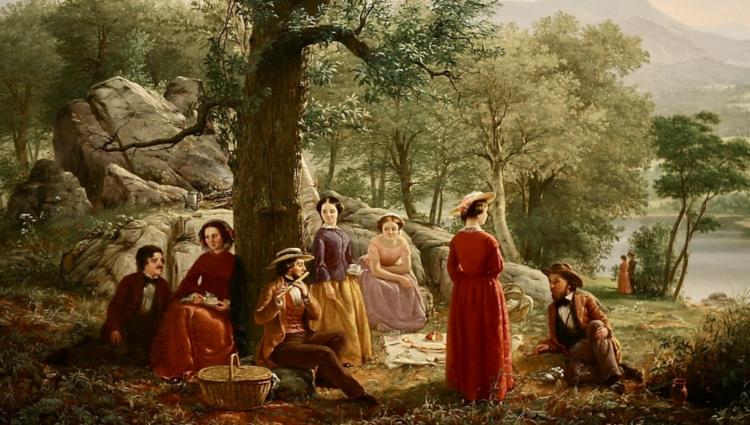
The featured image is “Recreation” (1857), by Jerome Thompson, and is in the public domain, courtesy of Wikimedia Commons.