The key to understanding Thomas More’s generous dedication to the real but limited good he could do on earth is, as Frank Mitjans makes clear, that More’s constant contemplation of God was the source of his boundless care for the souls surrounding him.
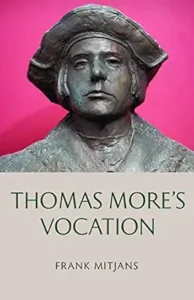
Thomas More’s Vocation, by Frank Mitjans (320 pages, The Catholic University of America Press, 2023)
 The city whose foundation we have now gone through,” Glaucon said, “has its place in speeches, since I suppose it exists nowhere on earth.” “But in heaven,” Socrates said, “perhaps, a pattern is laid up for the man who wants to see and found a city within himself on the basis of what he sees.” (Plato, Republic, 592b)
Thomas More’s 1516 masterwork Utopia takes its title from a Greek conjunction of his own coinage, meaning “No Place.” This is not Plato’s word in the passage cited above: οὐδαμοῦ (oudamou), meaning “nowhere.” But as Frank Mitjans argues in his recent study, Thomas More’s Vocation, More certainly invents the now-ubiquitous term “utopia” with an eye to this exchange in Plato’s ancient dialogue—and to the argument behind it.
In the Republic, Plato’s Socrates defends justice by likening the soul of the just man to a well-ordered city, whose rulers direct its guardians and people toward a common good discerned by right reason. Applied to our own person, this pattern means that we strive to govern our passions and measure our actions by what our intellect discerns as true, good, and beautiful.
By using an imaginary city or polis as a model of personal self-perfection, Socrates teaches a valuable if negative lesson about actual political affairs. The difficulty of approximating perfection on the individual level exposes the practical impossibility of achieving it at the level of political society, populated as it is by succeeding generations of struggling souls, and not likely always to be ruled by the most virtuous among them.
If it is hard enough to induce oneself to think, feel, and do what is right on a consistent basis, how reasonable is it to expect governments to persuade (or per impossible, to force) everyone to do so? With characteristic irony, More echoes Platonic wisdom by remarking that “it is impossible for everything to turn out well” in political society, “unless all human beings are good, and I don’t expect that to happen for some years to come.”
Even while borrowing from prior philosophers, Mitjans notes, More exhibits “a detachment and independence from their conclusions.” This holds true for More’s response to Plato’s treatment of the limits of political life.
For Socrates, the attempt to bring justice into politics is akin to Hercules’s efforts to slay the many-headed Hydra. Since he is likely to be devoured before performing the requisite number of decapitations, the prudent man will prefer to mind his own business, steering clear of public affairs unless his intervention is necessary to prevent the very worst of injustices.
Though More is well aware of the dangers of speaking truth to power, he insists that a philosopher and Christian is obliged to do what he can for the common good, even at the cost of personal sacrifice and risk. “If you cannot tear out distorted opinions by the roots, if you cannot cure long-standing vices according to your liking, that is still no reason to desert the commonwealth.” Since government exerts a powerful influence, for better or worse, on the conditions in which we seek happiness, More pleads with those possessing the requisite knowledge and skills to assist in the navigation of the ship of state: “If you cannot make something good, at least make it the least bad you can.”
The risks entailed in genuine statesmanship are by no means negligible. Aside from his authorship of Utopia, More is perhaps most famous on account of his execution in 1534 for refusing to recognize King Henry VIII as Head of the English Church. Yet how many realize that, prior to his resignation from government, More successfully encouraged Parliament to reject legislation granting the King supreme power over the English clergy? Nor was this the first time More had risked his life to oppose the pride of kings.
During his first stint in Parliament, in 1504, More persuaded that body to take the then-unusual step of nixing a tax Henry VII wished to impose upon his hitherto compliant subjects. The frustrated monarch had More’s father imprisoned, and would have come for More himself had the Grim Reaper not intervened to collect a royal harvest.
In 1523, when he was Secretary to King Henry VIII, More was elected Speaker of the House of Commons. Having petitioned the King to grant him and the assembly freedom of speech, More succeeded in thwarting then-Chancellor Wolsey’s attempt to pressure Parliament to pass another tax, narrowly escaping a retaliatory assassination attempt by pleading with Henry to shield him from his minister’s wrath.
More’s entire political career was characterized by a willingness to die if necessary not only for the sake of the Church, but for the cause of good government more generally. If even the best government is as limited as we have seen, it is all the more wondrous that More found the inspiration to risk his life for the sake of making things less bad. Tracing the roots of this inspiration is the focus of Mitjans’s illuminating book.
Without attempting to summarize Mitjans’s intricate account of More’s youthful friendships, studies, and spiritual life, we can say that the source of Thomas More’s vocation to statesmanship is glimpsed in the words of Plato quoted above—as filtered through More’s intensive engagements with other authors and with leading scholars of his day.
From Cicero, More learns that the height of wisdom is to serve one’s city, that the gifts of nature and fortune must guide one’s choice in how to do so, and that fulfilling this duty requires courage and resilience. From his friend Erasmus, More learns that “Christ on the cross draws everything to his service,” even secular knowledge and practice. From St. John Chrysostom, More learns that the Gospel is to be preached and practiced in the public forum. From St. Augustine, he learns that the contemplative life finds its fulfillment in acts of charity.
In a series of poems charting his spiritual path, More declares that the lover of God must “set” his love “unto God” in a wholly unique manner, loving him with “body, soul, wit, cunning mind, and thought,” for “part will he none but either all or naught.”
At first glance, this exclusive focus on God might seem to demand a withdrawal from active life, but More finds otherwise. Though he esteems the pleasures of this world “void of perfect joy and sure delight” in comparison to “that blessed, joyful, heavenly port” to which he is journeying, the lover of God does not neglect his fellow pilgrims. Rather, for the sake of his one true love, he strives “with fair virtue to adorn [his] soul,” enduring “any distress or sorrow” through which he and his companions must pass on the way to “the heavenly light.”
It may be odd to think of a man constantly dealing with clients, kings, courtiers, wife, children, servants, and friends as focused wholly on God. Yet the fruits of More’s spiritual program speak volumes. Erasmus echoed the testimony of countless others when he described More as a man made for friendship, who seemed to possess no limits either in the number of his friends, nor in what he would sacrifice for their benefit. And similar things could be said for his treatment of political and personal rivals, of the general public, and of future generations.
The key to understanding More’s generous dedication to the real but limited good he could do on earth is, as Mitjans makes clear, that More’s constant contemplation of God was the source of his boundless care for the souls surrounding him. By referring every relationship to the single object of all his desires, More was able to bear any sacrifice tending to his salvation and theirs.
Profiting mightily from Socrates’s suggestion, the young More plots the course of his life by tuning his soul to the pattern of heaven. Thus is he able not only to found a city in himself, but also to ameliorate the sufferings and correct the errors of this earthly city, pointing the way to a merrier meeting place in which, for those who do likewise, “God my be all in all” (1 Cor. 15:28).
__________
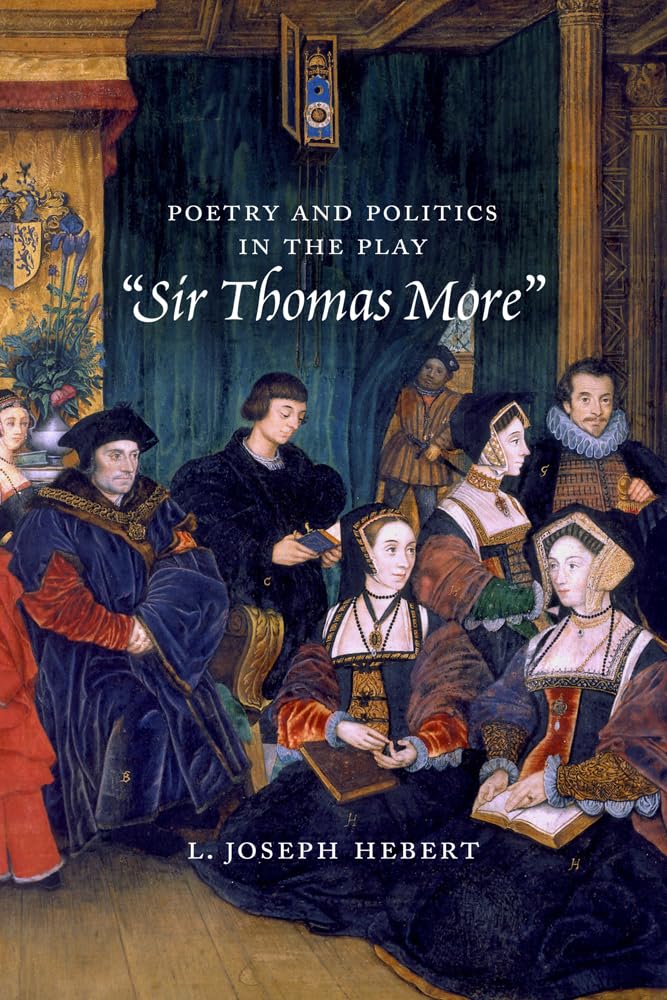
Joseph Hebert’s new book is Poetry and Politics in the Play Sir Thomas More. This essay first appeared on Mr. Hebert’s Substack.
The Imaginative Conservative applies the principle of appreciation to the discussion of culture and politics—we approach dialogue with magnanimity rather than with mere civility. Will you help us remain a refreshing oasis in the increasingly contentious arena of modern discourse? Please consider donating now.