Historians past and present have offered many guides to the Founding era, but what makes Bradley Birzer’s account so delightful are his wholehearted patriotism and the fairness with which he tells the story. In this telling, we hear the dramatic, symphonic nature of one of the most exciting political times ever recorded in the course of human events.
The Declaration of Independence: A Radical Experiment in Liberty, by Bradley J. Birzer (278 pages, Stone House Press, 2026)
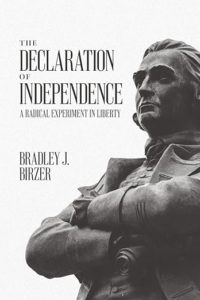 TIC founder Brad Birzer’s title is a bit misleading. While the Declaration of Independence is treated in detail, The Declaration of Independence: A Radical Experiment in Liberty is not merely an examination of the political document that the scholar of rhetoric Stephen Lucas labeled “perhaps the most masterfully written state paper of Western civilization.” Instead, this book is a perfectly-sized (253 pages of main text) survey of the historical events, persons, influences, and ideas that led to July 4, 1776, the beginning of America’s national experiment in ordered liberty.
Dr. Birzer doesn’t bring the reader to 1776 until the fourth chapter. Rome was not built in a day, nor was American independence wrought in a year. The first chapter, “Before 1774,” gives a grand picture of how the conditions that favored an independent nation were present decades before it was in sight. There were worries among the English as early as 1633 that the still-fragile colonies might one day form their own nation. Despite (or maybe because) the rough quality of life outside of European civilization, American population growth was robust from the beginning. American productivity was high. And that spirit of independence and furious love of the liberty of self-government were especially strong among the colonists, many of whom were Protestants with an often healthy but sometimes extreme aversion to inherited authority structures. One might say that American independence was determined from the start or perhaps overdetermined.
Even so, it wasn’t going to be easy. The attachment to the Mother Country was strong, even for many colonists who resented the British Parliament’s treatment of them. Britain herself was not entirely united on the question of how to approach the American colonies—or any of her colonies, for that matter. Dr. Birzer lays out the internal British arguments about what sort of empire she was to have. Would it be an empire that was like the centralized Spanish or French empires? Or would it be a decentralized commonwealth? Though many liked the latter idea better (it was promoted by Burke and Smith), some favored the former.
The ascension of George III to the throne was a critical moment. Though William Pitt and others had been fans of a “laissez-faire approach” to the colonies, King George, under the influence of Lord Bute, wanted more control. His stationing of larger numbers in North America starting in the early 1760s—ostensibly to defend against the French—was seen as provocative. So, too, was the British Parliament’s laying down of various taxes on the colonists. While skeptics of American independence (then and now) like to complain that Americans just do not like to pay taxes, the American colonists’ position was that they were producing plenty of revenue for the Mother Country after taking on all the risks of crossing an ocean to settle. More importantly, they did not believe that Parliament had the right to tax them since they could not effectively be represented in the House of Commons from across that ocean.
The arguments made by the colonists were arguments from their rights as Englishmen, but, as Dr. Birzer notes, the language of universal natural rights started to become much more prominent by the late 1760s and early 1770s. Americans were indeed claiming something particular but also increasingly universal as time went on. They also became much more vehement in their claims.
The second chapter, “1774,” details both how the British attempted to clamp down on the colonies via the so-called Intolerable Acts as well as the Quebec Act. Of the latter act, we can say that it angered the people of the thirteen colonies because it expanded Canadian territory, centralized the government within Canada, and also offered toleration to Catholics. Though Dr. Birzer is himself Catholic, he never shies away from the reality of anti-Catholic feeling and even policy among the Founding generations.
Yet, for every British action, the American reaction was just as strong, if not stronger. The problem, as Dr. Birzer highlights along the way, is that when we talk about “the American” viewpoint, we have to remember it was a mixed one. The First Continental Congress in 1774 was divided among the “Reconciliationists,” “Radicals,” and “Moderates.” Even among those Radicals who were for independence, the great worry was how exactly such an independent nation would be organized.
While the Radicals didn’t get all they wanted in 1774, they did get the Suffolk Resolves approved, by which the American colonists called for “non-importation, non-exportation, and non-consumption, thus directly hitting the empire in the economic realm.” This forceful pushback on the Mother Country caused yet another British reaction. King George addressed Parliament on November 30, 1774, and declared that the ringleader, namely the Massachusetts Bay Colony, “has in divers parts of it broke forth in violences of a very criminal nature.” He vowed to ensure that Parliament would keep “supreme authority…over all the dominions of my crown….”
By February 1775, Parliament officially declared that Massachusetts was in a “state of rebellion.” War was coming. The third chapter, “1775,” begins with this declaration, and notes that even before the bullets began to fly in April, the war of ideas was fully raging. On the side of Britain, Dr. Birzer covers three representative writers: Samuel Seabury, William Allen, and the great Dr. Samuel Johnson. As Dr. Birzer had warned in his introduction, he does include some very long excerpts from writings throughout this book. While some will find this annoying, those who want to get in the heads of all sides of the debates will love reading Dr. Johnson (against) and Edmund Burke (for) American independence.
If there’s a complaint about the long quotations, it is that some of them do not seem to be properly blocked off in the text. Though it often became clear because of antique spelling or diction, this reader was occasionally briefly confused as to whether a passage was written in 2025 or 1775. Nevertheless, these historical passages are fun. Even when discussing armed battles, Dr. Birzer often offers multiple testimonies of what happened. Those first shots at Lexington are told by three different eye-witness accounts. So, too, many perspectives are presented among those firing intellectual shots on the side of the American Patriots.
As 1775 ended, some Americans still wanted peace and a deal with the Mother Country. More and more, however, agreed with Benjamin Rush, who wrote on October 29 that a “decree of heaven” had been issued that declared: “Britain and America will hereafter be distinct empires.” That may have been so, but John Adams, writing less than a month later, was worried about the vast divisions among the American people—especially between the northern and southern colonies. While they were definitely e pluribus, how to forge them into unum?
Adams asked a real question, but there was little time to answer it. By January 5, 1776, New Hampshire rewrote its own constitution to prepare for independence. George III, who had declared in a speech on October 26, 1775, that the colonies “now openly avow their Revolt, Hostility, and Rebellion,” had signed the American Prohibitory Act on December 22, 1775. That signature authorized the seizure of all American property being carried on the high seas by the King’s navy. There was no turning back.
The rest of the American colonies followed New Hampshire’s lead. Thomas Paine’s Common Sense, which argued for the cause of independence, had inspired many in the colonies. Though John Adams didn’t like Paine’s book that much, he was glad it was convincing others. Adams was still very worried about the form of government that the nearly-independent nation would take. Much of Dr. Birzer’s chapter on 1776 focuses on the discussions among Adams and others on what kind of a government this nation was to have, even as the pressure mounted. Even to the very end, Adams was a worrier about the details.
The Declaration of Rights authored by George Mason for the Virginia legislature was introduced on June 6, 1776, passed on June 12, and became the basis for the Virginia Constitution that was passed on June 30. Virginia’s ties with the Mother Country were cut. Yet, the Virginians were not only acting as a colony but also within the context of the Second Continental Congress. Richard Henry Lee proposed independence within that body on June 7. Though some of the colonies balked, the movement was becoming stronger and stronger. By July 2, the vote was made. Independence was declared. We celebrate on July 4 because it was on that day that the Declaration drafted by Jefferson and edited by Congress was passed.
In the final two chapters, Dr. Birzer discusses both the text and the sources of this bit of genius that Americans celebrate. As in the rest of the book, he is keen to note both the conservative aspects of the Declaration and its sources, as well as the radical aspects of its claims. It does root itself in natural law and natural rights, which are themselves rooted in God. Jefferson’s original draft was not quite as explicit on the divine connection, but the rest of the editors were keen to make that clear. They wanted to be clear that what they were claiming were the rights of Englishmen but also the rights of men as men under God. And they were insistent on political equality under the law, even if they could not guarantee that equality immediately.
Where did the American ideas come from? The final chapter covers the influences on the Revolution from the standpoint of Jefferson: Aristotle, Cicero, Algernon Sidney, and John Locke. Aristotle may not have been cited as much, but his understanding of the monarchical, aristocratic, and democratic elements of rule was essential. Jefferson and many of the Founders cited the thinker Dr. Birzer amusingly calls “Marcus T. Cicero” about the need for mixed government along with much else for a fledgling republic. Dr. Birzer finds the Catholic claim to hidden Thomistic influence through Sidney’s use of Bellarmine and other Catholic thinkers accurate—as long as one doesn’t get carried away with it. And, in contrast to some postliberal accounts, Dr. Birzer thinks the influence of Locke, for better and for worse, is important but often oversold.
Historians past and present have offered many guides to the Founding era, and Dr. Birzer assimilates many of them into his account alongside original sources. What makes his account so delightful are his wholehearted patriotism and the fairness with which he tells the story. Colonists, ministers, congressmen, and militiamen are all heard. Not always in unison—they often produced dissonance. But, in this telling, we hear the dramatic, symphonic nature of one of the most exciting political times ever recorded in the course of human events.
__________
The Imaginative Conservative applies the principle of appreciation to the discussion of culture and politics—we approach dialogue with magnanimity rather than with mere civility. Will you help us remain a refreshing oasis in the increasingly contentious arena of modern discourse? Please consider donating now.
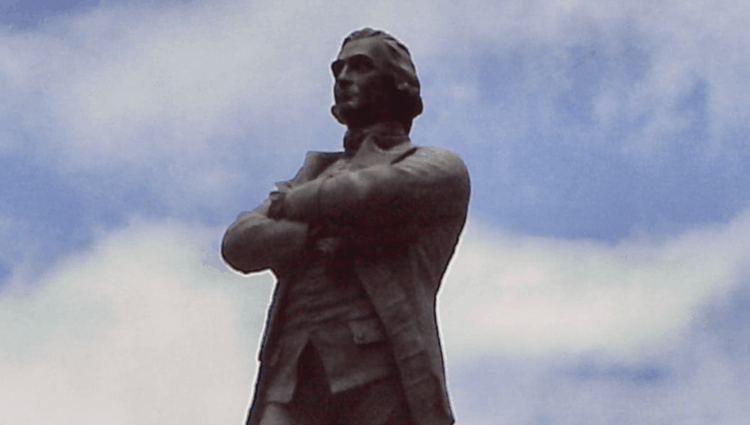
The featured image, uploaded by DiscoA340, is a photograph of the statue of Samuel Adams in Boston, Massachusetts, taken 9 June 2016. This file is licensed under the Creative Commons Attribution-Share Alike 4.0 International license, courtesy of Wikimedia Commons.