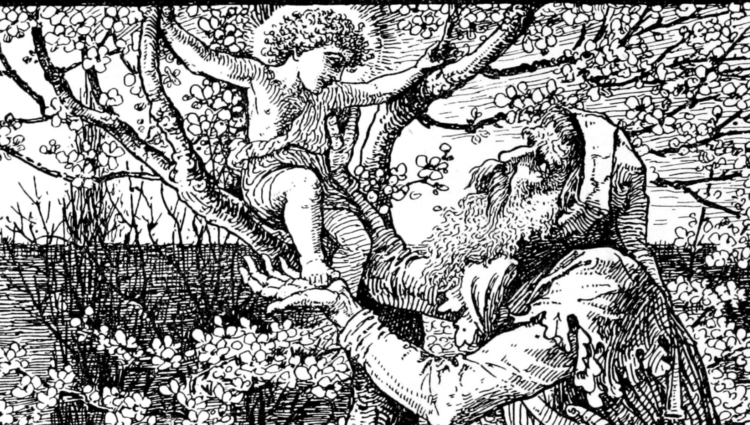
 Lovers of great children’s literature have probably read and enjoyed “The Selfish Giant” by Oscar Wilde, which Wilde had originally written for his own children, reading it to them with tears in his eyes. In the story, the Giant is healed of his selfishness by the love of a child. Angered by his discovery that the innocent child had wounds on his hands and feet, the Giant is consoled by the child who tells him that “these are the wounds of Love”.
“Who art thou?” said the Giant, and a strange awe fell on him, and he knelt before the little child.
And the child smiled on the Giant, and said to him, “You let me play once in your garden, to-day you shall come with me to my garden, which is Paradise.”
And when the children ran in that afternoon, they found the Giant lying dead under the tree, all covered with white blossoms.
Unbeknownst to Oscar Wilde at the time of “The Selfish Giant’s” publication in 1888, the happy ending to his wonderful fairy story would prove prophetic of Wilde’s own happy ending twelve years later.
No doubt such a statement, and such an insistence that Wilde died happily, will come as a great surprise to those familiar with the sordid lifestyle which led to his fall from grace to disgrace, and the squalid poverty in which he lived following his release from prison.
Indeed, it must be confessed that Wilde’s final days in a hotel room in Paris were anything but pretty and anything but happy. The happy ending would not come until the very end. It was Wilde’s deathbed conversion, his reception into the Catholic Church on the day before his death, which was the happy ending to his mortal life and the beginning of his living happily ever after in the undying lands of eternity.
Ironically and perversely, there are those who would deny Wilde his happy ending, who resent it, who see it as a betrayal of the principles of Pride and the practice of the homosexual lifestyle which Wilde had adopted.
During the final decade of his life, which was a decade of decadence, Wilde had become a selfish giant, abandoning his wife and children for a life of homosexual self-indulgence, ruining their lives and eventually ruining his own. And yet many of Wilde’s admirers prefer the selfish giant to the husband and father, to the pater familias who had written fairy-stories for his own children which have since delighted generations of other people’s children. These admirers of the decadent Wilde prefer the selfish giant who procured the “services” of young male prostitutes to the loving husband and doting parent. Such is their contempt for Wilde’s happy ending that they have sought to deny it, insisting that his sins were not forgiven and that he died as pridefully as he had lived with all his sins clinging to him.
The denial of the happy ending is built on the suggestion that the account of the deathbed conversion was a lie concocted by Robert Ross, Wilde’s devoutly Catholic friend, who was the only person present except for the priest whom Ross had summoned to the deathbed. In an article in the St James’s Gazette in early 1905, an anonymous author had sought to pour scorn on Ross’s account of Wilde’s death: “He did not become a Roman Catholic before he died. He was, at the instance of a great friend of his, himself a devout Catholic, ‘received into the Church’ a few hours before he died; but he had then been unconscious for many hours, and he died without ever having had any idea of the liberty which had been taken with his unconscious body.”
One wonders how the anonymous author could have known that Wilde was unconscious for several hours prior to his death, considering that the anonymous author was not there to witness the scenario he describes. Nonetheless, the seeds of doubt having been sown, it became commonplace to deny Wilde’s happy ending on the grounds that he was unconscious or not of sound mind (non compos mentis) and that Robert Ross’s account was a lie.
All this changed in May 1961 with the publication of an article in the London Magazine by a priest who was a colleague and friend of the priest who ministered to Wilde in extremis. The author, Fr. Edmund Burke, quoted from the papers of the late Fr. Cuthbert Dunne, the Irish Passionist priest, based in Paris at the time of Wilde’s death, who answered Robert Ross’s call.
Let’s take up the story in the words of Robert Ross and Fr. Dunne, the only people present.
Ross’s account is clear and unequivocal: “When I went for the priest to come to his death-bed he was quite conscious and raised his hand in response to questions and satisfied the priest, Father Cuthbert Dunne of the Passionists. It was the morning before he died and for about three hours he understood what was going on … that he was given the last sacrament.”
Now for Fr. Dunne’s account: “When we reached the little bedroom of the hotel, the attendants were requested to leave. Robert Ross knelt by the bedside, assisting me as best he could while I administered conditional Baptism, and afterwards answering the responses while I gave Extreme Unction to the prostrate man and recited the prayers for the dying.”
It is clear from this report that Wilde was unable to speak. But was he conscious and compos mentis? Could he hear and understand what was going on? Fr. Dunne had no doubt that Wilde was fully aware of what was happening:
He made brave efforts to speak, and would even continue for a time trying to talk, though he could not utter articulate words. Indeed, I was fully satisfied that he understood me when told that I was about to receive him into the Catholic Church and give him the Last Sacraments. From the signs he gave, as well as from his attempted words, I was satisfied as to his full consent. And when I repeated close to his ear the Holy Names, the Acts of Contrition, Faith, Hope and Charity, with acts of humble resignation to the Will of God, he tried all through to say the words after me.
Fr. Dunne was a good, conscientious priest in the carrying out of his duty to the dying man, visiting Wilde on several other occasions after the initial visit. “At these subsequent visits,” Fr. Dunne wrote, “he repeated the prayers with me again and each time received Absolution.”
There is perhaps no better way to evoke the beauty of Wilde’s reception into the Church in extremis than in the beautiful words of one of his decadent disciples, Ernest Dowson, in his poem, “Extreme Unction”:
Upon the eyes, the lips, the feet,
On all the passages of sense,
The atoning oil is spread with sweet
Renewal of lost innocence.
The feet, that lately ran so fast
To meet desire, are soothly sealed;
The eyes, that were so often cast
On vanity, are touched and healed.
From troublous sights and sounds set free;
In such a twilight hour of breath,
Shall one retrace his life, or see,
Through shadows, the true face of death?
Vials of mercy! Sacring oils!
I know not where nor when I come,
Nor through what wanderings and toils,
To crave of you Viaticum.
Yet, when the walls of flesh grow weak,
In such an hour, it well may be,
Through mist and darkness, light will break,
And each anointed sense will see.
Returning to the analogy with the Selfish Giant, we can picture Wilde, having received the sacraments, his mortal life having passed, “lying dead under the tree, all covered with white blossoms”. The tree is the cross, upon which Christ hangs, wearing “the wounds of Love”, beneath which the sinner, absolved from his many sins, wears a shroud of white blossoms, signifying his return to childlike innocence.
As for those who prefer Wilde’s pride to his humility, and who prefer his sins to the forgiveness of them, we will let Fr. Cuthbert Dunne condemn their injustice “done to a dead man who can say no word in self defence, and who, whatever his sins might have been, expiated them by suffering severe penalties: imprisonment, ostracism from the great world in which he had been an idol, loss of all that the cultivation of his brilliant talents had brought him, poverty in which he was left dependent on others for his sustenance. After all this, he turned to God for pardon and for the healing grace of the Sacraments in the end, and died a child of the Catholic Church.”
___________
The Imaginative Conservative applies the principle of appreciation to the discussion of culture and politics—we approach dialogue with magnanimity rather than with mere civility. Will you help us remain a refreshing oasis in the increasingly contentious arena of modern discourse? Please consider donating now.
The featured image is “Plate illustrating a story ‘The Selfish Giant’ in Wilde’s The Happy Prince and Other Tales. London: Nutt. 1st ed., 1888″ and is in the public domain, courtesy of Wikimedia Commons.