
I have to admit that I did not immediately warm to Karen Ullo’s novel. This was due to my own prejudice against both historical fiction and women’s romance. I was mistaken. Ullo won me over, and I came to admire and root for her protagonist, a tough but tender Frenchwoman.
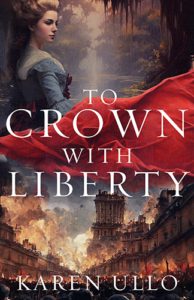 In my continued trawl through contemporary Catholic fiction, I have read action-hero books about a tough NYPD cop with mystical powers, introspective literary novels, fantasy, science fiction, children’s stories, and fairy tales. Romance and historical fiction were not on my list, but having been in touch with Karen Ullo, Editorial Director and co-founder of Chrism Press for some suggested titles, it seemed a good idea to read To Crown With Liberty, her own third novel (after Jennifer the Damned and Cinder Allia).
Ullo’s story follows Alix de Morainville Carpentier, a fictionalized noblewoman who becomes a lady-in-waiting to Marie Antoinette. After her family and friends are threatened by the Reign of Terror, Alix flees to Spanish Louisiana in 1795, now married to Joesph— her family’s gardener. In the Attakapas swamp near New Orleans, she confronts the trauma of her past, the choices she made to survive (at the cost of honor and possibly her soul), and questions of freedom, faith, and belonging.
The novel contrasts the collapse of the Old World in revolutionary France—where ideals of liberty, equality, and fraternity turn into violence and bloodshed—with the emerging optimism of the New World, where however, slavery and other forms of oppression persist. Ullo weaves in Catholic themes of redemption, grace, and the search for true liberty and happiness, drawing on legends from George Washington Cable’s Strange True Stories of Louisiana (1888).
The contrasts in themes and settings are matched by Ullo’s chosen style. She uses a split timeline with her heroine’s adventures in the New World intercut with her backstory: her aristocratic childhood, romance and marriage in France and the upheavals and ultimate terror of the French Revolution. Readers used to a conventional linear narrative may find the fractured story disconcerting, but Ullo uses it to good effect, maintaining tension by withholding interesting and vital information as she skips back and forth in the two times and settings. This technique also skillfully reveals the development of Alix’s character through her difficulties, and we see them resolved skillfully as the braided storylines converge.
My screenwriting tutor said the fantasy or science-fiction storyteller must know his created world better than God knows His world. Every detail must fit. Loose ends, plots, and sets can’t have holes lest the author lose his reader’s/viewer’s trust. The same dictum must surely apply to the author of historical fiction because the author is, essentially, creating an alternative world. However, the historical fiction author’s challenges are compounded because his alternative world (the historical setting) can be fact-checked.
In this respect Karen Ullo has done an outstanding job. She has mastered the details of eighteenth-century France—the court at Versailles and the geography of Paris—and as far as I know, she was also convincing with the details of the period’s costumery, manners, food, politics, economics, and social customs. Not only that, she also convincingly conjured up the French colony of Louisiana at the time, mastering the backwoods culture and customs, the ethnicities and languages in the melting pot of the New World, as well as creating a colorful and believable cast of characters each with their own story that interweaves with Alix’s. Her tapestry is complete with the threads of romance and faith woven through as the unifying element.
“Catholic fiction” is difficult because the traps are so numerous. One has to navigate through the temptations of theme-driven stories, shallow allegory, sentimental spirituality, overly obvious moral dilemmas, and pastiches that echo too heavily the famous heavy hitters of Catholic culture: Lewis, Tolkien, Waugh, Chesterton, etc. One also has to tiptoe through the culture clash of popular fiction vs. literary fiction. Does one write ripping good stories and hope the truth seeps through, or does one attempt stories that more consciously embody the truth and risk being preachy?
In addition to these challenges the author must hit his target audience on the bullseye. Is my audience Catholic? How much sex, violence and foul language will they tolerate? How do I handle those elements realistically but not explicitly? If our author wins through all those challenges there remains the challenge of getting published, getting reviewed, and getting read in a world where fewer and fewer people are happy to curl up with a good book. As one frustrated novelist said to me, “Writing the damn thing was like climbing Everest, then when I realized how hard it was to get published, I realized that was like climbing Everest a second time.”
I have to admit that I did not immediately warm to Karen Ullo’s novel. This was due to my own prejudice against both historical fiction and women’s romance. I’m afraid on first taste I relegated the book to one of those cheesy romances set in the antebellum South, with heroines with heaving bosoms, breathless passions, and a naughty negro maid.
I was mistaken. Ullo won me over, and I came to admire and root for her tough but tender Frenchwoman. Ullo stepped skillfully and successfully through the aforementioned minefield. Alix overcomes a physical disability, a dysfunctional family, a frustrated love, and the violence and turmoil of revolution to win through to learn reconciliation, maturity, and a true understanding of liberty, fraternity, and equality. Very soon I was on her side.
As one should with historical fiction, I also learned a lot about a fascinating period of history—both in France and the New World—about which I was ignorant. My reading of the novel overlapped with listening to The Rest is History podcast series on the French Revolution and also overlapped with Pope Leo’s recent visit to Paris. Seeing him celebrate Mass for nearly a million French people at the very site of the guillotine brought home the importance of history and the passion and power of those times made real by Ullo’s important story of Alix de Morainville Carpentier.
Final verdict? Tolle lege, tolle lege. Take up and read!
__________
The Imaginative Conservative applies the principle of appreciation to the discussion of culture and politics—we approach dialogue with magnanimity rather than with mere civility. Will you help us remain a refreshing oasis in the increasingly contentious arena of modern discourse? Please consider donating now.