 “The city comes into being for the sake of life, and the city exists for the sake of the good life,” (Aristotle, Politics I.2, 1252b27–30).
In this quotation from Aristotle’s Politics, he sets out the two reasons any city or nation is founded. The first is a practical reason: “for the sake of life”—i.e., so that its inhabitants might be safe from all intranquility and unrest, both foreign and domestic. The second reason is nobler and expresses the city or the nation’s ultimate goal: “for the sake of the good life.”
Both of these reasons for establishment are echoed in the Declaration of Independence. That the city or nation comes into being for the sake of life is shown by Thomas Jefferson’s insistence that life is an inalienable right. The principle that the city or nation exists for the sake of the good life is shown by the other two enumerated inalienable rights: “liberty and the pursuit of happiness.”
The good life is nothing more than a life lived in the pursuit of happiness.
The author of the Declaration of Independence did not understand “happiness” in the same way many moderns do, to be a passing emotional or hormonal contentment, but rather—classically trained in the liberal arts—he credited a passage from Cicero’s Tusculan Disputations as the epitome of his philosophy of happiness.
For Cicero, the happy man possesses peace of mind through moderation, consistency, and the classical virtues (see Cicero, Disputationes Tusculanae, IV.XVII). Simply put, the happy man is the virtuous man.
And it is for this reason that our nation was founded: that we might have the security of nation to pursue a way of life founded on and ordered to virtue—a life ordered to the pursuit of happiness.
Now, on this semi-quincentennial anniversary of our independence, it falls to us, standing on two and a half centuries of American tradition, founded on the security of life and liberty, to order our daily lives to the pursuit of happiness.
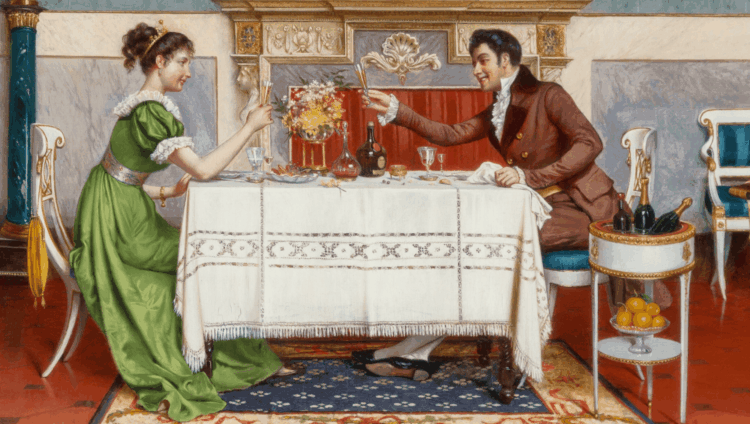
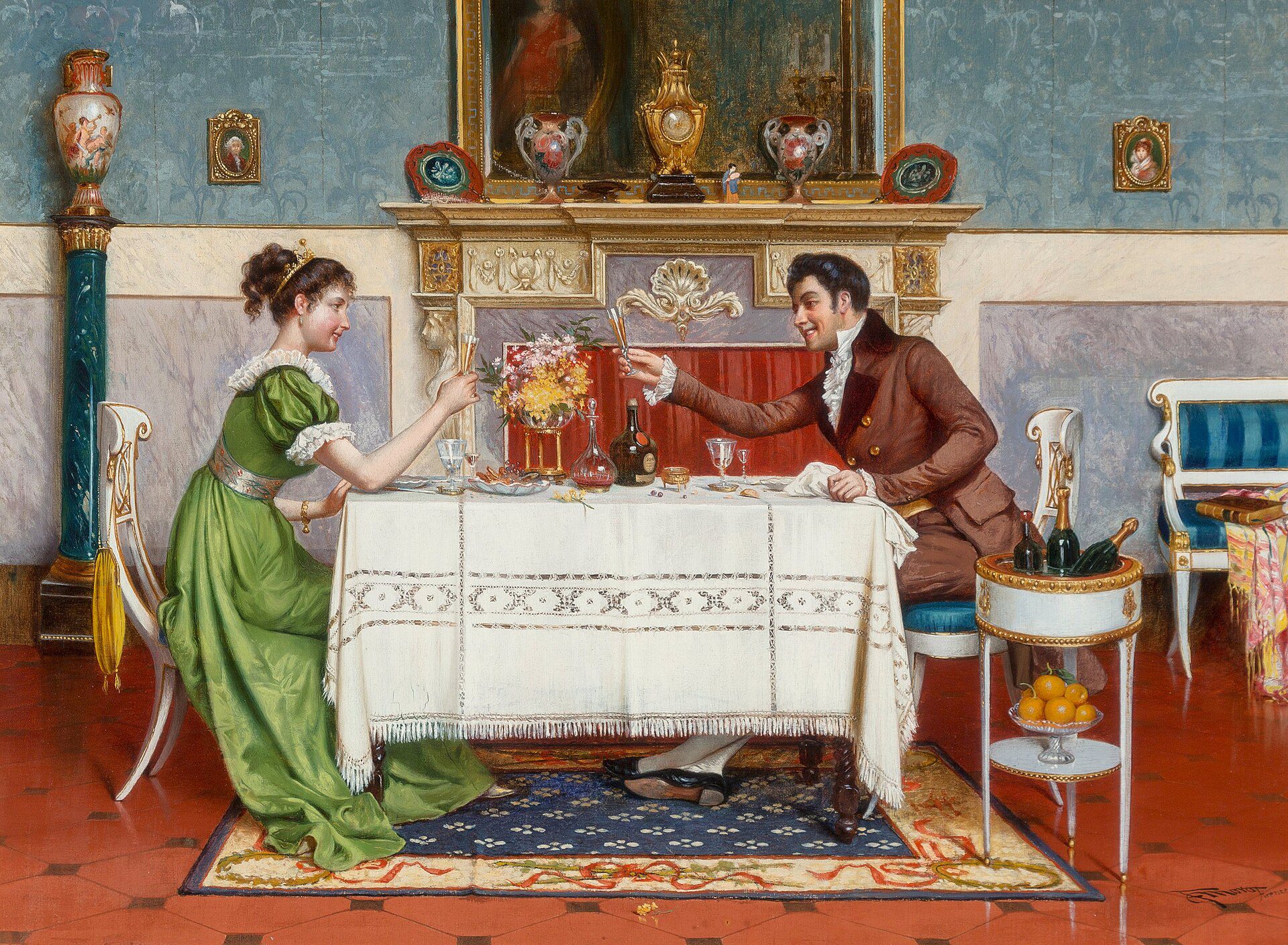
Please raise your glasses and join me in this toast to the pursuit of happiness.
__________
The Imaginative Conservative applies the principle of appreciation to the discussion of culture and politics—we approach dialogue with magnanimity rather than with mere civility. Will you help us remain a refreshing oasis in the increasingly contentious arena of modern discourse? Please consider donating now.
The featured image is “The Champagne Toast” by Ferrucio Moro, and is in the public domain, courtesy of Wikimedia Commons.