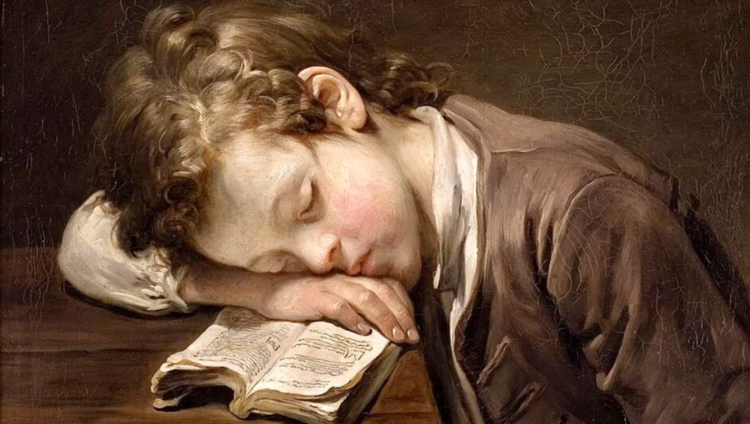
Were Tolkien and Chesterton correct in defining the English as inherently inert and slavishly slothful?
Smile at us, pay us, pass us; but do not quite forget;
For we are the people of England, that never have spoken yet.
—G. K. Chesterton (The Secret People)
It is June 9, 1941. Britain is at war. J. R. R. Tolkien writes to his son, Michael, who is an Officer Cadet at the Royal Military College at Sandhurst in Berkshire. The letter is full of fascinating musings, including a judgment on the “sloth” of the English:
I suppose the major English vice is sloth. And it is to sloth, as much or as more than to natural virtue, that we owe our escape from the overt vices of other countries. In the fierce modern world, indeed, sloth does begin almost to look like a virtue. But it is rather terrifying to see so much of it about, when we are grappling with the Furor Teutonicus.
 The phrase furor teutonicus, attributed originally to the First Century Roman poet Lucan, referred to the fury, battle frenzy and cruel bloodlust of the Teutonic tribes warring against the Roman Empire. Tolkien is applying it to contemporary Germany and the fury unleashed by Hitler’s Third Reich but he is rooting it nonetheless in Lucan’s classical understanding of such fury as being a perennial part of the essential character of the Germanic people in all ages. It is in this classical light that we should see his reference to English sloth, desidia anglica, as something that is a perennial character trait of the English people. To what extent can such sloth be attributed to the English people in all ages and to what extent might such sloth, indubitably a vice, “begin almost to look like a virtue”. The answer would seem to be connected to Tolkien’s suggestion that it saved England from “the overt violences of other countries”.
Reading Tolkien’s words, it is easy to hear echoes of Chesterton’s poem “The Secret People,” in which Chesterton compares the overt violence of other nations, especially in terms of their national revolutions, with the people of England “that never have spoken yet”. As with most literary Catholics of his generation, Tolkien read a great deal of Chesterton in his youth and it seems certain that he would have known Chesterton’s poem. His daughter Priscilla recalled her father reciting Chesterton’s poem “Lepanto” and she remembered her father reading to her Chesterton’s long epic poem, The Ballad of the White Horse. In addition, a good friend, George Sayer, affirmed that Tolkien knew several of Chesterton’s poems “by heart”.
Knowing that Tolkien probably knew “The Secret People”, it’s intriguing to read the poem in the light of Tolkien’s assertion that “sloth” is the defining vice of the English people which had preserved England from revolution and “the overt vices of other countries”.
The poem presents a sketch of English history from the time of the Norman Conquest to the present day. It is spoken in the narrative voice of the English people themselves, the “we” and the “us”, and the refrain is that “we have not spoken yet”.
In the section of the poem about the so-called English “Reformation” and the destruction of the monasteries, we see the injustice of “Reform” and the apparent slothfulness of the English in responding to it:
They burnt the homes of the shaven men, that had been quaint and kind,
Till there was no bed in a monk’s house, nor food that man could find.
The inns of God where no man paid, that were the wall of the weak.
The King’s Servants ate them all. And still we did not speak.
The narrative fast forwards a century to the English Civil War in the mid-seventeenth century and the act of regicide which followed in its wake:
And the face of the King’s Servants grew greater than the King:
He tricked them, and they trapped him, and stood round him in a ring.
The new grave lords closed round him, that had eaten the abbey’s fruits,
And the men of the new religion, with their bibles in their boots,
We saw their shoulders moving, to menace or discuss,
And some were pure and some were vile; but none took heed of us.
We saw the King as they killed him, and his face was proud and pale;
And a few men talked of freedom, while England talked of ale.
The suggestion is that the people of England tolerated tyranny, preferring to imbibe their fermented beverages in peace than to foment violence in the cause of freedom. There is the suggestion that their political inertia and indifference is the sloth of the slave who embraces his fate.
Then comes the age of revolution, which sets the world aflame but remains unkindled on English soil:
A war that we understood not came over the world and woke
Americans, Frenchmen, Irish; but we knew not the things they spoke.
The narrative continues with the Napoleonic Wars that followed in the wake of the French Revolution. The English fought heroically in foreign wars, proving their courage, but they remained indifferent to the oppression they suffered at home:
Men called us serfs and drudges; men knew that we were men.
In foam and flame at Trafalgar, on Albuera plains,
We did and died like lions, to keep ourselves in chains,
We lay in living ruins; firing and fearing not
The strange fierce face of the Frenchmen who knew for what they fought,
And the man who seemed to be more than a man we strained against and broke;
And we broke our own rights with him. And still we never spoke.
Chesterton’s poem moves to the Victorian age in which imperialism and industrialism are in the ascendant and in which a new mercantile class emerges to replace the old aristocracy:
… the last sad squires rode slowly towards the sea,
And a new people takes the land: and still it is not we.
If anything, the new class of ruling merchants in the age of commerce is worse than the aristocracy that it has replaced:
They have given us into the hand of new unhappy lords,
Lords without anger or honour, who dare not carry their swords.
They fight by shuffling papers; they have bright dead alien eyes;
They look at our labour and laughter as a tired man looks at flies.
And the load of their loveless pity is worse than the ancient wrongs,
Their doors are shut in the evening; and they know no songs.
And so we come to Chesterton’s own time and the suggestion that the English people might finally throw off their perennial sloth and slavery, staging a revolution of their own:
We hear men speaking for us of new laws strong and sweet,
Yet is there no man speaketh as we speak in the street.
It may be we shall rise the last as Frenchmen rose the first,
Our wrath come after Russia’s wrath and our wrath be the worst.
It may be we are meant to mark with our riot and our rest
God’s scorn for all men governing. It may be beer is best.
But we are the people of England; and we have not spoken yet.
Smile at us, pay us, pass us. But do not quite forget.
It’s well over a century since Chesterton’s poem was published and there’s still no apparent sign of an English Revolution. Does this mean that Tolkien and Chesterton are correct in defining the English as inherently inert and slavishly slothful? Should we “quite forget” those who have not spoken yet? Will they ever speak? Is beer best?
These questions will be answered, dear reader, if we revisit Chesterton’s poem from the proper perspective of English history, a perspective which Chesterton’s retrospective “people” get wrong. The truth that Chesterton’s “people of England” forget is that the real people of England have spoken for their liberty. They have fought for their freedom. They have died for it. They have had their own revolutions. The English, as we shall see when we revisit Chesterton’s poem next week, can be and have been as “revolting” as the French, or the Russians, or the Americans, albeit for a cause more noble. For the truth about the people of England, a fact they should regret, is that their story is quite forgotten, and must be remembered yet.
__________
The Imaginative Conservative applies the principle of appreciation to the discussion of culture and politics—we approach dialogue with magnanimity rather than with mere civility. Will you help us remain a refreshing oasis in the increasingly contentious arena of modern discourse? Please consider donating now.
The featured image is “The Lazy Boy” (1755), by Jean-Baptiste Greuze, and is in the public domain, courtesy of Wikimedia Commons.