A Republican 9-0 map is possible by cracking Nashville and Memphis across multi-county districts.
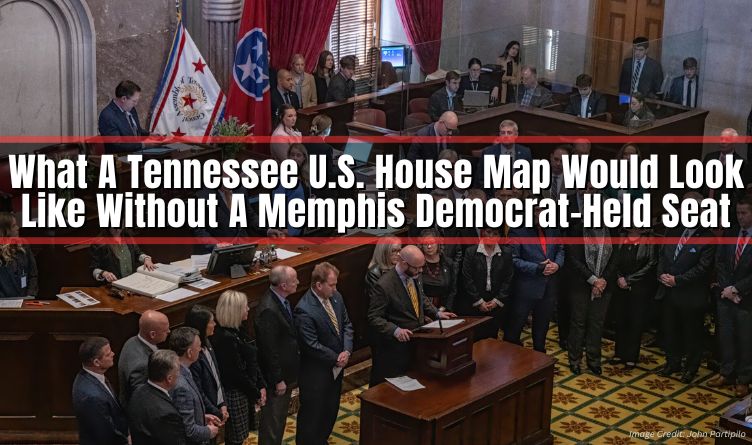
Image Credit: John Partipilo
***Note from The Tennessee Conservative – this article posted here for informational purposes only. Per The Tennessee Lookout’s Republishing Guidelines, this article has been edited for writing style & length.***
By Adam Friedman [Tennessee Lookout -CC BY-NC-ND 4.0] –
President Donald Trump announced Thursday that Tennessee’s legislative leaders had agreed to draw new maps that would eliminate the state’s only majority-minority district in Memphis in hopes of handing Republicans a 9-0 advantage in the state’s U.S. House map.
On Friday, May 1, Governor Bill Lee officially called a special legislative session of the Tennessee General Assembly to review and potentially redraw Tennessee’s congressional map after the U.S. Supreme Court ruled that districts can no longer be created using race-based metrics.
Trump’s declaration came one day after the U.S. Supreme Court struck down a section of the Voting Rights Act that required southern states like Tennessee to draw majority-minority U.S. House districts to help Black voters choose representatives.
“We should be clear that any map that breaks up Memphis is about diluting Black voting power,” said state Sen. Charlane Oliver, a Nashville Democrat. “That’s what happened in Nashville.”
Over the years, this tenet of the law has ensured that one U.S. Congressional district is based in Memphis and has always been held by the Democrat Party. The Supreme Court ruling, combined with past decisions allowing partisan gerrymandering, now makes it legal to break up the Memphis congressional district as long as state lawmakers can prove it’s for partisan, not racial, reasons.

This is not the first time state Republicans have redrawn districts for partisan benefit. After the 2022 redistricting cycle, Republicans increased their advantage in the state’s congressional representation from 7-2 to 8-1 by gerrymandering the Democrat stronghold of Nashville across three districts, rather than having one district encompass the whole city.
U.S. Sen. Marsha Blackburn, a Republican running for governor this year, shared a photo on social media of a map showing the GOP winning all nine congressional districts by healthy margins.
The Lookout, using the nonpartisan Dave’s Redistricting, was able to replicate a similar map to the one Blackburn proposed, but not with the same margins she posted. Based on the 2024 Presidential election, Republicans could achieve a 9-0 outcome, essentially cracking Nashville and Memphis, but would shrink their margins in almost every district.
“In a year where Democrats could perform really well, these Republicans could end up creating a map with more chances for the party to compete,” said Lisa Quigley, former chief of staff to Nashville Democrat U.S. Rep. Jim Cooper. “Plus they lose a lot of the incumbency advantage.”
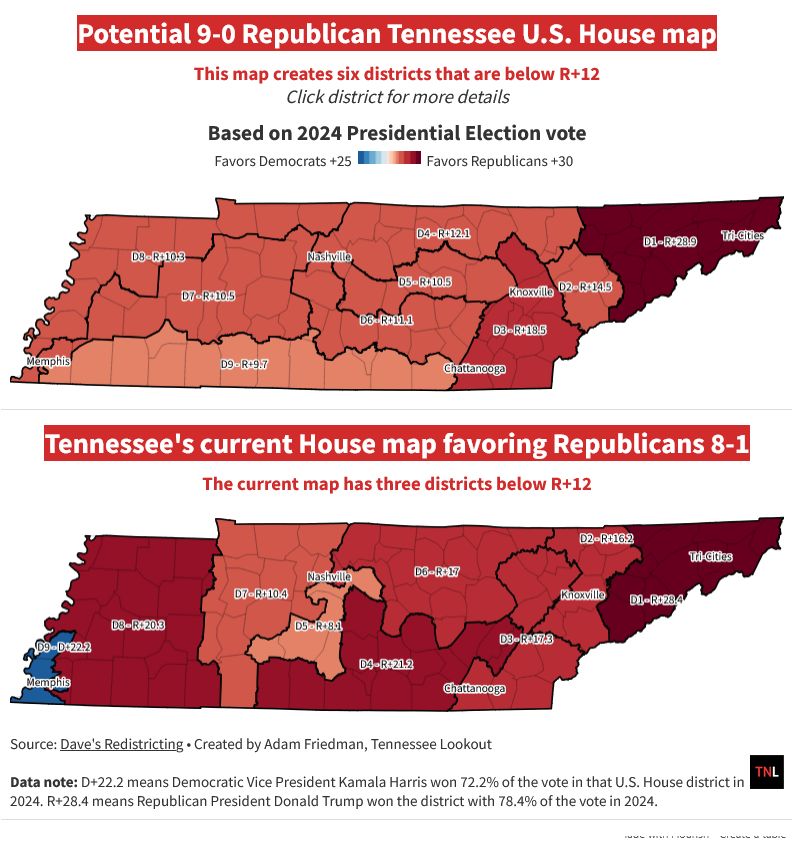
The map created by the Lookout shows nine districts where Republicans won 60% of the vote based on the 2024 Presidential election. But now six districts would have Republican margins of less than 12 percentage points, compared to the current two.
This map also shows Republicans would have only one seat where they won by more than 20 percentage points, compared to the current three.
The special session will need to quickly pass and implement any new map. The legislative session ended April 23, and qualifying deadlines for the current U.S. House map have already passed.
The primary elections are set for Aug. 6 and the general election for Nov. 3.
Trump has been pressuring Republicans across the country to draw new maps that would hopefully give his party more of an advantage in a midterm election. The party of the President in power usually loses enough seats in midterm elections to flip control of the U.S. House.
Typically, Tennessee and most states redraw their maps every 10 years after the U.S. Census. Tennessee drew new maps in 2022 and would again in 2032.
But Trump pushed Texas in 2025 to redistrict mid-cycle, kicking off a back-and-forth by both parties to partisan gerrymander their U.S. House map in the state legislatures where one party has complete control.