Image Credit: Canva
Note from The Tennessee Conservative: Editorial statements in this column are the sole opinion of the author; they do not necessarily reflect the opinions of the staff of this publication.
Submitted by Peter Maher –
Tennessee’s Advisory Committee on Open Government (ACOG) was created to strengthen compliance with the state’s public records and open meetings laws that are themselves grounded in the fundamental principles of our First Amendment: the public’s right to know, the freedom to receive information, and the transparency necessary for meaningful civic participation.
Its purpose is straightforward: promote openness, guide public officials, and ensure citizens have access to government activity. But recent records and official responses raise a more fundamental question—whether the body tasked with safeguarding these core constitutional values has consistently adhered to the same statutory standards and transparency principles it exists to uphold.

Statutory Duties: Public Meetings and Annual Reporting
Under Tennessee law, ACOG has several core obligations.
First, the statute explicitly requires that the committee “shall meet at least once during each calendar year.” Tenn. Code Ann. § 8‑4‑603(a)(2)(C)(i).
Second, the statute requires ACOG to submit a detailed annual report of its activities by March 1 each year to a defined group of state officials, including the Governor and legislative leadership. Tenn. Code Ann. § 8‑4‑603(b)(1).
These are not merely procedural requirements. They are the mechanisms through which ACOG itself is held accountable.
Where Are the Public Reports?
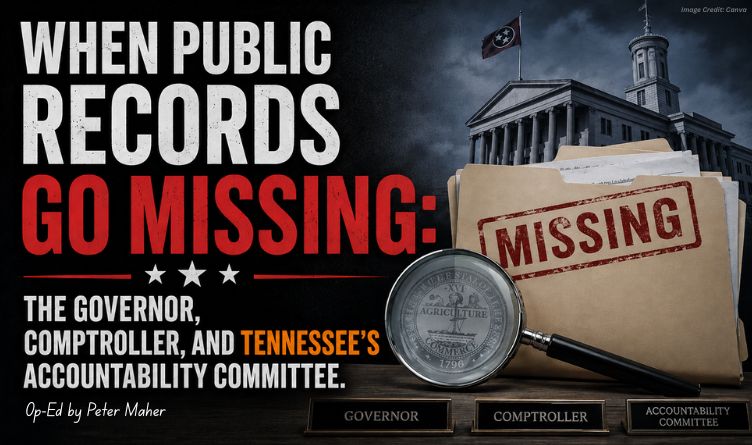
Public records requests recently submitted to our Office of the Governor sought copies of these statutorily required annual reports. Our Governor’s office responded using the state’s formal Public Records Request Response Form, stating that “no such record(s) exists or this office does not maintain record(s)” responsive to the request.
That response is notable because the statute expressly identifies the Governor as a required recipient of those reports. If any reports were prepared and transmitted annually as required, one would reasonably expect records reflecting their receipt to exist.
A separate public records request to the Office of the Comptroller—within whose broader transparency framework ACOG operates—further underscores the issue. That request produced only two documented annual reports attributable to ACOG over the entirety of its existence since its founding in 2008, ironically indicating that one being sent to the Office of Governor.
If our Office of the Governor is not receiving statutorily required annual reports from state agencies and advisory bodies, what policies or systems exist to flag that non-receipt? This question takes on particular weight when the missing reports come from the state’s own First Amendment, transparency, and accountability advisory committee. For an advisory body created to promote transparency, that gap is not merely administrative. It is foundational. And did ACOG confirm if their rare and sent annual report was received by our Governor?
The absence of such records—whether due to non-transmittal, non-retention, or an administrative breakdown—creates a documented discrepancy between statutory expectations and the public record.
COVID Didn’t Eliminate Transparency—It Enabled It
The timeline becomes more difficult to reconcile when viewed in light of Tennessee’s COVID-era transparency policies.
In March 2020, Governor Bill Lee issued Executive Order No. 16 to ensure that government operations would continue to function openly and transparently during the COVID‑19 emergency while protecting public health. The order specifically authorized governing bodies to meet electronically, rather than in person, provided those meetings remained open and accessible to the public.
In other words, transparency obligations were not suspended during the pandemic—they were adapted. Remote meetings were not only permitted, they were the mechanism by which compliance with open meetings laws could continue.
Yet, despite this framework, ACOG does not appear to conduct any meetings—remote or otherwise—during a multi-year period spanning the pandemic and beyond. If that absence is accurate, it cannot be explained by COVID limitations alone. The legal tools necessary to meet and remain compliant were already in place.
Structural Oversight: ACOG, the Comptroller, and OORC
ACOG operates within a broader institutional framework that further complicates the accountability picture.
By statute, ACOG functions with the guidance of the Office of Open Records Counsel and exists within the transparency structure overseen by the Comptroller of the Treasury. This creates an unusual dynamic: an advisory body tasked with advising on transparency, while also depending on the same institutional framework it is meant to help guide.
Recent public meetings illustrate this matter. After an extended period without public meetings, the Office of Open Records Counsel played a central role in reestablishing ACOG’s meeting activity. This continues to raise an institutional question: when an advisory body exists to inform transparency policy, but its own operational transparency depends on intervention by the implementing agency, where does accountability ultimately reside?
Statutory Balance vs. Reality
ACOG’s membership is deliberately structured to reflect a balance between representatives of government entities and representatives of nonprofit, media, and civic organizations. That balance is intended to ensure a mix of perspectives on transparency.
However, this structure introduces a concern when viewed alongside positions taken by some of the ACOG groups represented.
At least one ACOG member organization representing government officials asserts that it is not subject to the Tennessee Public Records Act, despite its close integration with public functions. Also, Tennessee law recognizes that nonprofit entities may be subject to public records requirements where they function as the equivalent of government, a principle affirmed in 2020 when the Davidson County Chancery Court ruled that an ACOG group was subject to the Tennessee Public Records Act. That decision underscores the legal tension within ACOG’s own membership structure, which by statute is required to maintain a balance between representatives of government entities and nongovernmental organizations under Tenn. Code Ann. § 8-4-602(b).
The result is an historic structural inconsistency: an advisory body designed to promote transparency includes representation from entities that dispute the applicability of Tennessee’s transparency laws.
Governance and Accountability
ACOG’s membership further includes ex officio participation by senior government officials, including a designee of the Attorney General and key General Assembly legislative committee chairs.
That structure ensures institutional experience and continuity. But it also raises a straightforward question: when statutory requirements—such as annual meetings or reporting—are not satisfied, responsibility for oversight and compliance is performative. It rests, at least in part, with individuals serving in official capacities connected to the state’s core governmental functions.
West Tennessee matters
In addition to structural concerns, issues of representation extend to geography. As I’ve shared in a previous Tennessee Conservative op-ed, West Tennessee has historically had limited representation in many statewide policy bodies and this is directly reflected to our state’s Advisory Committee on Open Government.
For a committee charged with addressing transparency issues across all 95 counties, geographic inclusion is not discretionary. It affects the substance, relevance, and legitimacy of any state committee’s work.
Sunset Review: A Long-Awaited Evaluation
For the first time since its creation in 2008, ACOG has been placed into Tennessee’s sunset review process through SB 1730.
Sunset review exists to answer foundational questions:
- Is the entity fulfilling its statutory duties?
- Is it operating effectively?
- Should it continue to exist?
For a committee dedicated to transparency, those questions are particularly important. They are not only about performance, but about basic credibility.
The concerns surrounding ACOG are not limited to a single report, meeting, administrative action or short op-eds. They reflect a broader question of alignment between the law, statutory requirements, accountability, public service, and reality.
Tennessee did not suspend transparency during the pandemic. It preserved it—through flexibility, including the use of remote meetings. Annual meetings were still required. Annual reports were still required. Oversight structures remained in place.
When gaps appear within (of all things) our state’s own transparency framework, the appropriate response is not to be assumed, but documentation and clarity and public service.
Transparency is not a principle that applies one way. It is a standard that must be demonstrated—especially by those entrusted to uphold it.
References:
ACOG : Tennessee Code § 8-4-602
Governor Bill Open Meetings Covid Order
Advisory Committee on Open Government
General Assembly SB1730 Sunset Bill