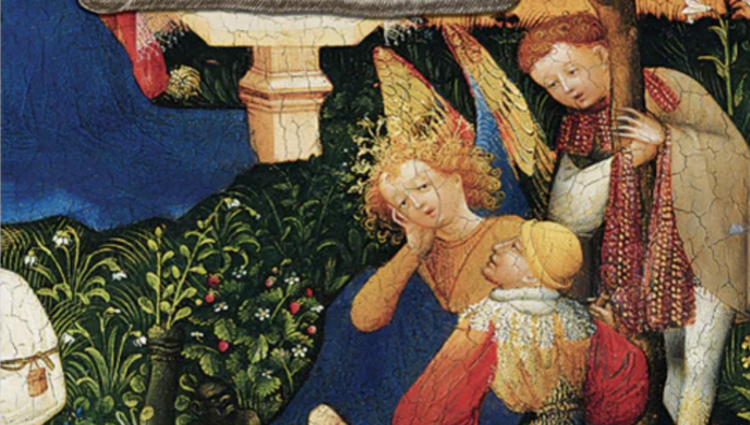
Robert Lazu Kmita’s “The Ultimate Quest” is a mystery story in the truest sense of the word. Confessing that the quest for the location of Paradise is not merely physical but is “theological-metaphysical”, he seeks clues from those who endeavour to read Genesis literally and those who read it allegorically, mystically, and symbolically.
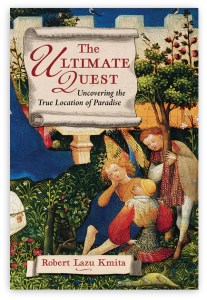 Many moons ago, I wrote an essay for this illustrious journal entitled “Which Way Is Heaven?” Was it above us? Was heaven in the heavens? Should we look up at the stars in childlike wonder to discover it? Is childlike wonder itself the way to heaven? Or should we look towards the east (ad orientem) in the expectation of the rising sun and the coming of the light? Does the rising sun orientate us towards the Rising Son? Is this why Christian liturgical worship has traditionally been ad orientem, with priest and people tuning eastward in mystical expectation? Or should we look instead to the mystic west towards the Grey Havens to which Frodo and the Elves sail at the end of The Lord of the Rings? This earlier essay sprang to mind as I opened Robert Lazu Kmita’s new book, The Ultimate Quest: Uncovering the Location of Paradise (Angelico Press). But the quest on which Dr. Kmita embarks is not the quest for the eternal paradise of Heaven but the quest for the primal paradise of Eden, the lost Paradise from which our first parents were banished.
To be honest, I would normally have steered well clear of any book which promised to find the Paradise that we have lost. Such books are usually weird and wayward, promising the promised land without keeping the promise that Christ demands of us, the promise that we follow him faithfully and truthfully in the light of the Gospel as elucidated by theological orthodoxy. Those who seek to guide us to Eden (or Eldorado, or Atlantis) are usually seeking the new age in their old age, like aging hippies trying to get back to the Garden. Those seeking the paradise lost are defying and denying the divine prohibition on a quest for lost innocence. The seekers of this sort of innocence are guilty of egregious theological and philosophical ignorance. Indeed, the one thing that seems to unite all such guides is the fact that they are misguided.
The reason that I cracked open the pages of Dr. Kmita’s book, setting aside all misgivings, is my awareness that Dr. Kmita is not wayward and that he is only weird (wyrd) in the Anglo-Saxon sense of the word, which is to say that he has a keen sense of God’s mystical presence in all things. He has written for The Imaginative Conservative and for the St. Austin Review, the cultural journal which I have edited for 25 years, and for many other estimable journals, both in print and online. He has authored many books and has collaborated on others, including an Encyclopedia of J. R. R. Tolkien’s World in Romanian, his native tongue. Holding a PhD in philosophy, he is also a consummate theologian and is widely read in great literature. In brief and in sum, he is well rounded because he is well grounded in the roots of Christendom, picking its fruits to nourish his own writing.
Knowing that Dr. Kmita is worth reading, and that his views on any topic are worth hearing and probably heeding, I joined him on the “ultimate quest” for the “true location of Paradise”.
In his foreword, Dr. Kmita places himself in “the role of an improvised Sherlock Holmes” on the hunt for clues. He doesn’t look for them in the clueless volumes of the aforementioned new agers but in the ancient and ageless tomes of civilization, especially in the writings of the saints: Augustine, Aquinas, Ambrose, Isidore of Seville, Gregory of Nyssa, Gregory of Nazianzus, Athanasius the Great and Maximus the Confessor.
Confessing that the quest for the location of Paradise is not merely physical but is “theological-metaphysical”, he seeks clues from those who endeavour to read Genesis literally and those who read it allegorically, mystically, and symbolically. Which of these clues lead us closer to an understanding of Paradise and its location and which are merely red herrings leading us astray?
In the opening chapter, Dr. Kmita focuses on Christopher Columbus and the belief that the First World of our parents, “the Earthly Paradise”, might be found in the virgin territory of the New World. The following four chapters, which focus on the writing of Augustine and Aquinas, are on surer footing than Columbus’ first-footing in the New World, placing the quest on the terra firma of theological wisdom. The penultimate and longest chapter of the book brings Saints Gregory of Nyssa and Gregory of Nazianzus into the conversation, while the concluding chapter introduces the divinely comedic presence of Dante.
It is not for me to spoil the future reader’s enjoyment of the quest by giving away Dr. Kmita’s conclusion at the conclusion of the book, which is the conclusion of the quest. The Ultimate Quest is a mystery story in the truest sense of the word and Dr. Kmita is indeed in “the role of an improvised Sherlock Holmes”. Heaven forbid that any reviewer should reveal the answer to the mystery which the finding of the clues reveals. It is, after all, a mystical truth that doing what heaven forbids does not lead to the discovery of Paradise but its loss.
__________
The Imaginative Conservative applies the principle of appreciation to the discussion of culture and politics—we approach dialogue with magnanimity rather than with mere civility. Will you help us remain a refreshing oasis in the increasingly contentious arena of modern discourse? Please consider donating now.