WHEN it comes to political bravery, President Trump has no equal. At the end of February, he made the risky decision to slay the Iranian nuclear problem once and for all. In just two weeks Trump delivered a crushing military victory against Iran, the perpetual bête noir of Middle Eastern politics. Since 1979, when a radical apocalyptic death cult overthrew the Shah of Iran, the world has been terrorised by a theocratic government dedicated to the destruction of ‘little Satan’ (Israel) and ‘big Satan’ (the United States). Thanks to Trump that epoch is over . . . or is it? The risk is that Trump’s domestic enemies will turn victory into defeat.
For 47 years, US presidents all refused to countenance the possibility of Iran having a nuclear weapon, but baulked at decisive action to defeat Iran and simply kicked the can down the road. None more so than President Barack Obama. His 2015 Iran deal handed them back US$100billion in return for just a ten-year promise not to enrich uranium. Obama saw this as a legacy victory; others, me included, saw it as capitulation to a regime whose avowed long-term aim is the destruction of the West.
If proof were needed of the Iranian theocracy’s real intent, Iran immediately used its Obama-returned treasure to build a terror network, to develop its nuclear weapons programme further, and to finance a slew of terrorist armies with which to attack America’s closest Middle Eastern ally, Israel. In his first term as President, Trump canned Obama’s lily-livered, short-sighted deal and in his second term he set out to use America’s paramount military muscle to cut the Gordian Knot that has tied up Middle Eastern politics for several generations.
At the eleventh hour Trump has stopped Iran from building nukes and the ICBMs (intercontinental ballistic missiles) that could carry them to the West. If you think that the Iran War is economically painful now, how would that compare with a nuclear attack on the West by the mad mullahs in Tehran? If they were prepared to butcher 46,000 of their own protesting citizens earlier this year, what would they be prepared to do to us? I sleep better at night knowing that Iran does not have an atom bomb. So for the moment the main objective of the war is won. But will the United States win the peace?
Not if global media have their way. The Iran War is already being written about by the BBC and most of the Western liberal media as if America had suffered a catastrophic defeat. In America the New York Times has portrayed the war with Iran as a gross miscalculation, while the New Republic headlined ‘The president is setting up the US to lose another war in the Middle East.’ Similarly, Bloomberg has written: ‘Trump’s Iran speech dressed up defeat as victory’. The belief that Iran has won the war is echoed by award-winning Canadian journalist Andrew Mitrovica: ‘The US and Israel thought that they could decimate Iran. But Iran’s survival – despite massive human costs – is a victory.’
The sad truth is that TDS (Trump derangement syndrome) runs so deep that even much of the right-wing commentariat is hostile to Trump’s foreign policy. In a recent interview Sir Max Hastings, former editor of Britain’s most right-wing newspaper, theDaily Telegraph, opined that Donald Trump is deranged and said that he went to bed at night fearful about ‘what new enormity the United States – our most cherished friend – might inflict on the world’.
But surely this is a delusional and defeatist shortsightedness. As US Treasury Secretary Scott Bessent noted, ‘I wonder what the hit to global GDP would be if a nuclear weapon hit London . . . I am less concerned about short-term forecasts, for long-term security.’
There will be damage to the world economy no doubt, but interestingly the US stock market has recently closed at new highs.As for Trump’s allies, not the EU but the oil-producing allies in the Gulf, they will suffer in the short term. However, these financially well-padded states are already expanding existing bypasses such as Saudi Arabia’s East-West pipeline to the Red Sea and the UAE’s Habshan-Fujairah line to reduce their reliance on the Strait of Hormuz. The extraordinary possibility of a pipeline exiting through the Israeli port of Haifa is also under consideration. The market will adjust. In the medium term, development of alternative oil supply lines and the increase in renewable energy will drain Iran of its economic power.
However, for the Democratic Party, the Iran War is a political opportunity even if it comes at the cost of defeat for America. While, according to a recent poll, 71 per cent of Republicans think that there were sufficient reasons to start the war with Iran (disregarding the fact that Iran started the war with the US 47 years ago), some 94 per cent of Democrats think that the reasons for the war were insufficient. Taking independents into account, 63 per cent of American voters do not approve of Trump’s reasons for going to war.
With the midterm congressional and gubernatorial elections coming in November, Trump needs more than a military victory: he needs to procure a credible peace. The fear, which Trump readily acknowledges, is that if he loses the Senate to the Democrats as well as the House of Representatives, he will be impeached. The last two years of his presidency would then be mired in a storm of contention antipathetic to either free market economic growth or American geopolitical goals. There is no question that the Democrats, now a far-left socialist party with a paranoid hatred of Trump, would prioritise the destruction of Donald Trump over a de-nuking of Iran.
The problem for Trump, at this juncture of the on/off peace negotiations in Islamabad, is that Iran’s leaders, who may be mad but are not stupid, are fully aware of Trump’s dilemma – that to claim full victory, not just military success, he also needs a credible peace. The Iranian leadership are calculating that they can run down the clock and win the long game. They judge correctly that a defeatist Western media and a future Democrat president, like Obama, will hand them victory on a plate.
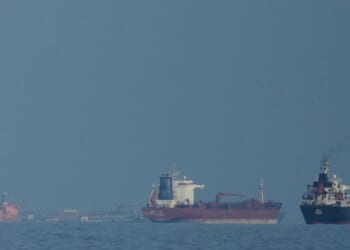
Given Trump’s natural reluctance to put troops on the ground after the debacle in Iraq and Afghanistan, the only leverage left to him is either more bombing or economic strangulation. The former course is problematic because destruction of ports, bridges and power stations will be deemed illegal. My reading of the Geneva Conventions is that these targets would be justifiable on the grounds that they are essential assets of the Iranian war machine. But you can bet your life that the pro-Muslim United Nations and the whole brigade of leftist judges and international pressure groups who are already screaming ‘war crime’ will up the ante. So, for now, Trump has plumped for financial strangulation by blockading Iran’s oil exports. The Americans have cleverly concluded that two can play the game of blockading the Straits of Hormuz.
Without oil revenue how can Iran continue to pay MOIS (the Ministry of Intelligence and Security) and the IRGC (Iranian Republican Guard Corps) salaries, let alone start to rebuild their basic defence infrastructure? Can the Iranian government hold out longer than Trump?
Then there is a question of which Iranian government is going to show up in Islamabad. Since the decapitation of its leaders, rumours abound about who really runs Iran. There has always been a division between hawks and doves. But now there is not just a struggle over policy; in the leadership vacuum there will be a fight for power and money. The betting is that the IRGC, which has increased its power over the last 40 years, will gain yet more power at the expense of the clerics. As in Venezuela after the removal of President Maduro, Trump will hope that a more pragmatic leadership will emerge; the last two years of his presidency may depend on it.
When it comes to turning military victory into defeat, the United States has form. The standard historic view of the Vietnam War is that America suffered an overwhelming military defeat. It did not. North Vietnam’s Tet Offensive in January 1968 presaged the north’s most crushing military defeat of the Vietnam War. After the war North Vietnamese spy Dr Duong Hoa ‘bluntly denounced the venture [the Tet Offensive] as a grievous miscalculation by the Hanoi Hierarchy, which . . . had wantonly squandered the Southern insurgent movement [Viêt Công].’ Yet a liberal US media, led by the legendary US broadcaster Walter Cronkite at CBS, unanimously described Tet as a defeat for America.
Media defeatism continued for the rest of the war. By contrast President Richard Nixon and his secretary of state, Henry Kissinger resolved to bring about peace by first defeating North Vietnam. Nixon abandoned his predecessor’s anaemic military strategy and bombed the hell out of the Ho Chi Minh Trail which, by 1969, had developed into a flanking supply highway through Laos and Cambodia. Bombing worked. Nixon’s Christmas Linebacker II bombing campaigns were so effective that they brought North Vietnam to the negotiating table. The Paris Peace Accords duly ended the Vietnam War in January 1973.
However, a Democrat Party that controlled both the House and the Senate immediately banned US bombing of the Ho Chi Minh Trail and withdrew funding for ARVN (the Army of the Republic of Vietnam), the South’s regular army. Abandoned by the Democrats, the result, two years later, was the fall of Saigon. US media and the Democrats had turned victory into defeat.
The question that needs to be asked today is whether Trump’s stunning military victory will be similarly undone if the Democrats win the midterm Congressional elections in November. Whatever the outcome we can be sure that most of the global commentariat will be rooting against Donald Trump, for the Democrats . . . and for Iran.