In Cather’s “The Professor’s House,” Augusta’s devoutly Catholic presence is the presence of the real, the perennial presence of the reality which permeates the past, present and future, making sense of all time from the perspective of eternity. In concluding the novel in this way, Willa Cather is baptizing the whole novel with Augusta’s presence.
 Willa Cather is one of the finest American novelists of the twentieth century. O Pioneers! (1913), My Ántonia (1918) and Death Comes for the War Poets (1927) are considered classics of American literature. She won the Pulitzer Prize for One of Ours (1922) and such was the high esteem in which she was held by F. Scott Fitzgerald that he considered The Great Gatsby a failure when compared with My Ántonia.
Cather’s novel The Professor’s House was published in 1925, the same year in which The Great Gatsby first appeared, and the two novels share much in common. Both works are commentaries on the narcissism of contemporary American culture, in which secular values are beginning to eclipse Christian virtue. Ironically, however, Cather’s novel hints at the necessity of virtue much more evocatively than does Fitzgerald’s. Whereas The Great Gatsby focuses primarily on modern man’s obsession with material wealth and the perceived status that it brings, The Professor’s House sets such materialism against the higher ideals practiced and preached by several key characters.
Cather’s novel is divided into three parts. The first part focuses on the family of Professor Godfrey St. Paul, a university professor of history and the author of a book entitled Spanish Adventures in North America. The second and central part recounts the story of Tom Outland, a friend and former student of Professor St. Paul, killed during World War One, whose posthumous presence haunts the narrative like a ghost. The third and final part focuses on the professor as he struggles to make sense of the life he has lived and is living.
One of the most enigmatic aspects of the story is to be found in its title. The novel is not primarily about the professor but about his house. More specifically and significantly, it is about the old house, the family home, which he and his wife vacate at the beginning of the story, as distinct from the new house into which they move. Although the professor moves into the new house, he refuses to vacate the old home, continuing to use the small garret office in which he had always worked. This old house is haunted by memories of the past, especially by memories of the deceased Tom Outland. Symbolically, Professor St. Paul prefers the past to the present, the old world to the new, finding comfort in those memories which relieve him from the painful presence of his present life.
The professor finds himself alienated from the world of homo economicus, the world in which the pursuit of material possessions and the status they bring is the primary motive of life. His wife has succumbed to such worldly pursuits and so has his elder daughter. Theirs is the world that is lived in the professor’s painful present, which his life in the new house represents. He seeks sanctuary in the old home. It is here that the vacuity of the present can be exorcised by the values of the past, not simply the past in which he lives as an historian but the past in which he lives with the presence of his deceased friend.
Tom Outland is a true outlander. He doesn’t belong in the world of homo economicus. He is a stranger in the vale of tears, an exile from the cynical world which knows the price of everything and the value of nothing. His story is told as the centrepiece of the novel. It is told in the first person by Tom himself as a retrospective narrative remembered by the professor. It’s as though Tom’s ghost is speaking directly to the professor, as his voice speaks directly to the reader.
Tom discovers the presence of the past while working as a cowboy, riding the range in New Mexico. He and a friend stumble upon an ancient cliff city, long abandoned by a now extinct tribe. Filled with a noble desire to have the treasures of the past preserved, Tom travels to Washington hoping to get politicians and scholars at the Smithsonian Institute to take an interest. As with James Stewart’s character in the 1939 film, Mr. Smith Goes to Washington, Tom’s idealism is met with cynicism and indifference.
There is, however, another way that Tom discovers the presence of the past and that is through the reading of books and the learning of Latin. With respect to the former, intertextual allusions to Robinson Crusoe and Gulliver’s Travels are suggestive. The former book suggests a desire to salvage what is good from the wreckage of life; the latter suggests a satirical disdain for modernity. As for the learning of Latin, which would open the doors of academe to him, thereby opening the arms of the friendship of the professor when he becomes his student, he does so at the behest of a Catholic priest, Father Duchene. In this minor character, who nonetheless plays a major role, we see an inkling of Willa Cather’s Catholic sensibility which would reemerge two years later with Death Comes for the Archbishop. This sensibility also emerges in the character of Augusta, the devoutly Catholic woman who serves as the seamstress to the professor’s family. In many respects, Augusta’s understated presence is difficult to overstate. She is the Catholic presence in the professor’s life which enables him to see the crux of the matter at the novel’s conclusion. It is Augusta’s Christian wisdom which brings him to his senses, enabling him to face the future with fortitude. She brings him to his senses in the literal sense by saving him from being asphyxiated by gas while he slept, saving his life, but she also brings him to his senses in the deeper life-giving sense of giving him a reason to live: “Augusta, he reflected, had always been a corrective, a remedial influence…. Very often she gave him some wise observation or discreet comment to begin the day with … and though he used to wince under them, he hurried off with the feeling that they were good for him….”
It is surely significant that the novel ends with Augusta’s presence. She is reading an old religious book and being observed by the professor. “It occurred to [him] … that he would rather have Augusta with him just now than anyone he could think of. Seasoned and sound and on the solid earth she surely was, and, for all her matter-of-factness and hard-handedness, kind and loyal. He even felt a sense of obligation toward her, instinctive, escaping definition, but real. And when you admitted that a thing was real, that was enough….”
Augusta’s devoutly Catholic presence is the presence of the real, the perennial presence of the reality which permeates the past, present and future, making sense of all time from the perspective of eternity. In concluding the novel in this way, Willa Cather is baptizing the whole novel with Augusta’s presence. In dong so, considering that the novel is structured in three parts, she has presented a literary triptych in which Tom Outlander’s past is the central panel, flanked on either side by the professor’s present life and concerns. The spirit that pervades all three parts, all three literary panels, is the spirit of the perennial Christian truth which makes sense of the nonsense of modernity. For this reason, The Professor’s House should be considered alongside Death Comes for the War Poets as a classic of twentieth-century Catholic literature, even though neither work is written by a Catholic. As for comparing it with The Great Gatsby, the better known novel published the same year, we might be tempted to echo F. Scott Fitzgerald’s judgment that his own novel is a failure by comparison.
__________
The Imaginative Conservative applies the principle of appreciation to the discussion of culture and politics—we approach dialogue with magnanimity rather than with mere civility. Will you help us remain a refreshing oasis in the increasingly contentious arena of modern discourse? Please consider donating now.
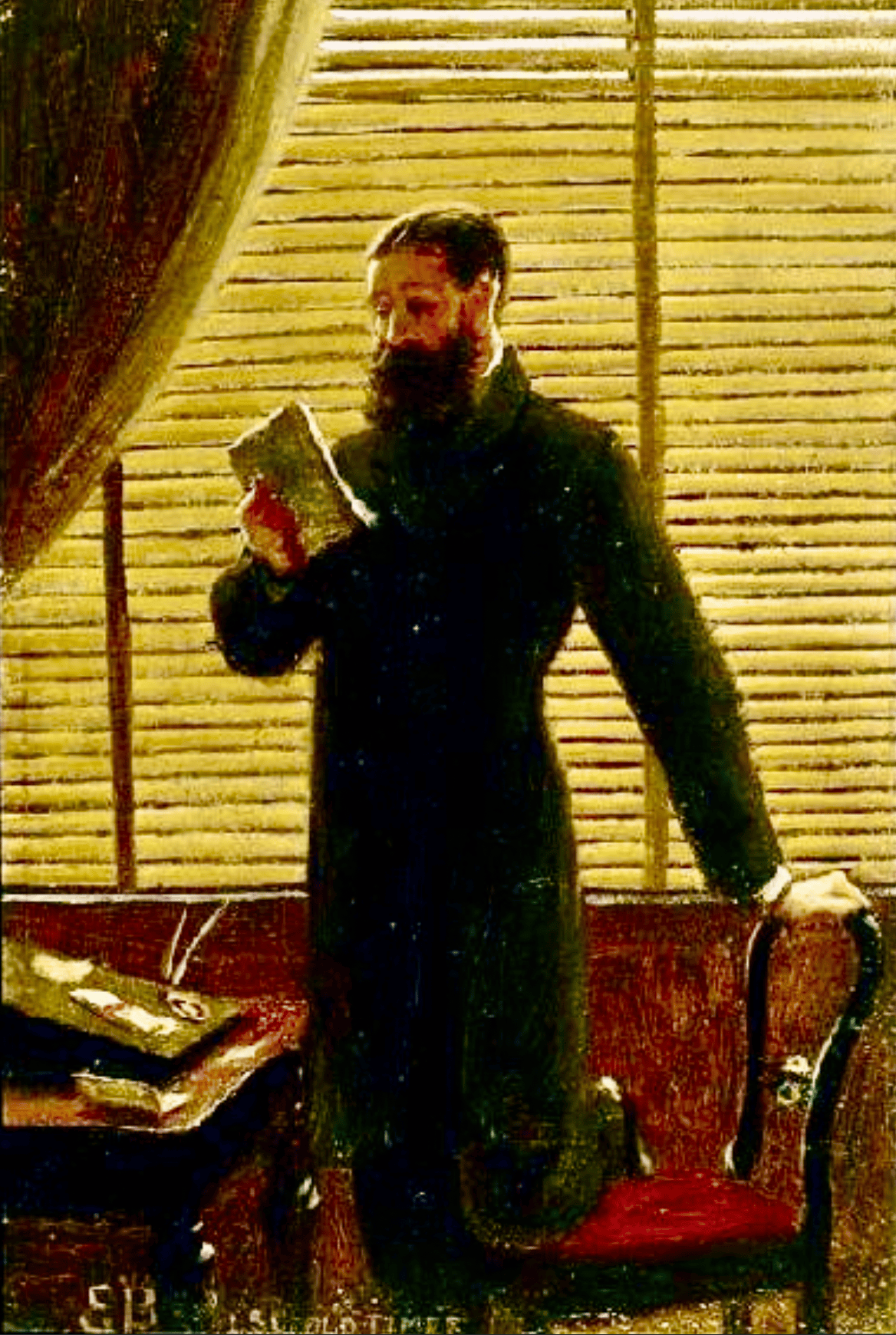
The featured image is “Old Times” (1877), by Edmund Blair Leighton, and is in the public domain, courtesy of Wikimedia Commons.