THE novelist L P Hartley said: ‘The past is a foreign country.’ But it is a wholly inadequate metaphor. The past is so much more remote than that, for the simple reason that it no longer exists.
As far as overseas travel is concerned, if you’re prepared to make the effort, it is generally possible to visit even the most foreign of countries and see them first-hand. But the past can never be visited. It relies entirely on records. We have many photographs, but these are capable only of recording how the place ‘looked’. We can and do project much on to these pictures, but in order to have some idea of how the place really ‘was’, it is necessary to turn to the recollections of those who were there.
And so, my motivation for writing autobiographical anecdotes is born not of a narcissistic desire to paint a self-portrait, but an attempt to provide at least a glimpse of the place where I grew up. A place which simply does not exist any more. Not in any significant aspect or detail.
It’s not just the street crime, the litter and the overcrowding of modern Britain which make me wistful for the country of my childhood. The fact is that in the 1950s, England was a more gentle place, where people seemed to have more time for each other. Nowhere was this more evident than in the interactions between grown-ups and the children.
These days, the mutual aloofness and distance which routinely characterises encounters between strangers across the ‘generation gap’ make it difficult for anyone too young to remember to picture just how safe, friendly and perhaps, equally important for a child eager to explore the world around him, simply how accommodating the England of my childhood really was.
Here is the first of four anecdotes from that time which I hope illustrate the sort of unconditional kindness that a child might receive from complete strangers.
***
In 1953, our home was a rural council house which backed on to open fields. With only three more houses before Lawford Lane petered out into a genuine backwater, it was, at least in those days, as close to living out in the country as it was possible to get and yet still be near a regular bus route into town. Beyond lay only agriculture, stretching almost ten miles as far as the outskirts of Coventry.
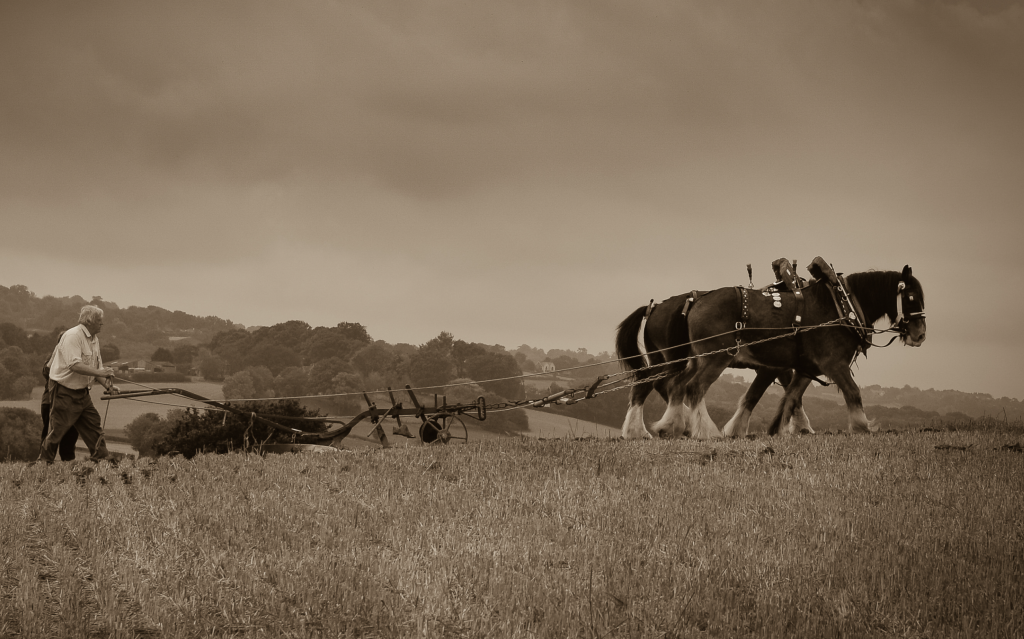
And in those early 50s it was an agriculture which still made use of horses for pulling various implements. It wasn’t exclusively horse power, there were some tractors too of course, but combine harvesters, which exude those familiar rectangular hay bales, were rarely seen on a small family farm. Crops such as wheat and oats were still more commonly harvested with old-fashioned binding machines with their characteristic paddle-wheel design. These left behind them traditional sheaves which looked little different from those seen in nineteenth-century paintings.
There were enormous changes to come. But until then, British agriculture, still picking itself up after the deprivations of the Second World War, looked pretty much as it had done in the 1930s.
And so, when we moved to the location in which I was to spend my childhood and adolescence, the farmer who worked the fields immediately behind our house was still using horses for ploughing and pulling the binder at harvest time. A pair of huge shire horses plodded up and down the furrows, while flocks of birds circled around, ready to dive down and snap up any insects exposed by the plough’s passing.
Unsurprisingly, my six-year-old sister and I were both completely beguiled by this picturesque sight and often, after school, if the horses were out, we would stand for long periods, looking over our back fence, just watching these magnificent creatures at work. One day, the farmer, having noticed our fascination, came over and asked us if we’d be interested in helping him ‘put the horses away for the night’.
Needless to say, we clambered straight over the garden fence in an instant and we followed him and his team to the farm on the hill beyond. In the farmyard, he unshackled the plough and handed the long reins connected to the horses’ collars to my sister.
‘You can take them into the stable now,’ he told her. He gently slapped the beasts on the rump and they immediately started to move slowly across the farmyard towards the stable and into their stalls.
Carol and I shared the reins, but clearly these beasts knew perfectly well the way to go and didn’t really need either myself or my sister to help them find their home. But it was kind of the farmer to allow us to think that we were doing something useful, as the horses prepared themselves for the evening meal in their nosebags.
When it was time to finally leave, we ran all the way home, eager to tell mother about how we had been ‘helping with the horses’. This experience didn’t ever happen again, but we never forgot it.
It was all just in time, since by next year the farmer had sold his horses and finally converted his farm to entirely mechanical traction; this may have been one reason why he felt inclined to be generous about sharing this ‘end of an era’ experience with us. After that, as a Dinky Toy enthusiast, I was quite interested in his Fordson tractor, but it was no match for those magnificent shires.
Next week: ‘Down-line clear . . .’