 Michel de la Tour D’Auvergne gave his horse to his servant. He watched the man take the two animals to the head of the bridge over the Grosne, and then with a sudden gesture of complete release he threw himself down on the river bank and gave himself up without reserve to the scene before him. For it was of this that he had been thinking night and day ever since his ordination three months ago. Indeed, he knew now that it had always been at the back of his mind ever since that far-off day when Dom Jean-Marie Gouet had first told him the story of Cluny. It was at the Tower of Cléry, under the great cedars with their thick and slow-moving shadows in the August heat. He and Gabrielle had sat all the heavy Auvergnat afternoon listening to the low voice of the monk as he told the story of the little convent on the river that once in dark and violent days had renewed the hope of Christendom.
There was little to suggest that far-off stress in the scene now before him—the narrow stream, not so clear as the mountain-sprung rivers of the Auvergne, the fields stripped by the harvest, the orchards fading into gold, the gray walls and the dusky hedges, the long timber-reeded eaves of the houses peering shaggily over the deep-gutted streets, and then, against the lazy-blue Burgundian sky, the gray thrust of the towers of the abbey. They were Cluny, firm and tall, massive yet springing with the relaxed strength of the earth, interlaced with light and air. There was the clenched concentration of the will in the thrust of their stones, the tenderer opening-out of prayer in their graceful patterning of the sky. Seen from the edge of the river, their boldest carvings were but a line of molding on the edge of that masque of shade and light, as if the generations of masons and sculptors who had raised those towers had surrendered the pride of their craft when they took even the blue air for the stuff of their dreams.
But Michel thought of this only for the moment with which one takes possession of long-anticipated delight. Here where the heart has longed to be—but even as he thought that this was home-coming, that here whatever store of days had been appointed to him would be spent, a bubble of laughter came rolling to him across the bridge, and a rout of serving maids in full short skirts and white caps with flying ribbons followed after, giggling and shrieking. Michel slid to his feet, dusted his coattails, and straightened his bands with almost a single motion. The first of the maids stifled her giggles and gathered up her disheveled petticoats in a curtsy. Michel nodded.
“Is Cluny celebrating the harvest with a carnival?” he asked, trying to keep the corners of his lips still. Michel de la Tour d’Auvergne was twenty-five years old, and for three months now he had been a priest, but he knew that there was nothing in his slight, wiry frame to inspire awe in anybody. At the thought he must have unconsciously raised his chin, for the girl who had lifted mischievous eyes to his sobered instantly.
“Does not M. l’Abbé know that the Cardinal de la Rochefoucauld has come for the Grand Chapter? He has made a fête for all the town.”
“The fountain in the square is running wine,” added one of her companions, who had come up curiously; but the first maid pulled at her skirt.
Michel stared at them. He had thought first to have a quiet visit with Dom Jean-Marie Gouet, and now he would have his uncle to reckon with. True, he would have had to see his Eminence sooner or later. The Cardinal was only one of several people Michel would have to consult; his mother, his brother Armand, M. Emery must also be seen. Next to M. Emery, Michel had most wanted and most dreaded to talk to his uncle. In the days when his resolution was slowly crystallizing, all of these people who must be consulted on any disposition he should want to make of his life had seemed threatening enough but still remote. Now suddenly he was, as it were, face to face with the most imposing of them.
For a moment he hesitated, staring at the girls without seeing them. He should have remembered that this was the year of the Grand Chapter, but though the patronage of its Commendatory Abbot was, he knew, the pride of Cluny, somehow he had never associated his uncle Dominique with Cluny. He could see his fair face, like that of a shrewd and rather humorous angel, in the King’s salon at Versailles or in his mother’s boudoir at Cléry, or in the streets of Rouen even, where his devotion to his episcopal duties had made him beloved of all, but not here. At the thought of the radiant elegance of the Cardinal something somber and fierce and lonely leaped forth from the towers of Cluny. And for once Michel understood why ninety-nine men out of a hundred found the great church of Saint Hugh old and dark and barbaric even. At that moment the whole history of Cluny, that had flamed again in his imagination as he read during the slow hours of that last retreat at Saint-Sulpice before the ordination, seemed a strange and faraway thing, as remote as the twelfth century with all its mighty ardors and its vast struggles from the elegant security of this year of grace, 1788. Automatically Michel brushed a fleck of powder from his black sleeve, and one of the watching girls giggled afresh.
He looked absently at the girl who had first spoken to him. She had a keen, pretty face that in a few years, when the girlish complacency had faded, would be sharp, even shrewish. He settled his hat and went on quickly to the bridge. He heard the second girl, a rolling-eyed, loose-tongued wench, giggle again and whisper loudly, “It was the wine that woke him up,” and the first girl hiss to her to mind her manners and have some respect for his Reverence. But Michel looked neither to right nor to left, charging down the bridge much as his soldier brother might have ridden into the cannon’s jaws.
The streets of Cluny were full of holiday-makers, and more than once as he scraped a plastered wall he regretted the security of his horse. The chestnut-sellers with their braziers and the apple-sellers with their deep wicker baskets had penetrated the abbey gates, and a constant coming and going of servants and townsfolk filled the outer courtyards; but the nave of the great church was, as he had expected, almost empty. A few countrywomen in high starched caps and short, heavily bundled petticoats were moving in and out among the great columns, dropping awed little curtsies to the statues of the saints above them. The light from the clerestory windows had softened with the passing of the afternoon, and as always there seemed to be a mist behind and between the ambulatory columns in the choir. The blue in the windows above the sanctuary had darkened as it always did in the afternoon, until it made Michel think of the mountain lakes of the Auvergne on the eve of the October storms. Nowhere else was there a blue so passionately deep, so persistently pure, as if a mass of ice were burning at its crystalline heart. Again Michel noted what he had never forgotten from his childhood, how as the blue of the windows darkened, other colors emerged from their storied patterns. It was not only the flecks of scarlet and ruby burning like flame in the grate of the blue, but here and there panes of orchid and purple and even saffron-yellow and topaz were flaming together, as if it were simply enough to raise any hue to its ultimate intensity to burn away all dissonance and estrangement. He noted, too, how softly the reflected colors lay on the gray pillars of the nave. Rich as was the tapestry of the windows, it was yet but a veil on the luminous stillness of the vaulted apse. And the old sense of peace, not as something chill and passive and remote, but as something warm and close and living, like a summer night filled with stars, came to him again.
Suddenly, the distance between Saint Hugh and Dominique, Cardinal de la Rochefoucauld, did not seem so great. Indeed, for a moment Michel saw them side by side before his mind’s eye. For could not the colors burned of human personality as of metal come home together in the harmonious resolution of pure intensity? But the very word “intensity” that seemed so appropriate to Abbot Hugh in the stiff thirteenth-century carving on the pillar above him seemed completely inappropriate to Abbot Dominique, doubtless still at table with his guests in the beautiful abbatial palace of Jacques d’Amboise. And for the first time it came to Abbot Dominique’s ungrateful nephew that perhaps the modern abbot would be a little easier to talk to than the medieval, though doubtless there were arguments that Hugh would have warmed to that no modern man would so much as name.
Michel knelt down and asked Saint Hugh, surely not so far away in Paradise as not to hear a whisper from his beloved church, to help him and be with him now in the first crisis of the way he had embarked upon. Indeed, on what better ground could the help of the great Cluniac builder be invoked than this? With a sudden accession of confidence, Michel rose from his knees. Surely in these ancient precincts of Cluniac glory it should not fall strangely upon the ears of a Cluniac abbot that his nephew was minded to take the habit of Cluny and serve the ends for which this great magnificence was in the first place raised.
_________
This essay is a chapter from To the End of the World. Republished with gracious permission from Cluny Media.
Imaginative Conservative readers may use the code IMCON15 to receive 15% off any order of not-already discounted books from Cluny Media.
The Imaginative Conservative applies the principle of appreciation to the discussion of culture and politics—we approach dialogue with magnanimity rather than with mere civility. Will you help us remain a refreshing oasis in the increasingly contentious arena of modern discourse? Please consider donating now.
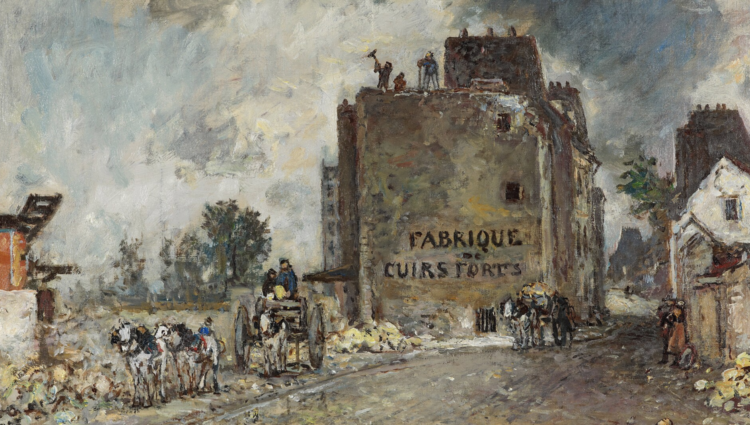
The featured image is “Demolition work in Rue des Franc-Bourgeois St. Marcel” (1868), by Johan Barthold Jongkind, and is in the public domain, courtesy of Wikimedia Commons.