 It’s always exciting whenever a missing piece of the puzzle of William Shakespeare’s life comes to light. One such piece was discovered recently in a London archive by Lucy Munro, Professor of Shakespeare and Early Modern Literature at King’s College London. In doing research on the location of London playhouses, Dr. Munro stumbled upon a plan of the Blackfriars area in 1668 which confirms the exact location of the Blackfriars Gatehouse, which Shakespeare had purchased in 1613 and which his granddaughter would sell in 1665.
“This discovery throws into question the narrative that Shakespeare simply retired to Stratford and spent no more time in the city,” Dr. Munro said. “It has sometimes been thought that he bought his Blackfriars property merely as an investment, but we don’t know that this is true, or that he never used it for himself.” Referring to the common assumption by scholars that Shakespeare left London following the fire that destroyed the Globe Theatre in June 1613, three months after Shakespeare had purchased the Blackfriars Gatehouse, Dr. Munro suggests that the purchase of the large house supports the supposition that he remained in London, citing his collaboration with the young playwright John Fletcher as evidence: “We know that Shakespeare co-authored Two Noble Kinsmen with John Fletcher later in 1613. And this new evidence that the Blackfriars house was quite substantial makes it not inconceivable that some of it may have been written in this very property.”
At this point, the careful literary sleuth begins to see some flaws in the logic that Dr. Munro employs. First, we don’t know that Shakespeare collaborated with John Fletcher, though it does seem that Two Noble Kinsman and also Henry VIII contain sections written by both playwrights. Considering that Shakespeare had never collaborated with any other playwright prior to the alleged collaboration with Fletcher, why would he suddenly decide to change the writing habits of a lifetime? Isn’t it more likely that Fletcher finished plays that Shakespeare had left unfinished at the time of his retirement, or, in the case of Henry VIII, that Fletcher had sanitized the play to make it more acceptable to the state’s censors?
As for Dr. Munro’s assumption that Shakespeare bought the Blackfriars property as a residence for himself, why does she not wonder why Shakespeare had never bought a house to use as a residence in London in the two decades or more that he had spent in the city? Why would he purchase a residence shortly before leaving London for good when he had never seen the need to own a London home prior to this?
To be fair to Dr. Munro, she concedes that there are many unanswered questions surrounding the life of Shakespeare. “I think there’s sometimes an assumption with things relating to Shakespeare biography that everything’s been gone over again and again, and there isn’t really anything left to find, when actually there are still some bits of the jigsaw puzzle kind of still out there,” she said, prior to the publication of her research in the Times Literary Supplement on April 17.
 Unfortunately, however, even professional Shakespeare scholars appear to be ignorant of the pieces of the puzzle that have been found. This becomes clear when we look at what is known about the Blackfriars Gatehouse and Shakespeare’s purchase of it, his last major legal transaction in London. As already stated, it is very unlikely that he bought it to live in. He had already shaken the London dust from his feet, or would soon do so, and had retired to New Place, the large house in Stratford he had purchased for his family from Catholic recusant friends back in 1597. Why, then, did he buy it? Most academics, failing to dig any deeper than the surface, have unquestionably accepted the most obvious answer. “It was, apparently, an investment pure and simple,” wrote Samuel Schoenbaum, a view shared by A.L. Rowse who concluded that “the gatehouse was no more than an investment”.[i] If, however, we dig a little deeper we are confronted with a number of problematic questions. If Shakespeare was interested in purchasing property purely as an investment, why did he not do so earlier? By the time that he bought the Gatehouse he had been living in London for a couple of decades and perhaps for a quarter of a century, seemingly content to rent accommodation for the whole time. There is no record of Shakespeare buying any other property in London, whereas there is evidence to show that he lived in rented accommodation. Isn’t it odd that he should suddenly decide to invest in property after seemingly showing no previous interest in doing so? At the very least, these questions should prompt the diligent investigator to search for other motives.
An investigation into the history of the Blackfriars Gatehouse reveals that it was “a notorious center of Catholic activities”.[ii] As its name would indicate, it had originally belonged to the Dominican Order until the dissolution of the Monasteries. During the reign of Queen Mary, the mansion was in the possession of Thomas Thirlby, the Catholic Bishop of Ely, who sold it to his cousin, William Blackwell, the town clerk of London. At the latter’s death in 1569, the Gatehouse was inherited by his widow, Mary, née Campion, who was related to Edmund Campion, the Jesuit martyr. The papist sympathies of Mary Blackwell are suggested by the fact that the Catholic Bishop of Ely was allowed to lodge at her house until his death in 1570. Further evidence of these sympathies can be seen from the fact that Mary Bannister, the sister of another Jesuit martyr, Robert Southwell, was a tenant at the Gatehouse for a time, and from the fact that Katherine Carus, the widow of a defiantly recusant judge, had died there “in all her pride and popery”.[iii]
In 1585 Mary Blackwell was accused of recusancy and, in the following year, a government informer reported his suspicions that the house had become a centre for secret Catholic activity: “Now there dwells in it one that is a very unconformable man to her Majesty’s proceedings. It has sundry backdoors and bye-ways, and many secret vaults and corners. It has been in time past suspected, and searched for papists, but no good done for want of knowledge of the backdoors and bye-ways of the dark corners.”[iv] This description, awash with suggestions that the house concealed several priests’ holes,[v] clearly establishes the Gatehouse as a hub of recusant activity by the mid-1580s, shortly before Shakespeare took up residence in London.
In 1590 the Gatehouse passed into the possession of Mathias Bacon, Mary Blackwell’s grandson, who leased it to a Catholic, John Fortescue, whose father, Sir Anthony Fortescue, had been implicated in a conspiracy against Elizabeth in 1562, and whose mother was related to Cardinal Pole. John Fortescue married Ellen, the daughter of Ralph Henslowe, a Catholic recusant from Hampshire, who was a kinsman of the Earl of Southampton, Shakespeare’s patron and himself a recusant Catholic. In 1591, two priests, Anthony Tyrrell and John Ballard, reported that they had delivered “such stuff as we brought from Rome” to John and Ellen Fortescue, and in the same year it was recorded that “Fennell the priest does use to come very much to Mr John Fortescue’s house”.[vi] In 1598, acting on a report that the Gatehouse was a hive of recusant activity which had “many places of secret conveyance in it” and “secret passages towards the water”, i.e. towards the river Thames from whence priests could make their escape, the authorities raided the house. John Fortescue was absent during the search but his wife and daughters were interrogated, admitting that they were recusants but refusing to confess that they had hidden priests in the house. The Jesuit, Oswald Greenway, stated in his autobiography that he had paid a surreptitious visit to the Gatehouse on the day after the raid, being informed that there had been priests in the house during the search but that their hiding-places had not been discovered.
Fortescue, his wife, and their two daughters, were all imprisoned after the raid but seem to have recommenced their recusant activity following their release. In 1605, the Jesuit, John Gerard, asked Ellen Fortescue, in her husband’s absence, if he could use the Gatehouse as a “safe-house” in which Catesby, Percy, Winter and other “gunpowder plotters” could meet in secret. Wisely and prudently, she declined to admit the conspirators, claiming that she did not approve of Catesby. Her prudence on this occasion probably saved her life, and the lives of her family. A few months later, after the plot had been discovered, Father Gerard, now the most wanted man in England, appeared in desperation at the Gatehouse, wearing a wig and false beard as a disguise, and asking for shelter, stating that he did not know where else to hide. “Full of sadness” (plenus dolore), John Fortescue replied: “Have you no one to ruin but me and my family?”[vii] Unlike many of his Jesuit confreres, Father Gerard managed to escape the clutches of his pursuers, slipping out of the country in disguise. Shortly afterwards, John Fortescue also went into exile, harried out of his home and his country by the incessant persecution.
Little is known of the history of the Gatehouse in the few years from the time that the Fortescues went into exile and the time that Shakespeare purchased it from its latest owner, Henry Walker, but as late as 1610 it was reported in Naples that it was the base for Jesuits plotting to “send the King an embroidered doublet and hose, which are poisoned and will be death to the wearer”.[viii] As much as such a statement can be dismissed as the product of the idle fantasies of embittered exiles or anti-Catholic spies, it is apparent nonetheless that Shakespeare had chosen to purchase one of the most notorious Catholic houses in the whole of London. This in itself is curious enough but it is not by any means the end of the story.
Shakespeare chose to lease the Gatehouse to John Robinson, son of a gentleman of the same name who was an active Catholic. It was reported, in 1599, that John Robinson senior had sheltered the priest, Richard Dudley, in his home. He had two sons, Edward and John, the former of whom entered the English College at Rome and became a priest, the latter of whom became Shakespeare’s tenant. It is clear, therefore, that Shakespeare knew that in leasing the Gatehouse to John Robinson he was leaving it in the possession of a recusant Catholic. In consequence, and as Ian Wilson surmised in Shakespeare: The Evidence, Robinson was “not so much Shakespeare’s tenant in the Gatehouse, as his appointed guardian of one of London’s best places of refuge for Catholic priests”.[ix] Furthermore, John Robinson was not merely a tenant but was quite obviously a valued friend. He visited Shakespeare in Stratford during the Poet’s retirement, and was seemingly the only one of the Bard’s London friends who was present during his final illness, signing his will as a witness.
Returning to Dr. Murray’s metaphor about pieces of a jigsaw puzzle, let’s assemble the pieces of the puzzle which have been discovered but of which Dr. Munro does not seem to be aware.
The Blackfriars Gatehouse had been a hub for recusant activity in London since at least 1586, and probably earlier. When Shakespeare purchased it he must have known of its reputation and he chose to lease it to an active Catholic, whose brother had presented himself to the English College at Rome to study for the priesthood in 1613, the very year in which Shakespeare bought the property.
Having assembled these pieces together, let’s try to place Shakespeare himself in the picture. Is it not possible and, given the evidence, perhaps even probable that Shakespeare had bought the property, for the huge sum of £140, more than twice the sum he paid for New Place in Stratford, because he wanted to safeguard its future as a safe house for London’s persecuted Catholics? Did he perhaps buy it as a spiritual investment, more than as merely a financial one, becoming the benefactor of what he perceived to be a noble cause?
__________
The Imaginative Conservative applies the principle of appreciation to the discussion of culture and politics—we approach dialogue with magnanimity rather than with mere civility. Will you help us remain a refreshing oasis in the increasingly contentious arena of modern discourse? Please consider donating now.
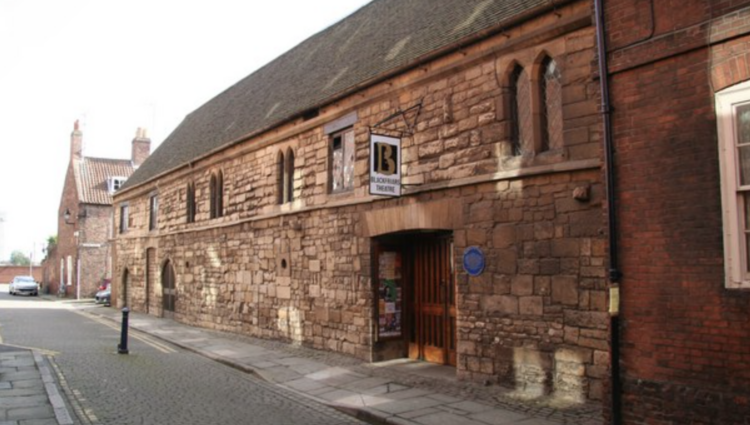
The featured image, uploaded by Richard Croft, is a photograph of Blackfriars Theatre. This file is licensed under the Creative Commons Attribution-Share Alike 2.0 Generic license, courtesy of Wikimedia Commons. The image of t blue plaque erected by City of London at 5 St Andrews Hill, London EC4V was uploaded by Spudgun67. This file is licensed under the Creative Commons Attribution-Share Alike 4.0 International license, courtesy of Wikimedia Commons.
Notes:
[i] Samuel Schoenbaum, William Shakespeare: A Documentary Life, Oxford: Oxford University Press, 1975, p. 223; A.L. Rowse, William Shakespeare: A Biography, New York: Harper & Row, 1963, p. 445
[ii] H. Mutschmann & K. Wentersdorf, Shakespeare and Catholicism, New York: Sheed and Ward, 1952, p. 136
[iii] Richard Wilson, Secret Shakespeare: Studies in Theatre, Religion, and Resistance, Manchester: Manchester University Press, p. 260
[iv] T. Wright (ed.), Queen Elizabeth and her Times: A Series of Original Letters (2 vols), London, 1838, vol. II, p. 249; cited in Mutschmann & Wentersdorf, op. cit., p. 137
[v] Priests’ holes were secret hiding places concealed with architectural ingenuity in many recusant households. These can still be seen in many of England’s surviving Tudor houses.
[vi] Mutschmann & Wentersdorf, op. cit., p. 137
[vii] From original documents in the archives of St Cuthbert’s College in Ushaw, Co Durham; cited in E.K. Chambers, William Shakespeare: A Study of Facts and Problems (2 vols), Oxford: Clarendon Press, 1930, vol. II, pp. 167-8
[viii] John Morris, The Troubles of Our Catholic Forefathers (3 vols), London: Burns & Oates, 1972, vol. I, p. 144
[ix] Ian Wilson, Shakespeare: The Evidence, New York: St. Martin’s Griffin, 1999, p. 397