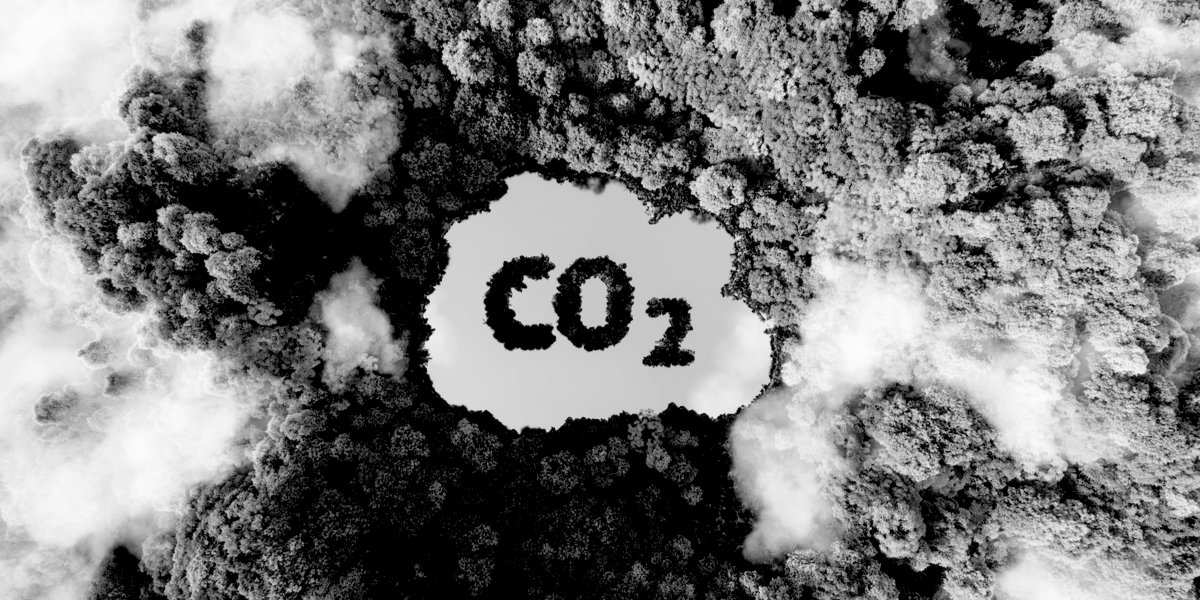
AT THE summit of Mauna Loa, Hawaii, the most recent measurement of atmospheric CO2 is 425 parts per million. If you happen not to live on Mauna Loa you can get a CO2 monitor from Amazon for £9.99, but the reviews are mixed so you might prefer something a bit more five-star.
What would your new monitor tell you if you set it up at home or took it to the park? Indoors, it will probably show in the range of 600 to 800 ppm. If you bake bread or cook for a family it will often show in excess of 1,000 ppm. A city park might be around 500, depending on wind and weather. If you work in a particularly airless office you might find yourself getting a bit sweaty or headachy as the proportion climbs above 2,500, but in that event you are more at risk of spores from mould than you are from the gas.
It is a feature of modern life that we have governments who are obsessed with the dangers of a trace gas but recently forced everyone to stay in a CO2-enhanced environment for 23 hours a day, and to wear a mask to ensure even higher inhalation levels when out and about.
Contrary to the narrative that ’97 per cent of scientists agree’, the role of CO2 in climate change is hotly debated among those who know something about it. Ice cores and other ways of looking into the distant past show that CO2 levels alter after changes in global temperature, not before. If it doesn’t lead, it can’t cause. Actual temperature readings have contradicted the modelled predictions for decades, showing barely any increase. An average global temperature is a meaningless statistic.
Climate models predict disaster, but the clock has stopped at two minutes to midnight for half a century. The Greenland ice sheet has not melted, no crude oil tankers have collided with Antarctic icebergs, the Northwest Passage is still mostly impassable, tropical islands have not sunk below the waves, coral is abundant and healthy and my central heating bills have risen only because of Ed Miliband. Private jets still deliver bigwigs to climate conferences. Polar bears are enjoying a population boom, fewer people die of cold, typhoons and hurricanes have not become more severe.
If rising emissions are responsible for climate change, the effects appear mostly benign. Above all, more CO2 means more plant growth (aided by a small increase in rain in arid areas). Crop yields are optimised above 1,000 ppm, a lot higher than current levels. Given advances in agricultural technology and demographic trends it is unlikely that humans will ever again experience famine outside a war zone.
So you would imagine that climate scientists would park the CO2 theory and look for something else to account for climate variations. Changes in ocean currents, volcanic eruptions, sunspots, the earth’s rather wobbly course around the sun, that we are still recovering from the Little Ice Age, the length of ladies’ skirts – practically anything might be a better field of investigation. They don’t, for the simple reason that CO2 is where the money is, and more hysteria means more money.
Conveniently there are some countries which can be blamed for climate change and they also have lots of money, the UK and US in particular. The UK’s crime was to launch the industrial revolution, which allowed life expectancy to double worldwide and infant mortality to decline by 95 per cent. Due to the earth’s rotation prevailing winds are almost always west to east. Only one large country absorbs more CO2 than it produces, and that is the US. (There’s an awful lot of vegetation in flyover country.)
It’s an odd situation. You can deny historical facts such as the Holocaust and Mao’s famine deaths of millions with only a raised eyebrow in response but as soon as you question a speculative prediction about the future you will be investigated by Ofcom, cancelled by your school or university and made a pariah in polite society.
Yet judging by actions, not words, most of the world isn’t buying the narrative that CO2 is poison. China opens a coal-fired generator nearly every week, India nearly every fortnight and Indonesia develops coal mines like billy-o to supply them.
The explanation for this divergence may lie in a simple matter of dates. In the Christian West round numbers seem important, for other nations they are just a count. In his classic text The Pursuit of the Millennium: Revolutionary Millenarians and Mystical Anarchists of the Middle Ages, Norman Cohn described the hysteria last time a thousand years rolled round. It’s been in print for 50 years and is by turns astonishing and darkly comic.
It is also noticeable that in AD 1000 there weren’t any Protestants, officially. Protestant countries (Germany, Britain, Canada) are notably more worked up about climate doom than Catholic countries (Latin America). This may be due to a lizard memory among Catholic institutions of the idiocies that Cohn describes.
Cohn’s tale of vigils, pogroms, self-flagellation etc peters out in about 1037. The world went mad for 50 years, but one by one men recovered their wits. History does not repeat itself, but maybe it rhymes. If so we can expect climate hysteria to die out on the same timescale. Cheer up! Only another 11 years to go!