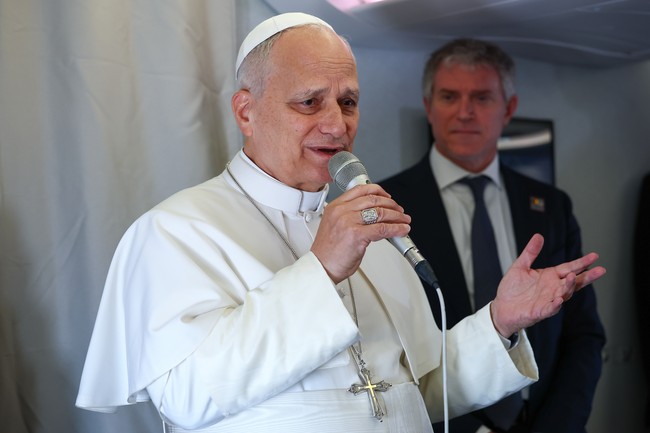
The Pope likes to share strong opinions, and, given that he is the Pope, one would hope that those opinions are based on deep thought and a solid understanding of the issues he speaks to.
No doubt he tries to do so, of course. After all, he’s not some rando on the internet who can just spout off and have little impact on the world. Billions of people listen to what he says, and while even Catholics need not agree with him to remain faithful in their religion, we certainly take what he says seriously.
NEW: Pope Leo XIV says he carries this photo of a young boy who he says was killed during the Israeli-Lebanon War.
The boy was photographed last November welcoming the U.S-born pontiff to Lebanon. pic.twitter.com/TAXJbYDLS2
— Christopher Hale (@ChristopherHale) April 23, 2026
Even liberals have developed a strange new respect for his opinions, now that they happen to coincide with their own. It’s the Marjorie Taylor Greene phenomenon, where people whom the left hates suddenly become heroes for echoing a liberal opinion.
BREAKING: Bill Maher just eviscerated leftist hypocrisy.
“I love hypocritical America. See liberals suddenly love the Pope. Doesn’t believe in gay marriage, no women priests, but now since he’s feuding with Trump, MSNBC loves this guy.” pic.twitter.com/JveLwmTttN
— Eyal Yakoby (@EYakoby) April 18, 2026
Unfortunately, the Pope is as hobbled as the rest of us when it comes to developing sound opinions. We have to rely on others for most of the information we get, and there is an awful lot of misinformation out there.
Putting aside the arguments about the necessity of war, this shows the level of widespread misinformation now.
People Leo is apparently carrying around a photo of a boy in Lebanon who he thinks is dead, but is actually fine. https://t.co/S2NOcyO58u pic.twitter.com/yvPfoSvIBt
— AG (@AGHamilton29) April 24, 2026
The Pope’s story about a young Muslim boy who welcomed him to Lebanon is very compelling. He is using a strong rhetorical move—a perfectly legitimate one, of course, but much more powerful than just making a logical statement—by humanizing and particularizing a principle.
This boy right here, holding this photo of me, died due to a cruel war. It is a powerful image. It tugs at the heartstrings. It is particularly powerful because it is a Muslim welcoming a Christian.
And the Jews killed him. I’m sure that is not the message the Pope wanted to emphasize, but it is what many people heard.
This boy, who enthusiastically welcomed the Pope in Lebanon last year, was found dead after three days under rubble following an Israeli bombing pic.twitter.com/raDCcC70M2
— HatsOff (@HatsOffff) April 13, 2026
Only it wasn’t true. Sure, the Pope no doubt carries the photo, and it is powerful. But the boy is alive and well. Even the news outlet that originally reported the story has retracted it, saying he is alive and well.
But a correction in a minor news source based in the Middle East doesn’t exactly carry the weight of a story broadcast around the world by the Pope, shared millions of times by accounts big and small, on news programs and in newspapers.
No doubt the Pope believed what he was saying was correct, and he certainly shared the story because he knew it would be particularly powerful, as it humanized an abstraction. But by sharing an unverified, now-proven-to-be-false story, the Pope wound up becoming an unwitting propagandist.
I see many examples like this. I just saw a New York Times columnist share a video of what purported to be Israeli settlers on the West Bank attacking Palestinians, along with comments condemning Israelis. The only problem was…the video was less than an hour old, and there was no way of knowing whether what we were seeing was what was claimed.
FACT CHECK: This image is from August 18, 2020. A Houthi sniper shot a girl named Rowaida in Taiz, Yemen while she was carrying water home. The original post is still live on X.@Partisangirl recycled a 6 year old Houthi atrocity photo and blamed Israel.
The truth got 397 likes.… pic.twitter.com/tEr0kn7cpx
— Open Source Intel (@Osint613) April 22, 2026
Lots of videos and images are recycled as part of propaganda campaigns, and these days they are usually aimed at slandering Israel. They work. There is a moral panic about Israel, with people convinced that Israelis are committing horrible atrocities, when the atrocities pictured were often committed by Islamists.
Owen doesn’t believe rape occurred on Oct 7 despite numerous images of naked female corpses, filmed testimony from both witnesses and perpetrators, and independent confirmation from a UN investigation.
But he DOES believe this bestiality libel that strains credulity. 🧵 https://t.co/cGJ0pvHJe4
— Adam Fisher (@AdamRFisher) April 24, 2026
We all make mistakes, of course, and I don’t doubt the good intentions of the Pope in sharing this story.
I do hope, though, that in the future he would be a bit more careful about the stories he shares.
Editor’s Note: Do you enjoy HotAir’s conservative reporting that takes on the radical left and woke media? Support our work so that we can continue to bring you the truth.
Join HotAir VIP and use promo code FIGHT to receive 60% off your membership.